
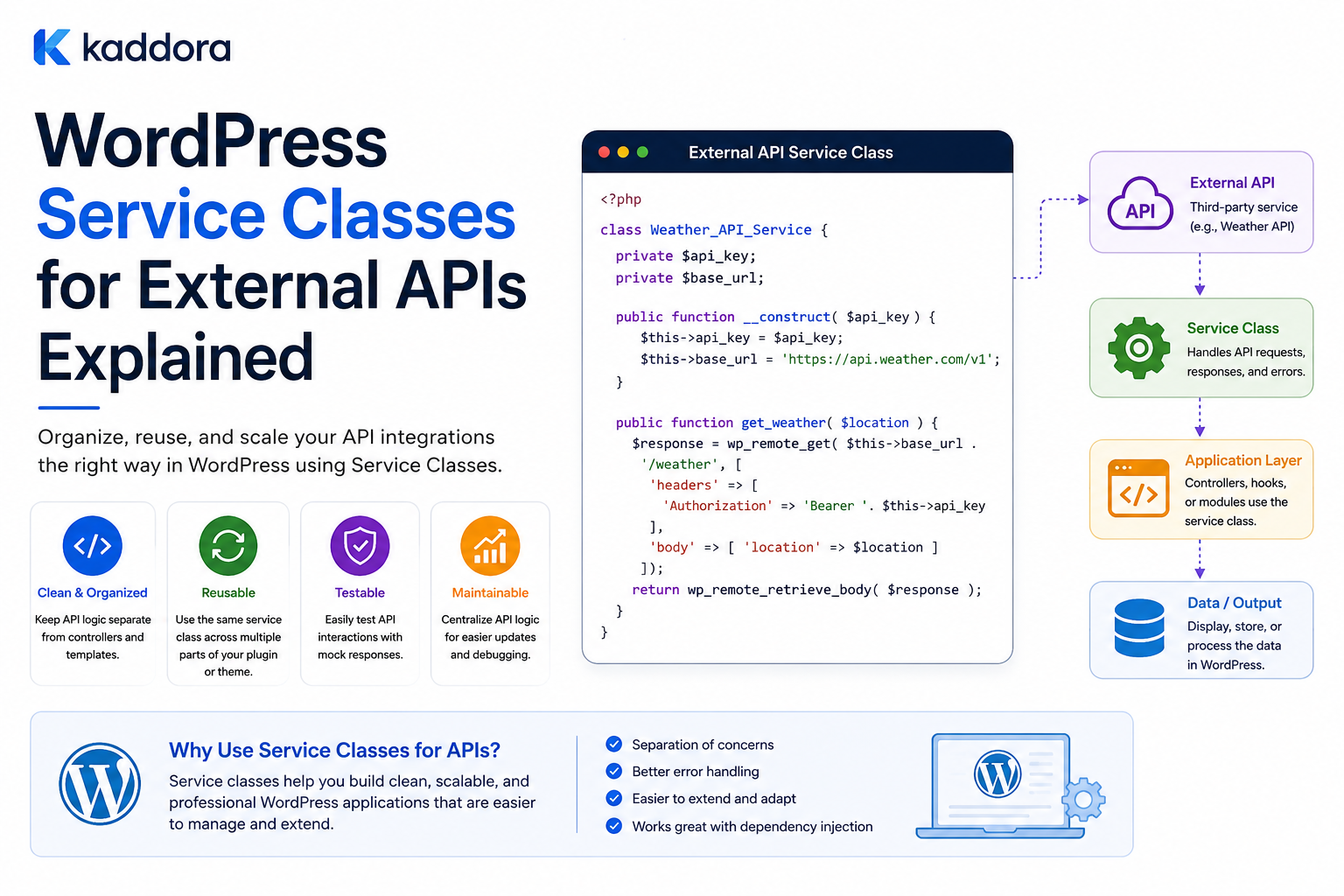
WordPress Service Classes for External APIs Explained
Introduction
Modern WordPress plugins often connect to external services.
A plugin may communicate with:
CRM platforms
Payment providers
AI services
Analytics platforms
Email services
SaaS applications
Shipping providers
Marketing platforms
In a small plugin, developers may place API calls directly inside hooks or functions:
$response = wp_remote_get( 'https://api.example.com/customers' );
This may work initially.
As the integration grows, however, the code can become difficult to maintain:
WordPress Hook ↓ Authentication ↓ HTTP Request ↓ JSON Parsing ↓ Error Handling ↓ Business Logic ↓ Database ↓ Logging
When all of this exists inside one function, testing and debugging become difficult.
A better approach is to use service classes.
The architecture can become:
WordPress Hook ↓ Service Class ↓ API Client / Adapter ↓ External API ↓ Repository / Local State
Each component has a specific responsibility.
The core principle is:
Use service classes to coordinate application behavior while keeping HTTP transport, credentials, provider-specific rules, and persistence in appropriate layers.
What Is a Service Class?
A service class contains a specific application operation or workflow.
For example:
final class KDR_Customer_Sync_Service { public function sync( string $customer_id ) { // Synchronization workflow. } }
The service class is not necessarily the API client.
Instead, it coordinates the operation:
Service ↓ API Adapter ↓ API Client ↓ Provider
Why Use Service Classes?
Service classes help prevent large procedural functions.
Without them:
Hook ↓ Everything
With them:
Hook ↓ Service ├── API ├── Validation ├── Mapping └── Persistence
This provides clearer boundaries.
Service Class vs API Client
These should not be confused.
API Client
Responsible for communication mechanics:
HTTP
Headers
Timeouts
Authentication
Raw responses
Service Class
Responsible for application workflow:
What operation should happen
Validation
Business rules
Calling adapters
Updating local state
Handling workflow outcomes
A typical architecture is:
Business Service ↓ API Adapter ↓ API Client ↓ HTTP API
Service Class vs Provider Adapter
The adapter translates provider-specific behavior.
The service coordinates the application workflow.
For example:
Customer Sync Service ↓ Customer Provider Interface ↓ CRM Adapter ↓ CRM API Client
The service should not contain:
CRM-specific endpoint CRM-specific error code
Service Class vs Repository
A repository deals with local persistence.
For example:
Customer Service ↓ Customer Repository ↓ WordPress Database
The service decides what should happen.
The repository handles how local data is stored and retrieved.
Keep Responsibilities Separate
A useful architecture is:
Controller / Hook ↓ Service ↓ Provider Adapter ↓ API Client ↓ External API Service ↓ Repository ↓ WordPress Database
This separation reduces coupling.
Example Service Class
A simplified customer synchronization service:
final class KDR_Customer_Sync_Service { public function __construct( private KDR_Customer_Provider $provider, private KDR_Customer_Repository $repository ) {} public function sync( string $external_id ) { $customer = $this->provider->get_customer( $external_id ); if ( is_wp_error( $customer ) ) { return $customer; } return $this->repository->upsert( $customer ); } }
The service does not need to know which CRM is being used.
Keep WordPress Hooks Thin
Avoid:
add_action( 'some_hook', function () { // 200 lines of API logic. } );
Prefer:
add_action( 'some_hook', function () { $service = kdr_get_customer_sync_service(); $service->run(); } );
The hook becomes a trigger rather than the place where business logic lives.
Why Thin Hooks Matter
Thin hooks are easier to:
Read
Test
Replace
Reuse
Debug
The same service can also be triggered through:
WP-Cron
REST
WP-CLI
Admin actions
Webhooks
Service Classes and Dependency Injection
Dependency injection allows a service to receive its dependencies explicitly:
final class KDR_Order_Sync_Service { public function __construct( private KDR_Order_Provider $provider, private KDR_Order_Repository $repository ) {} }
This improves testability and reduces hidden global dependencies.
Avoid Excessive Globals
A service that repeatedly calls:
global $wpdb;
or:
get_option();
throughout every method can become difficult to test.
WordPress APIs are sometimes appropriate, but isolate infrastructure access where practical.
Use Interfaces at Important Boundaries
For example:
interface KDR_Order_Provider { public function get_order( string $external_id ); }
A service can depend on:
KDR_Order_Provider
instead of:
CRM A
This makes provider replacement easier.
Service Class for API Retrieval
Example:
final class KDR_Customer_Service { public function __construct( private KDR_Customer_Provider $provider ) {} public function get_customer( string $external_id ) { return $this->provider->get_customer( $external_id ); } }
The service can later add validation or business rules without changing callers.
Service Class for Synchronization
A synchronization service may coordinate:
Fetch Changes ↓ Validate ↓ Normalize ↓ Upsert ↓ Checkpoint
For example:
Sync Service ├── Provider ├── Repository ├── Checkpoint Store └── Logger
Service Class for API Health Checks
A health service can coordinate:
Load Connection ↓ Validate Credentials ↓ Call Safe Endpoint ↓ Interpret Result ↓ Store Health State
The API client itself should not decide the overall integration health.
Service Class for Connection Testing
Similarly:
Connection Test Service ↓ Credential Manager ↓ Provider Adapter ↓ API Client
This allows the same testing workflow to work across providers.
Service Classes and Credential Management
Do not make every service independently implement OAuth refresh.
Prefer:
Service ↓ Provider / API Client ↓ Credential Manager
The credential manager handles:
Access tokens
Refresh tokens
Expiration
Reauthorization
Credential state
Service Classes and Retry Logic
Retry behavior should generally be centralized.
Instead of every service implementing:
Retry Backoff Retry-After
create shared infrastructure.
For example:
Service ↓ API Client ↓ Retry Policy ↓ Provider
Provider-specific exceptions can still be classified separately.
Service Classes and Rate Limiting
Similarly, rate limiting should not be independently implemented inside every service.
A shared rate limiter can coordinate:
CRM Sync ERP Sync Webhook API Fetch Health Check Reconciliation
against the provider's quota.
Service Classes and Caching
A service can decide when cached data is acceptable:
Service ↓ Cache ↓ API
The API client should not necessarily decide business-level caching rules.
For example:
Customer Profile → Cache for short period
while:
Payment Status → Always verify current state
Service Classes and Idempotency
A service can define the logical operation identity:
operation_id
while the API client or adapter translates it into the provider's idempotency mechanism.
This separates business operation identity from HTTP details.
Service Classes and Transactions
For local processing:
Service ↓ Validate ↓ Database Transaction ↓ Repository ↓ Commit
Avoid holding database transactions open while waiting for long external HTTP requests.
Service Classes and Error Handling
Services should return structured or normalized errors rather than exposing provider-specific details throughout the application.
For example:
Provider: invalid_grant
can become:
Reauthorization Required
The service can then decide:
Pause Sync Notify Admin
Service Error Categories
Useful categories include:
authentication authorization network rate_limit provider validation conflict resource_missing database unknown
This makes recovery decisions more consistent.
Service Classes and Logging
A service can log business-level events:
customer_sync_started customer_sync_completed customer_sync_failed
The API client can log transport-level details:
HTTP 503 Latency Request ID
Never log credentials.
Service Classes and Monitoring
Services can emit useful business metrics:
Customers Synced Orders Processed Failures Duration
while infrastructure layers expose:
API Latency HTTP Errors Rate Limits
Both levels are valuable.
Service Classes and Webhooks
A webhook handler should generally be thin:
Webhook Controller ↓ Event Validator ↓ Service ↓ Provider Adapter
The webhook endpoint should not contain large synchronization workflows.
Example Webhook Flow
External Provider ↓ Webhook Endpoint ↓ Verify Signature ↓ Persist Event ↓ Queue ↓ Service ↓ Adapter / API ↓ Repository
This supports reliable asynchronous processing.
Service Classes and Queues
Large external API operations should usually run in background jobs.
The service can be invoked by the worker:
Queue Job ↓ Service ↓ API
rather than directly inside a visitor request.
Service Classes and WP-Cron
WP-Cron can trigger:
Scheduled Sync ↓ Sync Service
The same service can also be triggered manually.
This avoids duplicating synchronization logic.
Service Classes and WP-CLI
A CLI command can use the same service:
wp kdr sync customers ↓ Sync Service
This is especially useful for:
Large imports
Recovery
Maintenance
Debugging
Service Classes and REST APIs
A REST controller should call a service:
REST Controller ↓ Service ↓ Provider
The controller handles:
Authentication
Authorization
Input validation
HTTP response formatting
The service handles application workflow.
Service Classes and Admin Screens
An admin action can similarly call:
Admin Action ↓ Service
This allows the same business logic to be reused.
Avoid Duplicate Business Logic
Bad architecture:
WP-Cron → Sync Logic A REST → Sync Logic B WP-CLI → Sync Logic C
Better:
WP-Cron ──┐ REST ─────┼→ Sync Service WP-CLI ───┘
One workflow, multiple entry points.
Service Class Granularity
Avoid a single:
KDR_Everything_Service
that handles every feature.
Prefer focused services such as:
CustomerSyncService OrderSyncService ProductSyncService ConnectionService HealthCheckService WebhookService
Each should have a clear responsibility.
Avoid Tiny Useless Services
The opposite problem is creating classes for trivial one-line functions.
Service classes are most useful around meaningful application boundaries.
Service Classes and Domain Models
A service can operate on normalized application data:
External API ↓ Adapter ↓ Normalized Model ↓ Service
This prevents business logic from depending on raw provider JSON.
Normalized Data Example
Provider response:
{ "contact_id": "ABC", "full_name": "Example User" }
Adapter converts it into:
array( 'external_id' => 'ABC', 'name' => 'Example User', );
The service operates on the normalized representation.
Service Classes and Repositories
A synchronization service may use:
Provider ↓ Service ↓ Repository
The repository handles:
Find Create Update Delete
The service controls the workflow and business rules.
Service Classes and Checkpoints
For incremental synchronization:
Sync Service ↓ Load Checkpoint ↓ Fetch Changes ↓ Process ↓ Commit ↓ Save Checkpoint
The checkpoint store remains a separate infrastructure component.
Checkpoint Safety
A service should never advance the checkpoint before the associated data has been safely processed.
This is especially important when a worker can fail after partially processing records.
Service Classes and Reconciliation
A reconciliation service can:
Load Remote State ↓ Load Local State ↓ Compare ↓ Repair ↓ Record Result
The same provider adapter used by normal sync can often be reused.
Service Classes and Conflicts
A conflict-resolution service can handle:
Remote Version vs Local Version
according to source-of-truth rules.
Do not hide complex conflict policies inside the raw API client.
Service Classes and Multi-Tenant Systems
Services should operate using explicit connection context:
final class KDR_Connection_Context { public function __construct( public readonly string $connection_id, public readonly string $tenant_id, public readonly string $provider ) {} }
This helps prevent accidental cross-tenant credentials or data.
Never Use a Global Current Tenant
In background processing, there may be no active browser session.
Jobs should contain the necessary connection context:
Job ↓ Connection ID ↓ Tenant ↓ Credentials
The credential manager can resolve the actual secret securely.
Service Classes and Environment Manager
Services can remain independent of:
Sandbox Production
The environment manager can provide the appropriate endpoint and credentials.
This keeps environment decisions out of business logic.
Service Classes and API Adapters
The architecture from the previous article can be extended:
Business Service ↓ Provider Interface ↓ Provider Adapter ↓ API Client ↓ Credential Manager ↓ WordPress HTTP API
Each layer has a specific purpose.
Service Classes and Testability
A service becomes easy to test when its external dependencies are injected.
For example:
Service ├── Mock Provider ├── Mock Repository └── Mock Logger
Then tests can verify business behavior without external API calls.
Example Service Test
A test might arrange:
Provider returns customer Repository stores customer
and assert:
Customer Sync = Successful
No real API is required.
Test Error Handling
Mock:
Provider → WP_Error
and verify:
Service → Returns Failure → Does Not Commit Checkpoint
Test Retry Decisions
Mock:
Provider → RateLimitError
and verify:
Service → Schedules Retry
rather than marking the operation as permanently failed.
Test Reauthorization
Mock:
Provider → AuthenticationError
and verify:
Service → Pauses Connection → Requests Reauthorization
according to the integration policy.
Service Class and API Mocking
Service classes work particularly well with the API Adapter Pattern.
Tests can replace:
Real Adapter
with:
Mock Adapter
while testing business workflows.
This keeps test suites fast.
Service Classes and Integration Tests
Integration tests can use the real adapter with a mocked HTTP layer:
Service ↓ Real Adapter ↓ Mock HTTP
This tests more of the integration without contacting production.
Service Classes and Sandbox Tests
For selected end-to-end tests:
Service ↓ Real Adapter ↓ Real API Client ↓ Sandbox
This validates the complete stack.
Common Service Class Mistakes
Putting Raw HTTP in Services
Tightly couples business logic to providers.
Putting Business Rules in API Clients
Makes transport classes difficult to reuse.
Giant Service Classes
A service handling everything becomes another monolith.
Hidden Global Dependencies
Makes tests and multi-tenant operation difficult.
No Dependency Injection
Creates tightly coupled code.
Duplicated Workflows
Different entry points implement slightly different versions of the same logic.
Mixing Persistence and HTTP
Makes failures and transactions harder to reason about.
Advancing Checkpoints Too Early
Can skip synchronized data.
Logging Secrets
Creates security risks.
Service Class Lifecycle
A robust service can follow:
Validate ↓ Load Context ↓ Load Credentials ↓ Call Provider ↓ Normalize ↓ Apply Business Rules ↓ Persist ↓ Record Result
For asynchronous workflows:
Queue ↓ Service ↓ Complete / Retry / Fail
Why choose ThemeKaddora?
ThemeKaddora provides WordPress plugins and digital products designed for website owners, developers, agencies, and businesses.
Its product categories include solutions for:
WooCommerce
AI
Analytics
Marketing
Automation
Productivity
Business growth
ThemeKaddora focuses on practical functionality, modern WordPress development, performance, compatibility, and professional website requirements.
When searching for a WordPress plugin alternative, businesses should evaluate the actual problem first and then choose a solution that provides long-term value.
Conclusion
Service classes provide a clean way to organize external API workflows in WordPress plugins.
Instead of putting everything inside:
Hook ↓ Huge Function
use:
Hook ↓ Service ↓ Provider Adapter ↓ API Client ↓ External API
and:
Service ↓ Repository ↓ WordPress Database
The first principle is thin entry points.
WordPress hooks, REST controllers, WP-Cron callbacks, admin actions, and WP-CLI commands should primarily trigger application services.
The second principle is separation of responsibilities.
The:
Service handles workflow.
Adapter handles provider-specific behavior.
API Client handles transport.
Credential Manager handles authentication state.
Repository handles local persistence.
The third principle is dependency injection.
Services should receive important dependencies rather than discovering everything through hidden global state.
This improves:
Testing
Maintainability
Reusability
Multi-tenant support
The fourth principle is centralized authentication.
Do not implement OAuth refresh separately in every service.
Use a shared credential manager.
The fifth principle is shared retry and rate limiting.
A CRM service, ERP service, webhook service, and health service may all consume the same provider quota.
Coordinate them through common infrastructure.
The sixth principle is normalized data and errors.
Services should receive predictable application-level structures rather than provider-specific JSON and error codes.
The seventh principle is durable synchronization state.
For incremental synchronization:
Fetch ↓ Process ↓ Commit ↓ Checkpoint
The service must not move the checkpoint forward before successful processing.
The eighth principle is asynchronous processing for large tasks.
Use queues for:
Large synchronization
Bulk imports
Reconciliation
Retryable API jobs
rather than blocking visitor requests.
The ninth principle is explicit connection context.
For ThemeKaddora SaaS products:
Tenant ↓ Connection ↓ Service ↓ Provider
This prevents cross-tenant credentials and data.
The tenth principle is reuse the same services everywhere.
For example:
WP-Cron ──┐ REST ─────┼→ Customer Sync Service WP-CLI ───┤ Webhook ──┘
One workflow can then be tested and maintained in one place.
A reusable ThemeKaddora architecture is:
WordPress Hook / REST / CLI / Cron │ ▼ Application Service │ ┌───────┼────────┐ ▼ ▼ ▼ Provider Repository Queue │ ▼ Adapter │ ▼ API Client │ ▼ Credential Manager │ ▼ External Provider
This structure can support CRM, ERP, AI, WooCommerce, analytics, payments, SaaS, and marketing integrations.
The most important principle is:
Service classes should coordinate application workflows without becoming containers for every technical concern.
A professional WordPress API architecture should therefore be:
Modular
→ Thin at the entry points
→ Provider-Aware
→ Testable
→ Dependency-Injection-Friendly
→ Queue-Aware
→ Credential-Safe
→ Tenant-Aware
→ Observable
→ Maintainable
When these principles are followed, WordPress plugins can add complex external integrations without turning individual hooks or functions into unmaintainable blocks of code.
Frequently Asked Questions
What is a service class in WordPress?
A service class contains a meaningful application workflow, such as customer synchronization, order processing, connection testing, or reconciliation.
Is a service class the same as an API client?
No. An API client handles HTTP communication, while a service coordinates application behavior and business workflow.
Should API calls be placed inside service classes?
The service can call an adapter or API client, but provider-specific HTTP details should normally remain outside the service.
Why use dependency injection?
It makes dependencies explicit and allows tests to replace real providers, repositories, or other services with controlled test doubles.
Should WordPress hooks contain business logic?
Keep hooks thin whenever possible. A hook should trigger a service rather than contain a large workflow.
How should service classes handle OAuth?
Use a centralized credential or token manager rather than implementing refresh logic separately in every service.
Should retry logic live inside every service?
Usually no. Shared retry and rate-limit infrastructure makes behavior more consistent across integrations.
Can service classes work with WP-Cron and WP-CLI?
Yes. The same application service can be invoked by cron jobs, CLI commands, REST endpoints, admin actions, or webhook workers.
How should services work in a multi-tenant SaaS plugin?
Pass or resolve explicit connection and tenant context so each operation uses the correct provider credentials and data.
Why choose Themekaddora?
Themekaddora provides lightweight, responsive, SEO-friendly WordPress themes with fast performance, WooCommerce compatibility, flexible customization, accessibility-conscious design, modern templates, regular updates, and professional support—providing a strong foundation for businesses building digital products and product-focused websites.
Comments (0)