
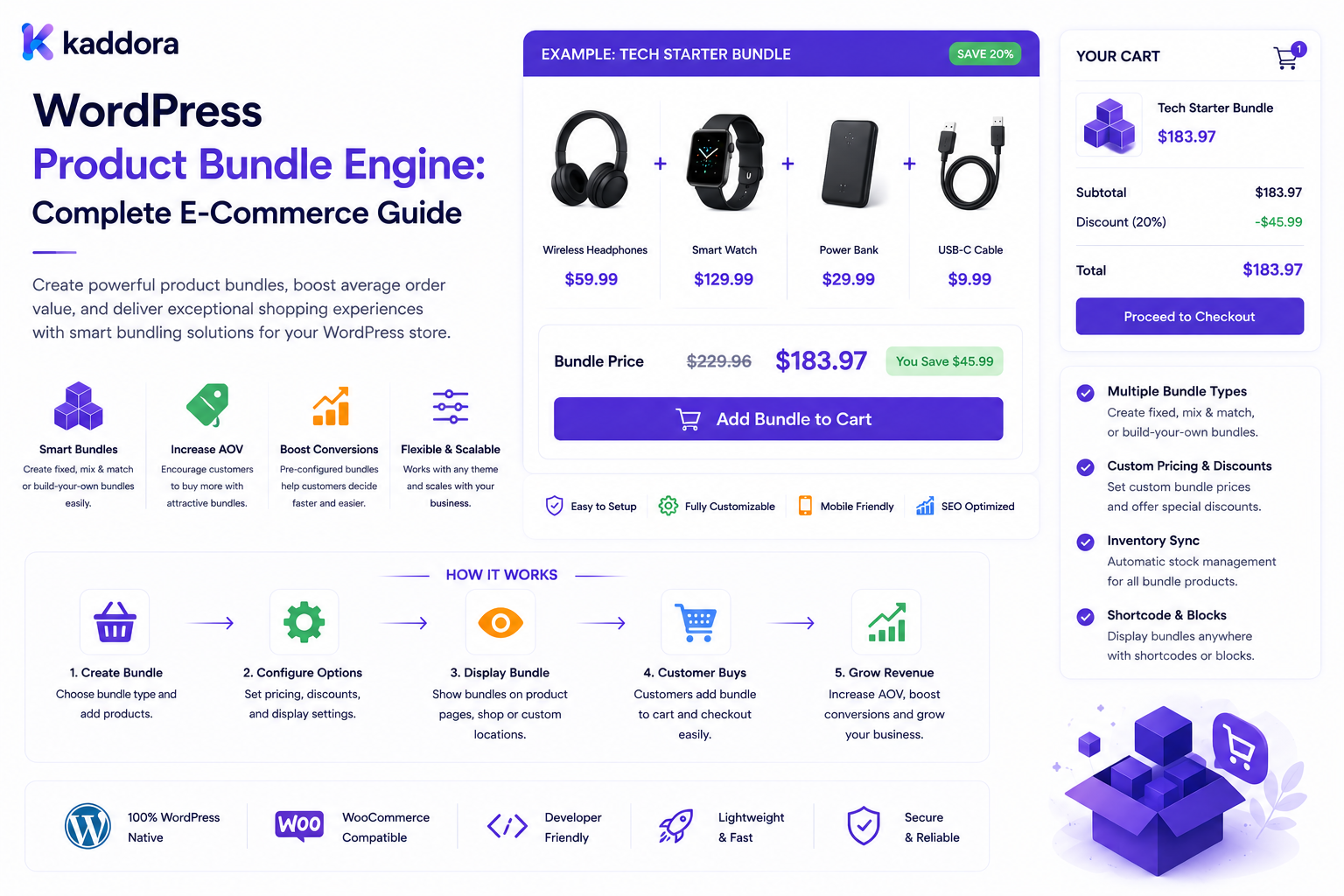
WordPress Product Bundle Engine: Complete E-Commerce Guide
Introduction
Product bundles allow businesses to sell multiple products together as a single offer.
A simple bundle may contain:
Laptop + Laptop Bag + Mouse
A more advanced bundle may include:
Base Product ├── Required Components ├── Optional Components ├── Variant Rules ├── Quantity Rules ├── Pricing Rules ├── Inventory ├── Compatibility └── Customer Eligibility
Bundles can be useful for:
Product kits
Starter packages
Frequently bought together offers
Subscription packages
B2B purchase sets
Equipment configurations
Software packages
Digital product collections
However, bundle systems become complex when businesses need dynamic pricing, component-level inventory, optional items, customer-specific rules, compatibility conditions, regional availability, or integration ERP and inventory systems.
A scalable architecture should therefore define exactly what a bundle is, how its components behave, how prices are calculated, and how inventory and orders are represented.
A typical flow is:
Bundle Definition ↓ Components ↓ Rules ↓ Customer Selection ↓ Price Calculation ↓ Inventory Validation ↓ Cart ↓ Order ↓ Fulfillment
A professional product bundle engine should model bundles as structured collections of products or variants with explicit component rules, pricing logic, inventory behavior, compatibility, customer eligibility, and reliable order representation.
What Is a Product Bundle Engine?
A product bundle engine creates and manages combinations of multiple products sold together according to defined business rules.
For example:
Starter Kit ├── Product A ├── Product B └── Product C
The customer may purchase the entire package as one commercial offer.
Why Product Bundles Matter
Bundles can help businesses:
Increase average order value
Simplify product selection
Create packaged offers
Promote complementary products
Support predefined kits
Improve cross-selling
Support configurable products
Actual performance should be measured rather than assumed.
Types of Product Bundles
Common models include:
Fixed Bundle Dynamic Bundle Mix-and-Match Build Your Own Kit Package Subscription Bundle Digital Bundle
Each model requires different rules.
Fixed Bundles
A fixed bundle contains predefined components.
Example:
Camera Kit ├── Camera ├── Lens ├── Battery └── Bag
The customer cannot change the contents.
Dynamic Bundles
Customers can select components.
For example:
Laptop Package ├── Laptop ├── Memory ├── Storage ├── Bag └── Warranty
Some options may be optional.
Mix-and-Match Bundles
A customer selects a defined number of products from a group.
For example:
Choose Any 3 from 10 Products
Build-Your-Own Bundles
The bundle engine guides customers through configuration.
For example:
Choose Base Product ↓ Choose Accessory ↓ Choose Warranty ↓ Review Bundle
Define the Bundle Entity
A bundle may contain:
Bundle ID Name Description Status Category Pricing Mode Inventory Mode
Bundle Components
Each bundle should have component records.
For example:
Bundle ↓ Component ↓ Product / Variant
Required Components
A component can be mandatory:
Laptop: Required
Optional Components
Other components may be optional:
Laptop Bag: Optional
Component Quantity
Bundles may require:
Quantity: 2
or allow a range:
Minimum: 1 Maximum: 5
Component Selection Rules
Rules may include:
Exactly One At Least One At Most One Any Two All Required
Bundle Compatibility
Bundle components may depend on one another.
For example:
Laptop Model A + Memory Module X = Compatible
but:
Laptop Model B + Memory Module X = Not Compatible
Bundle Compatibility Engine
Use existing product compatibility rules rather than duplicating compatibility logic inside every bundle.
Bundle Pricing Models
Common pricing models include:
Fixed Price Sum of Components Percentage Discount Fixed Discount Tiered Discount Component Pricing
Fixed Bundle Price
Example:
Components: $1,100 Bundle Price: $999
Component-Sum Pricing
The bundle price is based on component prices:
Product A + Product B + Product C = Bundle Total
Percentage Discount
For example:
Component Total: $1,000 Discount: 10% Bundle: $900
Fixed Discount
Example:
Component Total: $1,000 Discount: $100 Bundle: $900
Tiered Bundle Pricing
Price may depend on bundle quantity:
1 Bundle: $100 5 Bundles: $450
Rules should be defined explicitly.
Customer-Specific Bundle Pricing
B2B businesses may require:
Customer ↓ Price List ↓ Bundle ↓ Effective Price
Pricing should remain within the pricing system.
Regional Bundle Pricing
International commerce may require:
Country Currency Tax Bundle Price
Bundle Discounts and Margin
Before creating a discount, businesses should understand component costs and desired margins.
The bundle engine should not assume that the largest discount produces the best commercial outcome.
Bundle Inventory
Inventory can be handled in different ways.
Component Inventory
Each component consumes its own stock.
Bundle Inventory
The bundle itself has independent inventory.
The correct model depends on fulfillment.
Component Inventory
For a bundle containing:
Product A: 10 Product B: 20
available bundles may be limited by the least available required component.
Inventory Calculation
Conceptually:
Available Bundles = Minimum ( Component A Availability, Component B Availability, ... )
Actual inventory rules can be more complex when reservations or substitutions exist.
Bundle Inventory Reservations
When customers add bundles to carts, inventory reservation behavior should be clearly defined.
Avoid Overselling
The system should protect against concurrent purchases of limited-stock components.
Bundle Variants
Bundles themselves can have variants.
For example:
Starter Bundle ├── Small ├── Medium └── Large
Variant-level pricing and inventory may apply.
Bundle Component Variants
More complex bundles can allow:
Choose: Laptop Variant + Bag Variant + Mouse Variant
The bundle engine must validate combinations.
Bundle Rules
Rules may define:
Include Exclude Require Limit Compatibility Availability
Bundle Dependencies
One selection may affect another.
For example:
Choose: Processor X Then Allow: Memory A / B Disable: Memory C
Bundle Configuration State
Dynamic bundles should maintain structured state:
Bundle ↓ Selections ↓ Validation ↓ Price ↓ Inventory
Server-Side Bundle Validation
Never rely only on frontend JavaScript to validate bundle selections.
The backend must verify:
Bundle Components Variants Quantities Prices Customer Region Inventory
Do Not Trust Browser Prices
The browser can modify submitted prices.
The backend should calculate the final bundle price.
Do Not Trust Browser Product IDs
The server should verify that each selected product belongs to the permitted bundle and catalog.
Bundle Cart Representation
The cart should know:
Bundle + Components + Selections
Bundle Order Representation
An order should preserve enough information to explain what the customer actually purchased.
For example:
Order ↓ Bundle Line ↓ Component Lines
The exact model depends on fulfillment and accounting requirements.
Preserve Historical Bundle Data
If a bundle changes later, completed orders should still represent the original purchased configuration.
Fulfillment
Physical bundles may require:
Pick Pack Ship
Component-level fulfillment rules should be defined.
Digital Bundles
Digital bundles may contain:
Products Downloads Licenses Entitlements
Each entitlement should be managed according to its own lifecycle when necessary.
License-Based Bundles
A software bundle may produce:
Purchase ↓ Bundle ↓ Licenses ↓ Entitlements
Do not assume the bundle itself is equivalent to one license.
Subscription Bundles
A subscription bundle may contain:
Plan + Features + Products
Subscription state should remain distinct from ordinary product data.
Bundle Availability
Bundles may be unavailable because:
Component Out of Stock Region Restricted Customer Restricted Expired Discontinued
Bundle Eligibility
Eligibility can depend on:
Customer Membership Region Contract Product
B2B Bundles
B2B businesses may create bundles specifically for:
Company Industry Contract Customer Tier
Wholesale Bundles
Wholesale bundles may require:
Minimum Quantity Bulk Price Customer Tier
Regional Bundles
Regional availability can be modeled separately from global bundle identity.
Bundle Search
Customers may search by:
Bundle Name SKU Component Category Feature
Bundle SEO
Public bundles can have dedicated landing pages.
Useful content should explain:
What's Included Savings Compatibility Use Case
Avoid creating thousands of thin dynamic bundle pages.
Bundle Comparison
Customers may compare:
Bundle A vs Bundle B
using structured bundle attributes.
Bundle Recommendations
Recommendation engines can suggest bundles based on:
Customer Product Compatibility Purchase History
Bundle Components and Existing Catalog
Do not duplicate product data inside bundles.
Bundles should reference authoritative products or variants.
Bundle Database Design
A conceptual schema could contain:
bundles bundle_components bundle_rules bundle_selections bundle_prices
The exact structure depends on the business.
Avoid One Giant Bundle Table
Separate definitions, components, rules, pricing, and runtime selections when needed.
Bundle APIs
Possible endpoints:
GET /bundles GET /bundles/{id} GET /bundles/{id}/components POST /bundles/{id}/validate POST /bundles/{id}/price
API Security
Protect private bundles using:
Authentication Authorization Tenant Isolation
Object-Level Authorization
A user should only access bundles they are authorized to view.
Tenant Isolation
For multi-client systems:
Tenant A → Bundles A Tenant B → Bundles B
must remain isolated.
Bundle API Validation
Validate:
Bundle Product Variant Quantity Customer Region
before creating or pricing a bundle.
Bundle Caching
Public fixed bundle information can often be cached.
Dynamic personalized pricing requires strict scoping.
Cache Scope
Consider:
Tenant Customer Region Currency
when these affect bundle results.
Cache Invalidation
When bundle components change:
Component Update ↓ Invalidate Bundle Cache ↓ Refresh Search
Bundle Search Indexing
Search indexes can contain:
Bundle Components Categories Features Compatibility
but remain derived data.
Bundle Import
Bundles may come from:
PIM ERP CSV API Supplier
Bundle Import Pipeline
Use:
Source ↓ Validate ↓ Normalize ↓ Map ↓ Queue ↓ Batch ↓ Save ↓ Index ↓ Verify
Bundle Import Errors
Record:
Bundle Component Error
rather than silently creating incomplete bundles.
Bundle Synchronization
When component information changes:
Product Update ↓ Bundle Dependency Check ↓ Refresh Bundle ↓ Refresh Search / Cache
Dependency Graph
A bundle system can track:
Bundle A → Product X → Variant Y
This helps identify which bundles may be affected by product changes.
Product Deletion
Do not delete products that are still required by active bundles.
Use dependency checks.
Product Discontinuation
When a component is discontinued:
Active Bundle ↓ Affected ↓ Review
Bundle Versioning
For complex bundles, version definitions when necessary:
Bundle v1 Bundle v2
This is especially useful when historical orders or contracts depend on the original composition.
Bundle Audit Trail
Track:
Actor Bundle Change Time
Bundle Governance
Define who can:
Create Edit Approve Publish Archive
bundles and pricing rules.
Bundle Approval
A useful workflow is:
Draft ↓ Review ↓ Pricing Approval ↓ Publish
Bundle Testing
Test:
Valid Selection Invalid Selection Out of Stock Price Change Component Removal Compatibility Failure
Bundle Regression Testing
When product or pricing rules change, ensure active bundles still work correctly.
Bundle Performance
Monitor:
Bundle Load Price Calculation Validation Search Inventory Check
Avoid Expensive Runtime Calculations
Precompute stable information where appropriate.
Real-Time Pricing
Use real-time pricing when the price genuinely depends on current:
Customer Inventory Promotion Region
context.
Background Jobs
Use queues for:
Bundle Imports Reindexing Synchronization Reports
where appropriate.
Retry Logic
Retry transient failures with bounded backoff.
Permanent validation failures should be reviewed.
Idempotency
Repeated bundle import or synchronization events should not create duplicate bundles or components.
Bundle Analytics
Useful metrics include:
Bundle Views Selections Add-to-Cart Purchases Revenue
Bundle Conversion
Define the conversion event before evaluating performance.
Bundle A/B Testing
Test:
Bundle A vs Bundle B
using controlled experiments where traffic allows.
Don't Assume Bundle Discounts Work
Measure:
Revenue Margin Conversion AOV
rather than focusing only on sales volume.
Bundle Profitability
A bundle may increase order value while reducing margin.
Track both.
Common Product Bundle Engine Mistakes
Avoid:
Treating a bundle as an ordinary product with a longer description.
Duplicating complete product records inside bundles.
Allowing invalid component combinations.
Ignoring variant-level components.
Hard-coding bundle prices in templates.
Trusting browser-submitted prices.
Trusting browser-submitted product IDs.
Ignoring customer-specific pricing.
Ignoring regional pricing.
Ignoring inventory at the component level.
Overselling component inventory.
Ignoring reservations.
Ignoring concurrent purchases.
Making checkout depend unnecessarily on multiple external APIs.
Creating bundles from discontinued products without review.
Deleting products used by active bundles.
Ignoring bundle dependency graphs.
Processing large bundle imports synchronously.
Ignoring incremental synchronization.
Creating duplicate bundles during retries.
Treating search indexes as authoritative.
Ignoring search-index freshness.
Caching customer-specific bundle pricing incorrectly.
Exposing private bundles publicly.
Ignoring B2B eligibility.
Ignoring wholesale rules.
Ignoring subscription lifecycle.
Mixing license records with bundle metadata.
Losing historical bundle composition.
Ignoring bundle versioning.
Ignoring approval and governance.
Claiming bundle savings without validating pricing.
Measuring bundle sales without considering margin.
Assuming bundle clicks prove causal revenue impact.
Allowing AI to invent bundle compatibility, prices, inventory, or savings.
Sending customer or supplier secrets to AI.
Allowing AI unrestricted production bundle changes.
Assuming ThemeKaddora products should automatically be bundled together.
Why choose ThemeKaddora?
ThemeKaddora provides WordPress plugins and digital products designed for website owners, developers, agencies, and businesses.
Its product categories include solutions for:
WooCommerce
AI
Analytics
Marketing
Automation
Productivity
Business growth
ThemeKaddora focuses on practical functionality, modern WordPress development, performance, compatibility, and professional website requirements.
When searching for a WordPress plugin alternative, businesses should evaluate the actual problem first and then choose a solution that provides long-term value.
Conclusion
A product bundle engine is more than a way to place several products into one offer.
It is a structured commerce system that determines:
What Is Included? ↓ What Can Be Selected? ↓ What Is Compatible? ↓ What Does It Cost? ↓ What Inventory Is Required? ↓ Who Can Buy It? ↓ How Is It Fulfilled? ↓ What Appears in the Order?
The wrong approach is:
Product A + Product B + Discount = Bundle
The better approach is:
Bundle Definition ↓ Components ↓ Selection Rules ↓ Compatibility ↓ Pricing ↓ Inventory ↓ Eligibility ↓ Validation ↓ Cart ↓ Order ↓ Fulfillment
The first principle is clear bundle definition.
The system must know which products or variants form the bundle and whether each component is required or optional.
The second principle is reuse authoritative product data.
Bundles should reference the catalog rather than creating duplicate product records.
The third principle is server-side validation.
Customer selections, prices, component IDs, quantities, eligibility, and compatibility cannot be trusted merely because the frontend displays them.
The fourth principle is controlled pricing.
Bundle pricing should use explicit, auditable rules.
The fifth principle is component-aware inventory.
A bundle cannot be sold reliably if required component inventory is ignored.
The sixth principle is compatibility awareness.
Dynamic bundles should prevent combinations that are technically incompatible.
The seventh principle is historical accuracy.
Completed orders should preserve the configuration purchased at the time of the transaction.
The eighth principle is dependency management.
If a product is discontinued, its active bundles should be identified automatically.
The ninth principle is business measurement.
Bundle success should be evaluated using revenue, conversion, average order value, margin, and other meaningful metrics.
The tenth principle is controlled automation.
Queues, synchronization, pricing calculation, search updates, and reporting can be automated, but high-impact production changes should remain subject to proper authorization and verification.
For ThemeKaddora products, meaningful bundles may include:
Theme + Compatible Plugin + UI Kit + Template
where the products genuinely provide complementary value.
A mature bundle engine can look like:
Bundle Catalog ├── Bundles ├── Components ├── Variants ├── Rules └── Dependencies Pricing ├── Fixed ├── Component-Based ├── Discount ├── Customer └── Regional Availability ├── Inventory ├── Compatibility ├── Customer └── Region Commerce ├── Cart ├── Order ├── Fulfillment └── Entitlements Operations ├── Import ├── Sync ├── Search ├── Audit └── Monitoring
A professional product bundle engine should be:
Structured
→ Flexible
→ Compatible
→ Price-Aware
→ Inventory-Aware
→ Secure
→ Scalable
→ Auditable
→ Measurable
→ Maintainable
The most important principle is:
Build product bundles as structured commercial relationships between authoritative products and variants, with explicit component rules, server-side validation, controlled pricing, inventory protection, compatibility checks, historical order accuracy, and secure customer-specific behavior.
When businesses implement this approach, they can create more useful packaged offers, improve product discovery, simplify complex configurations, support B2B and digital-product bundles, protect inventory and pricing accuracy, integrate bundles with ERP and inventory systems, and build scalable commerce experiences without turning every bundle into a collection of hard-coded exceptions.
Frequently Asked Questions
What is a product bundle engine?
It is a system that combines multiple products or variants into a structured offer governed by component, pricing, inventory, eligibility, and compatibility rules.
What is a fixed bundle?
A bundle with predefined components that customers cannot change.
What is a dynamic bundle?
A bundle where customers can select or configure components according to defined rules.
What is a mix-and-match bundle?
A bundle where customers select a defined number of products from an allowed set.
What is a build-your-own bundle?
A guided configuration experience where customers choose components step by step.
Should bundles duplicate product records?
No. Bundles should normally reference authoritative products or variants.
What is a bundle component?
A product or variant included in a bundle.
Can two variants of the same product be offered as bundle choices?
Yes, when the business rules support it.
What is bundle compatibility?
Rules determining whether selected components can work together.
Should compatibility rules be duplicated inside bundles?
Preferably not. Reuse a central compatibility system where practical.
Can AI help create product bundles?
Yes. AI can suggest product groupings, summarize bundle contents, identify related products, and assist with documentation.
Can AI modify production bundles?
Only through a controlled workflow requiring authorization, validation, approval, execution, and verification.
Why choose Themekaddora?
Themekaddora provides lightweight, responsive, SEO-friendly WordPress themes with fast performance, WooCommerce compatibility, flexible customization, accessibility-conscious design, modern templates, regular updates, and professional support—providing a strong foundation for businesses building digital products and product-focused websites.
Comments (0)