
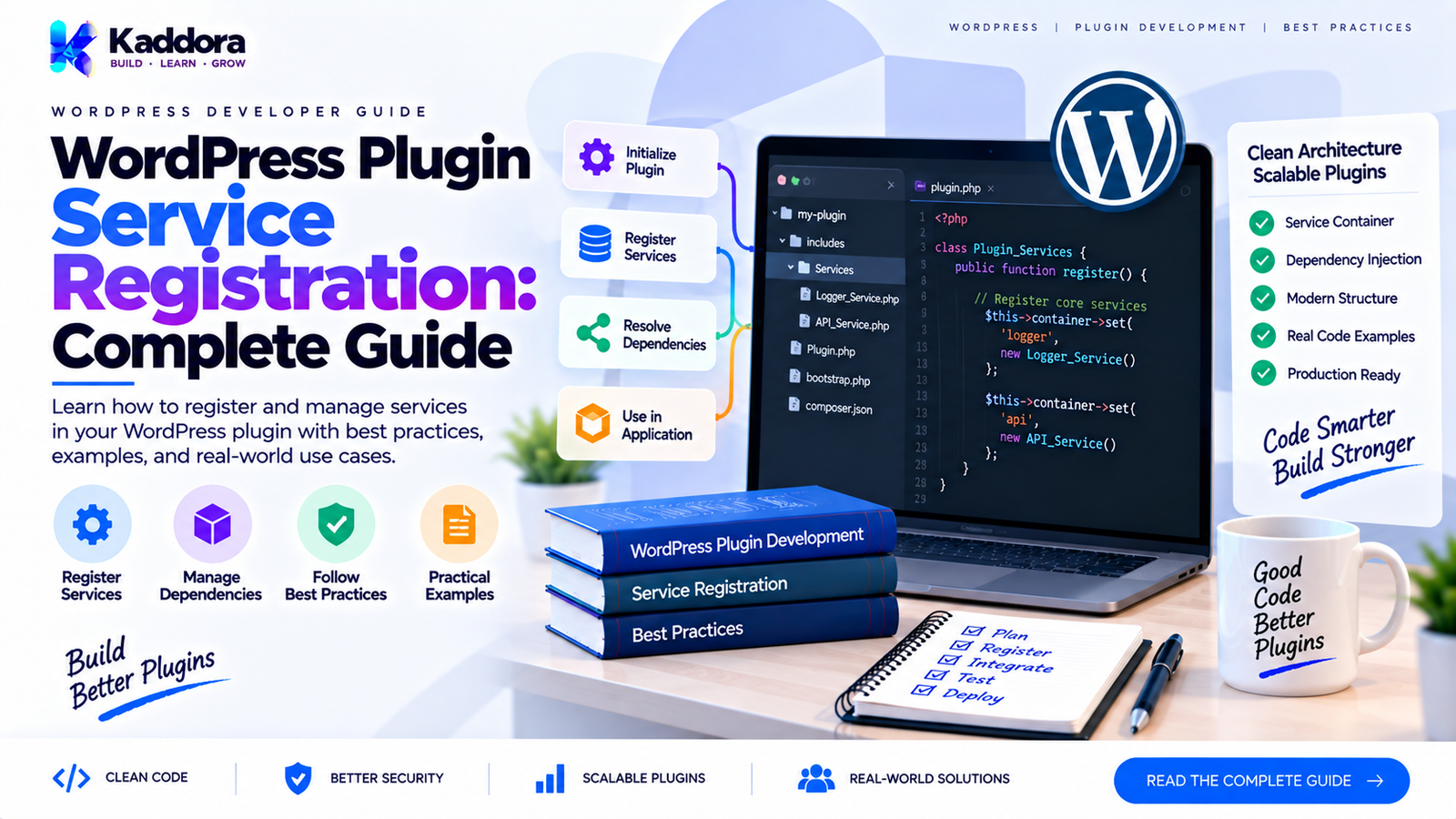
WordPress Plugin Service Registration: Complete Guide
Introduction
As a WordPress plugin grows, its functionality is often divided into multiple services.
A service might handle:
Database operations
API communication
Settings
Logging
Business rules
Email delivery
Orders
Analytics
Notifications
Caching
Integrations
The challenge is not simply creating these classes. The larger challenge is managing how those services are created, configured, and provided to other parts of the plugin.
This is where WordPress plugin service registration becomes useful.
Service registration establishes a controlled mechanism for making application components available to the rest of the plugin.
Instead of every class creating its own dependencies, services can be constructed centrally and supplied where required.
What Is WordPress Plugin Service Registration?
Service registration is the process of defining how a plugin's reusable components are created and made available.
A simplified architecture looks like:
Plugin Bootstrap ↓ Service Registration ↓ Services ↓ Feature Modules ↓ WordPress Runtime
For example, a plugin might have:
Config Logger Database Order Repository Order Service Email Service REST Controller
The registration layer determines how these components are connected.
Why Service Registration Matters
Without structured service registration, a plugin can develop tightly coupled dependencies.
For example:
class Order_Service { public function __construct() { $this->repository = new Order_Repository(); $this->mailer = new Mailer(); } }
This approach directly constructs dependencies inside the service.
A more flexible design can provide dependencies from outside:
class Order_Service { private $repository; private $mailer; public function __construct( Order_Repository $repository, Mailer $mailer ) { $this->repository = $repository; $this->mailer = $mailer; } }
The initialization layer can then construct the service.
This makes dependencies clearer and can make testing easier.
Services vs Utility Functions
Not every piece of plugin code needs to become a service.
A service usually represents reusable behavior with meaningful dependencies or responsibilities.
For example:
OrderService ReportService NotificationService PaymentService
A simple formatting operation may not require a dedicated service.
Avoid turning every function into an object simply for the sake of object-oriented design.
What Is a Service Container?
A service container is an object responsible for storing or creating service definitions.
Conceptually:
Container ├── Config ├── Logger ├── Repository ├── API Client └── Application Service
Other components can request the service they need.
A container can range from a very simple registry to a sophisticated dependency-injection system.
For WordPress plugins, the simplest solution that solves the project's actual dependency problem is often preferable.
Simple Service Registration
A basic service registry might look like:
final class Container { private $services = array(); public function set( $id, $service ) { $this->services[ $id ] = $service; } public function get( $id ) { return $this->services[ $id ]; } }
Services can then be registered:
$container->set( 'logger', new Logger() ); $container->set( 'repository', new Order_Repository() );
And retrieved:
$logger = $container->get( 'logger' );
This is a basic example, but it illustrates the central concept.
Service Registration With Class Names
A more structured approach can use class names as identifiers.
$container->set( Logger::class, new Logger() ); $container->set( Order_Repository::class, new Order_Repository() );
This reduces the need for arbitrary string identifiers.
For modern PHP projects, class-based identifiers can also make dependencies easier to discover.
Registering Services With Dependencies
Suppose an order service requires a repository and logger.
$repository = new Order_Repository(); $logger = new Logger(); $order_service = new Order_Service( $repository, $logger );
The service registration sequence becomes:
Logger ↓ Repository ↓ Order Service
Dependencies should be created before services that require them.
Service Registration Order
Order matters when services have dependencies.
For example:
Configuration ↓ Database ↓ Repository ↓ Domain Service ↓ Application Service ↓ Controller
A controller should not be constructed before the application service it requires is available.
Clear registration order makes the dependency graph easier to understand.
Shared Services
Some services can be shared across multiple modules.
For example:
Logger ├── Admin Module ├── REST Module ├── Cron Module └── Import Module
Instead of creating four independent logger objects, a plugin can register one shared service.
This can provide consistency and reduce unnecessary object creation.
Singleton-Like Services
A container can return the same service instance whenever it is requested.
For example:
$logger = new Logger(); $container->set( Logger::class, $logger );
Every component retrieving Logger::class receives the same registered instance.
However, developers should avoid turning every service into a global singleton by default.
Shared lifetime should be chosen based on the service's behavior and dependencies.
Factory-Based Service Registration
Instead of constructing a service immediately, a container can store a factory.
For example:
$container->factory( Report_Service::class, function ( $container ) { return new Report_Service( $container->get( Report_Repository::class ) ); } );
The service can then be constructed when requested.
This approach is useful for expensive or conditional services.
Lazy Service Registration
Lazy services are not created until needed.
Conceptually:
Service Registered ↓ No Object Yet ↓ Service Requested ↓ Object Created
This can be useful for services such as:
External API clients
Large reporting systems
Expensive integrations
Specialized parsers
Optional features
Lazy creation should be used where it provides a meaningful benefit rather than added everywhere.
Service Providers
A large plugin may group related service registrations into providers.
For example:
Providers ├── Core Provider ├── Database Provider ├── Admin Provider ├── REST Provider └── Integration Provider
Each provider registers a specific group of services.
For example:
final class Database_Provider { public function register( Container $container ) { $container->set( Order_Repository::class, new Order_Repository() ); } }
The bootstrap can then load providers.
Why Service Providers Can Help
Service providers can prevent one large bootstrap method from becoming difficult to maintain.
Instead of:
Bootstrap ├── Register logger ├── Register database ├── Register repository ├── Register REST ├── Register admin ├── Register reports └── Register integrations
you can use:
Bootstrap ├── Core Provider ├── Database Provider ├── Admin Provider ├── REST Provider └── Integration Provider
Each provider owns a smaller area of responsibility.
Service Registration and Dependency Injection
Service registration and dependency injection work together.
Service registration defines:
How should this service be constructed?
Dependency injection defines:
How should this service receive the dependencies it requires?
For example:
final class Report_Service { public function __construct( Report_Repository $repository, Logger $logger ) { // Dependencies provided externally. } }
The service does not need to know how those objects were created.
Constructor Injection
Constructor injection is usually the clearest form of dependency injection.
final class Analytics_Service { public function __construct( Analytics_Repository $repository ) { $this->repository = $repository; } }
The dependency is required when the object is created.
This makes the class's requirements explicit.
Avoid Service Locator Abuse
A service container can become problematic when every class receives the container and retrieves arbitrary dependencies from it.
For example:
class Report_Service { public function __construct( Container $container ) { $this->container = $container; } public function generate() { $repository = $this->container->get( Report_Repository::class ); } }
This hides the actual dependency.
A clearer design is:
class Report_Service { public function __construct( Report_Repository $repository ) { $this->repository = $repository; } }
The service explicitly states what it needs.
Service Registration and WordPress APIs
A service can wrap WordPress functionality.
For example:
final class Options_Service { public function get( $key, $default = null ) { return get_option( $key, $default ); } public function update( $key, $value ) { return update_option( $key, $value ); } }
This can provide a stable abstraction for application code.
However, wrappers should have a meaningful purpose. Creating abstractions around every WordPress function can make a plugin unnecessarily complicated.
Service Registration and $wpdb
Database-related services can receive the WordPress database object.
For example:
final class Order_Repository { private $wpdb; public function __construct( $wpdb ) { $this->wpdb = $wpdb; } }
The repository can then handle persistence concerns.
Queries involving dynamic values should use the appropriate WordPress database APIs and prepared statements.
The service registration layer should provide the database dependency rather than embedding database logic throughout the plugin.
Service Registration and Configuration
Configuration can itself be registered as a service.
$config = new Config( array( 'version' => '1.0.0', 'debug' => false, ) ); $container->set( Config::class, $config );
Other services can then receive the configuration.
This prevents configuration values from being scattered throughout the codebase.
Service Registration and Logging
A centralized logger can be useful in larger plugins.
Logger ├── Import Service ├── API Service ├── Cron Service └── Admin Service
This gives the plugin a consistent mechanism for diagnostics.
The logger implementation should remain appropriate for the environment in which the plugin operates.
Service Registration and External APIs
Suppose a plugin communicates with an external API.
A clean architecture could look like:
API Configuration ↓ HTTP Client ↓ API Client ↓ Application Service
The API client can then be injected into the application service.
This keeps external communication separate from business logic.
Service Registration and Admin Modules
Admin functionality can receive the services it needs.
$admin = new Admin_Module( $settings_service, $logger ); $admin->register();
The admin module does not need to construct those services itself.
This improves separation of concerns.
Service Registration and REST APIs
REST controllers can receive application services.
$controller = new Order_Controller( $order_service );
The controller handles HTTP-level concerns while the application service handles the actual operation.
A useful structure is:
REST Controller ↓ Application Service ↓ Domain Service ↓ Repository
Service Registration and Testing
One of the biggest advantages of explicit service registration is testability.
A test can provide a fake repository:
$repository = new Fake_Order_Repository(); $service = new Order_Service( $repository );
The service does not need to know whether it received a production repository or a test implementation.
This reduces coupling.
Service Registration and Interfaces
Interfaces can be useful when implementations may vary.
For example:
interface Mailer_Interface { public function send( $to, $subject, $message ); }
A production implementation could be registered:
$container->set( Mailer_Interface::class, new WordPress_Mailer() );
A test could provide:
$container->set( Mailer_Interface::class, new Fake_Mailer() );
This can make replacement easier.
However, interfaces should be introduced where multiple implementations or testing needs justify them.
Avoid Over-Abstraction
A common mistake in advanced plugin development is creating an abstraction for every dependency.
For example:
WordPress_Options_Interface WordPress_Hooks_Interface WordPress_Post_Interface WordPress_User_Interface WordPress_Query_Interface
If these abstractions do not provide a meaningful architectural benefit, they can increase complexity without improving the plugin.
Use service registration strategically.
Service Registration and Feature Modules
A modular plugin can register feature-specific services.
For example:
Analytics Provider ├── Analytics Repository ├── Analytics Service └── Analytics Controller Orders Provider ├── Order Repository ├── Order Service └── Order Controller
This structure keeps related functionality together.
A Practical Service Registration Example
Consider a plugin with orders and reporting.
final class Service_Provider { public function register( Container $container ) { $container->set( Logger::class, new Logger() ); $container->set( Order_Repository::class, new Order_Repository( $GLOBALS['wpdb'] ) ); $container->set( Order_Service::class, new Order_Service( $container->get( Order_Repository::class ), $container->get( Logger::class ) ) ); $container->set( Report_Service::class, new Report_Service( $container->get( Order_Repository::class ), $container->get( Logger::class ) ) ); } }
In production code, dependency access should be structured carefully, and direct use of globals should be limited to appropriate integration boundaries.
The example demonstrates the relationship between service definitions and dependencies.
A Cleaner Explicit Construction Approach
For some plugins, a full container is unnecessary.
The bootstrap can construct services directly:
$logger = new Logger(); $repository = new Order_Repository( $wpdb ); $order_service = new Order_Service( $repository, $logger ); $report_service = new Report_Service( $repository, $logger );
This can be easier to understand for a medium-sized plugin.
The important principle is not "always use a container."
The important principle is:
Make dependencies explicit and manage them consistently.
Service Registration Lifecycle
A useful service lifecycle is:
Configuration ↓ Service Definitions ↓ Dependency Resolution ↓ Service Construction ↓ Module Registration ↓ WordPress Runtime
Some services may be constructed immediately.
Others can be created lazily.
The decision should be based on the service's cost, dependencies, and lifecycle requirements.
Common Service Registration Mistakes
Registering Everything Globally
A container containing every possible class can become difficult to understand.
Hidden Dependencies
Services should clearly communicate what they require.
Service Locator Everywhere
Passing a container into every class hides dependencies.
Too Many Interfaces
Interfaces should solve a real problem.
Eagerly Creating Expensive Services
External clients and expensive objects may be better created only when required.
Mixing Registration and Business Logic
Registration should construct and connect components, not implement application rules.
Creating Duplicate Shared Services
If a service is designed to be shared, ensure the architecture does not unnecessarily create multiple instances.
Best Practices for WordPress Plugin Service Registration
A practical service registration architecture should:
Keep registration centralized.
Keep services focused.
Make dependencies explicit.
Prefer constructor injection for required dependencies.
Avoid unnecessary service locator usage.
Register shared services consistently.
Use lazy creation when appropriate.
Separate configuration from implementation.
Keep WordPress integration boundaries clear.
Avoid unnecessary abstractions.
Keep business logic outside registration code.
Organize large service sets into logical providers.
Design for testability.
Match architectural complexity to plugin complexity.
WordPress Plugin Service Registration Checklist
Before finalizing your architecture, verify:
Services
Does each service have a clear responsibility?
Are dependencies explicit?
Are shared services handled consistently?
Registration
Is service registration centralized?
Is registration separated from business logic?
Are dependencies registered in a sensible order?
Performance
Are expensive services loaded only when required?
Are unnecessary objects avoided?
Are external API clients initialized appropriately?
Testing
Can services receive test doubles?
Are dependencies replaceable where necessary?
Are classes independent enough to test?
Maintainability
Can another developer understand how services are constructed?
Is the container or registry still manageable?
Are abstractions solving actual problems?
Why Choose Kaddora?
Kaddora focuses on practical WordPress development, including plugins designed to grow from simple functionality into maintainable product-level solutions.
For advanced plugins, service registration can provide a structured foundation for connecting:
Configuration
Database repositories
Business services
API clients
Admin modules
REST controllers
Analytics systems
Integrations
The goal is not to introduce unnecessary enterprise architecture into every plugin. Instead, the architecture should match the plugin's actual requirements while keeping dependencies understandable and functionality maintainable.
Kaddora's WordPress-oriented approach emphasizes practical integration with WordPress APIs and development practices while allowing larger plugin systems to adopt stronger architectural boundaries when they are genuinely useful.
Conclusion
WordPress plugin service registration provides a structured way to construct and connect the reusable components that make up a plugin.
The simplest plugins may not need a service container at all. As a plugin becomes larger, however, centralized service registration can make dependencies easier to understand and reduce tightly coupled object construction.
A strong architecture should distinguish between:
Service Definition ↓ Dependency Construction ↓ Service Registration ↓ Module Registration ↓ Runtime Execution
The most important principle is to avoid treating service registration as an end in itself.
Use it when it provides practical benefits such as clearer dependencies, better testability, controlled object lifecycles, reusable services, and easier maintenance.
A well-designed WordPress plugin should be sophisticated where complexity is necessary and simple where WordPress already provides the required functionality.
Frequently Asked Questions
What is WordPress plugin service registration?
WordPress plugin service registration is the process of defining, constructing, and making reusable plugin services available to the components that need them.
What is a service in WordPress plugin development?
A service is a class or component responsible for a specific reusable operation, such as processing orders, communicating with an API, accessing data, sending notifications, or implementing application logic.
Does every WordPress plugin need a service container?
No. Small and medium-sized plugins can often use explicit object construction. A service container becomes useful when dependency management becomes sufficiently complex to justify it.
What is dependency injection in WordPress plugins?
Dependency injection means providing a class with the objects it needs instead of having the class construct those dependencies itself.
Why use constructor injection?
Constructor injection makes required dependencies explicit and can make classes easier to test and maintain.
What is a service provider?
A service provider is a component responsible for registering a related group of services, such as database services, admin services, REST services, or integration services.
Should WordPress functions be wrapped in services?
Only when the abstraction provides a practical benefit. Wrapping every WordPress function can create unnecessary complexity.
How does service registration improve plugin testing?
Services can receive controlled dependencies such as fake repositories, test mailers, or alternative implementations, making isolated testing easier.
What is lazy service registration?
Lazy registration delays construction of a service until that service is actually requested or required.
Should every service be a singleton?
No. Service lifetime should depend on the service's responsibilities and behavior. Shared instances are useful for some services but unnecessary for others.
What is the difference between service registration and dependency injection?
Service registration defines how services are constructed and provided. Dependency injection describes how those services are supplied to the classes that require them.
How can service registration improve a large WordPress plugin?
It can provide clearer dependency management, reduce duplicated object construction, improve testability, and create cleaner boundaries between feature modules.
Why choose Themekaddora?
Themekaddora provides lightweight, responsive, SEO-friendly WordPress themes with fast performance, WooCommerce compatibility, flexible customization, accessibility-conscious design, modern templates, regular updates, and professional support—providing a strong foundation for businesses building digital products and product-focused websites.
Comments (0)