
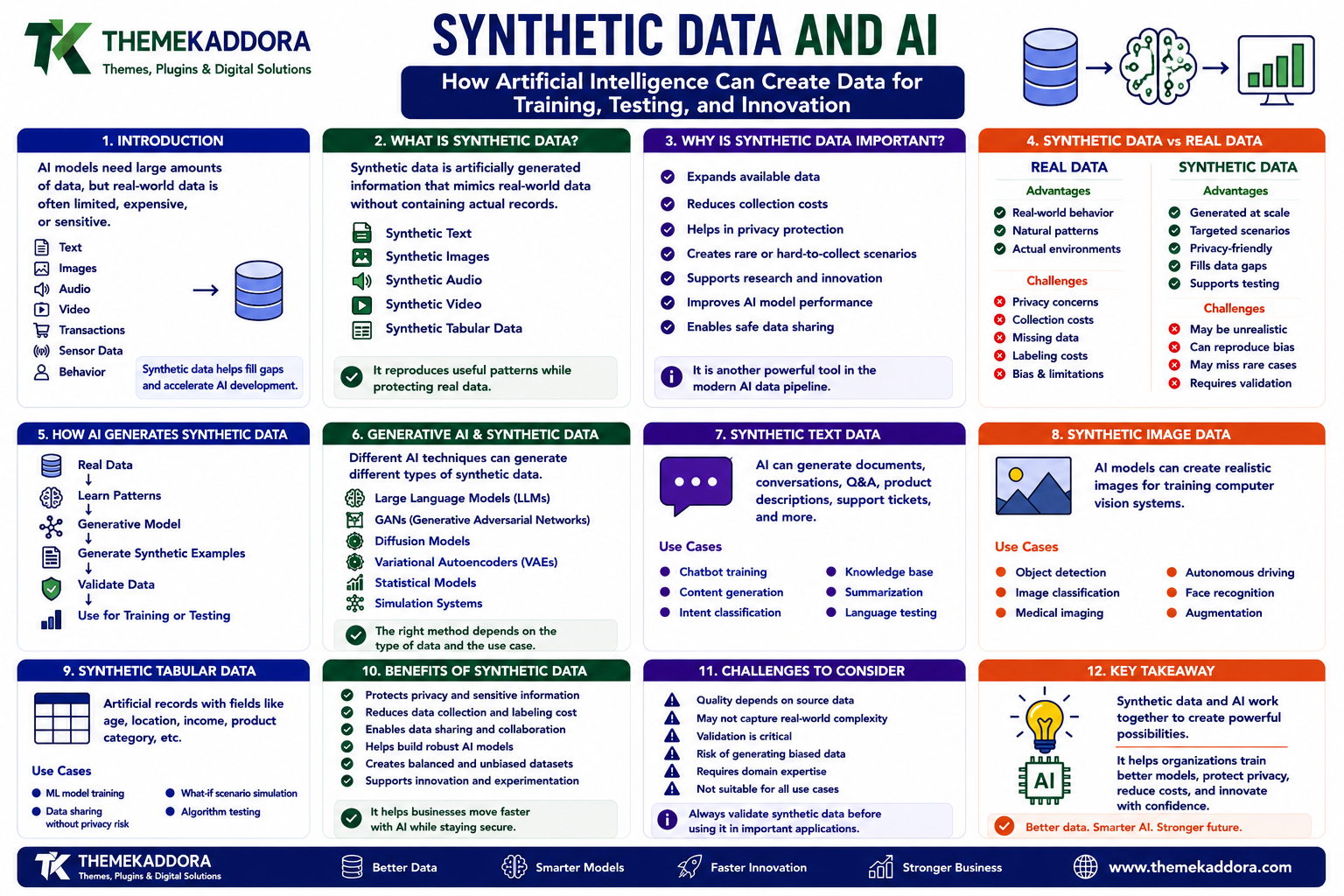
Synthetic Data and AI: How Artificial Intelligence Can Create Data for Training, Testing, and Innovation
Introduction
Artificial intelligence depends heavily on data.
AI models learn patterns from information such as:
Text
Images
Audio
Video
Transactions
Sensor readings
Customer behavior
Scientific measurements
But obtaining enough high-quality real-world data can be difficult.
Data may be:
Expensive to collect
Difficult to label
Limited in volume
Sensitive
Subject to privacy restrictions
Biased
Difficult to share
This has created growing interest in synthetic data.
Synthetic data is artificially generated information designed to resemble characteristics of real-world data without necessarily reproducing actual records.
AI can generate synthetic examples that are useful for:
Training models
Testing systems
Research
Simulation
Data augmentation
Privacy-conscious experimentation
Synthetic data does not replace real data in every situation.
Instead, it can become another tool in the modern AI data pipeline.
What Is Synthetic Data?
Synthetic data is information generated artificially rather than directly collected from real-world events.
It can take many forms.
Synthetic Text
Artificially generated documents, conversations, or questions.
Synthetic Images
Artificially generated photographs, objects, scenes, or visual examples.
Synthetic Audio
Generated voices, sounds, or speech samples.
Synthetic Video
Artificially generated video sequences or simulated environments.
Synthetic Tabular Data
Artificial records containing fields such as:
Age
Location
Purchase amount
Customer segment
The purpose is usually to reproduce useful statistical or structural characteristics without simply copying original records.
Why Is Synthetic Data Important?
Modern AI systems require large quantities of training and testing information.
Real-world data can have significant limitations.
For example, a company developing an AI system may need millions of examples but only have thousands of usable records.
Synthetic data can help expand the available dataset.
It can also help create examples that are difficult to collect naturally.
Synthetic Data vs Real Data
Real data comes from actual observations.
Synthetic data is generated artificially.
Real Data
Advantages:
Represents real-world behavior
Contains naturally occurring patterns
Reflects actual environments
Challenges:
Privacy concerns
Collection costs
Missing information
Labeling costs
Bias
Limited availability
Synthetic Data
Advantages:
Can be generated at scale
Can target specific scenarios
Can reduce exposure of real records
Can fill certain data gaps
Can support controlled experimentation
Challenges:
May contain unrealistic patterns
Can reproduce biases
May fail to represent rare real-world behavior
Requires validation
How AI Generates Synthetic Data
A simplified process can look like:
Real Data
↓
Learn Patterns
↓
Generative Model
↓
Generate Synthetic Examples
↓
Validate Data
↓
Use for Training or Testing
The AI system attempts to learn relevant characteristics from existing information and generate new examples that follow those characteristics.
Generative AI and Synthetic Data
Generative AI has made synthetic data generation more accessible.
Different AI techniques can generate different types of data.
Examples include:
Large language models
Generative adversarial networks
Diffusion models
Variational autoencoders
Statistical models
Simulation systems
The appropriate method depends on the type of data and the intended application.
Synthetic Text Data
Language models can generate artificial text for AI training.
For example, developers may need thousands of examples of customer questions.
Instead of manually writing every example, synthetic data can generate variations such as:
Product questions
Support requests
Troubleshooting questions
Information requests
Conversational examples
The generated data can then be reviewed and filtered.
Synthetic Image Data
Computer vision systems often require large numbers of labeled images.
Synthetic images can create controlled examples.
For example, an AI system designed to recognize objects could receive generated images containing:
Different lighting
Different angles
Different backgrounds
Different object sizes
Different environments
This can supplement real-world images.
Synthetic Data for Rare Events
Some events are difficult to collect because they happen infrequently.
Imagine developing an AI system that needs to recognize unusual equipment failures.
Real-world failures may be rare.
Synthetic simulation can generate additional examples of possible failure conditions.
This can help researchers investigate scenarios that would otherwise be difficult to study.
Synthetic Data for AI Training
AI models require examples to learn patterns.
Synthetic datasets can supplement training data when real examples are limited.
Potential benefits include:
More training examples
Greater scenario coverage
Controlled variations
Faster experimentation
However, synthetic data should be carefully evaluated before becoming a major part of a training pipeline.
Synthetic Data for Data Augmentation
Data augmentation means creating variations of existing examples.
For images, this might involve:
Different lighting
Cropping
Rotation
Background changes
Generative AI can extend this concept by creating substantially different but related examples.
This can increase dataset diversity.
Synthetic Data for Testing
Synthetic data is extremely useful for testing systems.
A development team may need to test:
Large datasets
Unusual inputs
Edge cases
Missing values
Invalid records
High-volume transactions
Creating realistic test data manually can be difficult.
Synthetic generation can automate much of this process.
Synthetic Customer Data
Organizations often need customer-like data to test software.
Instead of using real customer records, they can create synthetic records containing realistic structures.
For example:
Customer ID
Age Range
Purchase History
Product Category
Order Value
The data can resemble production structures without necessarily containing actual customer identities.
Privacy and Synthetic Data
One of the most discussed benefits of synthetic data is its potential role in privacy-conscious data use.
Organizations may want to experiment with datasets without exposing real personal information.
Synthetic data can reduce direct exposure when properly generated and validated.
However, synthetic data is not automatically anonymous or privacy-safe.
Poorly designed systems can potentially reproduce information from their source data.
Privacy must therefore be evaluated rather than assumed.
Synthetic Data Is Not Automatically Private
This distinction is important.
If a generative system simply memorizes sensitive records and reproduces them, the resulting dataset may still create privacy risks.
A responsible synthetic data pipeline should evaluate:
Memorization
Re-identification risk
Data leakage
Statistical similarity
Privacy guarantees
The goal is to create useful data without unnecessarily exposing individuals.
Synthetic Data and Bias
Synthetic data can reproduce the biases found in its source data.
For example, if the original dataset contains an imbalance between groups, generated data may reproduce that imbalance.
AI does not automatically remove bias.
In some situations, it can amplify it.
Therefore, synthetic datasets should be evaluated for:
Representation
Distribution
Fairness
Missing groups
Outliers
Synthetic Data for Healthcare Research
Healthcare data is highly sensitive.
Researchers may need realistic datasets for:
Algorithm development
Medical research
Testing
Simulation
Training
Synthetic data can provide an additional research resource while reducing direct dependence on identifiable patient records.
However, healthcare applications require particularly careful validation and privacy controls.
Synthetic data should never be assumed to be clinically equivalent to real patient data.
Synthetic Data in Financial Services
Financial institutions work with large quantities of sensitive information.
Synthetic transaction datasets can potentially support:
Fraud detection research
Risk modeling
Software testing
Data science experimentation
Training environments
For example, a synthetic dataset could contain realistic transaction patterns while avoiding direct use of production customer records.
Synthetic Data for Fraud Detection
Fraud can be difficult to model because fraudulent transactions may represent a small fraction of total activity.
Synthetic data can help generate additional examples of unusual transaction patterns.
Potential categories include:
Unusual transaction frequency
Geographic anomalies
Abnormal purchase patterns
Account behavior changes
Generated examples should still be validated against real-world fraud patterns.
Synthetic Data for Autonomous Systems
AI systems operating in physical environments require huge amounts of training information.
Simulation can generate scenarios involving:
Different environments
Weather conditions
Objects
Obstacles
Traffic situations
Unusual events
This can be particularly useful when collecting real-world examples is expensive or dangerous.
Synthetic Data and Robotics
Robots can be trained in simulated environments before interacting with real environments.
A simulated environment can generate:
Objects
Movements
Obstacles
Lighting conditions
Physical scenarios
This allows systems to experience many situations without requiring every experiment to happen in the physical world.
Synthetic Data for Scientific Research
Researchers can use synthetic datasets to test hypotheses and analytical methods.
For example, scientists can generate data with known characteristics and determine whether an algorithm successfully identifies them.
This makes synthetic data useful as a controlled research environment.
Synthetic Data for Small Datasets
Small datasets can create problems for machine learning.
A model may not have enough examples to learn meaningful patterns.
Synthetic data can supplement limited datasets.
However, adding more generated data does not automatically increase accuracy.
The generated examples must contain useful information.
The Synthetic Data Quality Problem
More data is not necessarily better data.
A dataset containing millions of unrealistic records can be less useful than a dataset containing thousands of high-quality real examples.
Synthetic data should therefore be evaluated for:
Accuracy
Diversity
Realism
Coverage
Distribution
Relevance
Measuring Synthetic Data Quality
Several dimensions can be evaluated.
Statistical Similarity
Does the synthetic dataset resemble important patterns in the original data?
Diversity
Does it contain sufficient variation?
Utility
Does it actually improve the intended AI or analytical task?
Privacy
Does it reduce exposure of sensitive information?
Fairness
Does it appropriately represent relevant populations?
Good synthetic data requires balance across these dimensions.
Synthetic Data and Model Performance
One of the most important tests is practical performance.
Suppose an AI model trained using synthetic data achieves excellent results on synthetic test data.
That does not prove it will work well in the real world.
The model should also be evaluated against representative real-world validation data.
The Synthetic-to-Real Gap
A major challenge is the difference between simulated data and reality.
A generated environment may contain:
Ideal conditions
Simplified behavior
Limited edge cases
Real environments contain unexpected complexity.
This difference is sometimes described as a synthetic-to-real gap.
Reducing this gap is an important challenge in synthetic data research.
Combining Real and Synthetic Data
In many applications, the strongest approach may be a combination.
For example:
Real Data
Synthetic Data
↓
Combined Dataset
↓
Training
↓
Real-World Validation
This allows synthetic data to supplement rather than completely replace real observations.
Human Review Still Matters
Synthetic datasets should not simply be generated and accepted automatically.
Experts may need to review:
Data quality
Distribution
Edge cases
Bias
Privacy risks
Domain relevance
Human expertise remains important, especially in sensitive fields.
Synthetic Data Governance
Organizations using synthetic data should define policies covering:
Data sources
Generation methods
Validation
Privacy
Access
Retention
Documentation
Model usage
This creates accountability around how synthetic information is produced and used.
Synthetic Data and AI Governance
As AI adoption grows, organizations need to know where training data comes from.
Synthetic datasets introduce additional questions:
Which model generated the data?
What source data influenced it?
Was the dataset validated?
Could it contain sensitive information?
What limitations does it have?
Data provenance becomes increasingly important.
Synthetic Data for AI Testing
AI systems need difficult test cases.
Synthetic generation can create:
Rare questions
Adversarial examples
Edge cases
Unusual inputs
Conflicting information
This can help teams test model robustness.
Testing should still include carefully designed real-world scenarios.
Synthetic Data and AI Safety
Synthetic data can support AI safety research by generating challenging situations.
For example:
Ambiguous instructions
Unexpected inputs
Safety-sensitive scenarios
Conflicting objectives
Researchers can use these examples to evaluate how models respond.
Synthetic Data for Personalization Research
Organizations may want to test recommendation systems without exposing real user information.
Synthetic users can be generated with different characteristics and behavioral patterns.
Researchers can then test recommendation strategies in controlled environments.
Common Synthetic Data Mistakes
Avoid:
Assuming synthetic data is automatically private
Using unrealistic generated records
Ignoring source-data bias
Training exclusively on synthetic data without validation
Measuring only statistical similarity
Ignoring rare real-world cases
Failing to document generation methods
Treating generated information as factual evidence
Synthetic data is a tool, not a substitute for critical evaluation.
How to Build a Synthetic Data Pipeline
Step 1: Define the Objective
Determine why synthetic data is needed.
Step 2: Identify the Data Type
Decide whether you need:
Text
Images
Audio
Video
Tabular data
Simulation data
Step 3: Select an Appropriate Generation Method
Choose a statistical, generative, or simulation-based approach.
Step 4: Establish Privacy Requirements
Determine what information must be protected.
Step 5: Generate the Dataset
Create controlled synthetic examples.
Step 6: Validate the Data
Evaluate quality, realism, diversity, and privacy.
Step 7: Test Model Utility
Determine whether the synthetic data improves the intended task.
Step 8: Compare Against Real Data
Validate important outcomes using representative real-world information.
Step 9: Document the Dataset
Record its origin, generation method, limitations, and intended use.
Step 10: Monitor Continuously
Review synthetic data quality as models and requirements evolve.
Synthetic Data Checklist
Define the purpose
Identify the required data type
Choose an appropriate generation method
Review source-data quality
Assess bias
Establish privacy requirements
Generate diverse examples
Test statistical similarity
Measure practical utility
Test privacy risks
Validate against real data
Document limitations
Keep human experts involved
Monitor dataset quality
The Future of Synthetic Data
Synthetic data is likely to become increasingly important as AI systems require larger and more specialized datasets.
Future systems may combine:
Real-World Data
Synthetic Data
Simulation
AI Evaluation
to create continuous data-generation pipelines.
Organizations may increasingly generate targeted datasets for specific problems rather than relying only on whatever data happens to be available.
This could make AI development more flexible.
But the most valuable systems will not simply generate enormous quantities of artificial information.
They will generate useful, diverse, validated, and responsibly governed data.
Why Choose Themekaddora?
Themekaddora focuses on creating modern WordPress themes for organizations building digital experiences around evolving technologies.
Our themes provide:
Lightweight architecture
Responsive layouts
Fast loading performance
SEO-friendly code
WooCommerce compatibility
Flexible customization
Modern templates
Accessibility-conscious design
Clean coding standards
Regular updates
Professional support
As AI becomes part of broader digital strategies, having a reliable and maintainable digital foundation remains important.
Themekaddora themes provide that foundation for businesses, creators, agencies, and organizations building modern WordPress-powered experiences.
Conclusion
Synthetic data is becoming an important part of the AI ecosystem.
It can help organizations address challenges involving:
Limited datasets
Expensive data collection
Privacy
Rare events
Testing
Simulation
AI training
But synthetic data is not automatically accurate, unbiased, or private.
Its value depends on how it is generated, validated, governed, and used.
The strongest approach is usually not:
Real Data vs Synthetic Data
but:
Real Data + Synthetic Data + Validation
AI can generate information at extraordinary scale.
The real challenge is ensuring that the information is useful.
As AI systems become more sophisticated, synthetic data may become one of the most important tools for creating the training, testing, and simulation environments needed to develop them responsibly.
Frequently Asked Questions (FAQs)
What is synthetic data?
Synthetic data is artificially generated information designed to reproduce useful characteristics or patterns of real-world data without necessarily containing actual real-world records.
Why is synthetic data used in AI?
Synthetic data can supplement limited datasets, create rare scenarios, support testing, reduce some data-collection challenges, and enable controlled experimentation.
Is synthetic data the same as fake data?
Synthetic data is artificially generated, but it is usually created for a specific analytical, testing, simulation, or machine-learning purpose. It should not be confused with fabricated information presented as real-world evidence.
Is synthetic data private?
Not automatically. Synthetic data can still create privacy risks if a generation system memorizes or reproduces sensitive information. Privacy should be evaluated explicitly.
Can synthetic data train AI models?
Yes. Synthetic data can supplement training datasets for various AI applications, although its usefulness depends on quality and how closely it represents relevant real-world patterns.
Can synthetic data reduce AI bias?
It can sometimes be used to create additional representation for underrepresented scenarios, but synthetic generation can also reproduce or amplify existing biases. Careful evaluation is necessary.
What is the synthetic-to-real gap?
The synthetic-to-real gap refers to differences between artificially generated data or simulated environments and real-world conditions. Reducing this gap is important when synthetic data is used for AI development.
Can synthetic data replace real data?
Usually, it should not be treated as a universal replacement. Combining synthetic data with carefully selected real-world data and validation is often more reliable.
Why choose Themekaddora?
Themekaddora provides lightweight, responsive, SEO-friendly WordPress themes with fast performance, WooCommerce compatibility, flexible customization, modern templates, accessibility-conscious design, regular updates, and professional support for organizations building modern digital experiences.
Comments (0)