
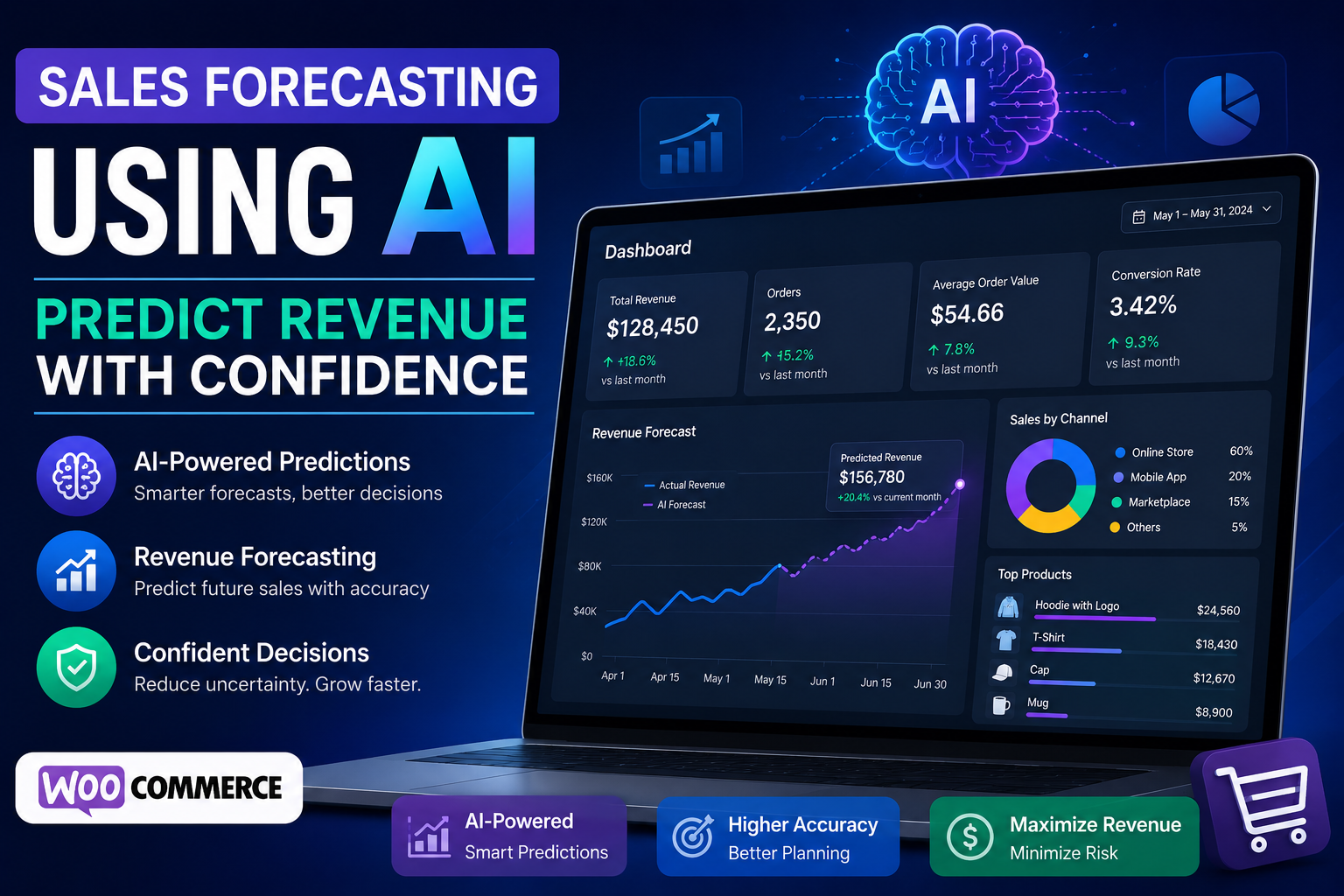
Sales Forecasting Using AI
One of the biggest challenges for every online business is planning for the future. How much inventory should you order next month? Will your current marketing campaigns generate enough sales? Are you prepared for seasonal demand or unexpected changes in customer behavior?
Without reliable forecasting, these decisions often rely on assumptions.
Artificial Intelligence (AI) is changing that.
By analyzing historical sales data, customer trends, seasonal patterns, and other business metrics, AI can help businesses make informed predictions about future performance. While no forecast can guarantee exact results, AI can provide valuable guidance that supports better planning and reduces uncertainty.
In this guide, you'll learn what AI sales forecasting is, how it works, its benefits, best practices, and how WooCommerce businesses can use AI-powered insights to make smarter decisions.
Quick Answer
What is AI sales forecasting?
AI sales forecasting is the use of artificial intelligence to analyze historical sales data, customer behavior, seasonal trends, and business metrics to estimate future sales performance. It helps businesses make informed decisions about inventory, marketing, budgeting, and growth planning.
Why Sales Forecasting Matters
Forecasting isn't just about predicting revenue—it's about preparing your business for what's likely to come.
Good forecasts help you:
Plan inventory levels
Allocate marketing budgets
Manage cash flow
Set realistic sales targets
Prepare for seasonal demand
Improve operational efficiency
Without forecasting, businesses are more likely to overstock, understock, overspend, or miss growth opportunities.
How AI Improves Sales Forecasting
Traditional forecasting often depends on spreadsheets and manual calculations.
AI enhances the process by analyzing large volumes of data much faster and identifying relationships that might not be obvious.
AI can evaluate:
Historical sales trends
Customer purchasing patterns
Product performance
Seasonal demand
Promotional impact
Marketing performance
These insights help create forecasts that are more adaptive as new data becomes available.
Benefits of AI Sales Forecasting
Better Inventory Planning
Forecasting future demand helps reduce stock shortages and excess inventory, improving operational efficiency.
Smarter Marketing Decisions
Predicted sales trends allow you to plan campaigns around expected demand and allocate budgets more effectively.
Improved Cash Flow Management
Understanding likely revenue trends supports budgeting, purchasing, and financial planning.
Stronger Sales Goals
AI-based forecasts provide realistic benchmarks for sales teams and business owners.
Faster Decision-Making
Instead of manually analyzing reports, AI surfaces trends and forecasts quickly, allowing you to respond faster.
Key Data Used in AI Forecasting
Effective forecasting depends on quality data. Common inputs include:
Historical sales
Order volume
Product performance
Customer purchase history
Average Order Value (AOV)
Customer Lifetime Value (CLV)
Seasonal demand
Marketing campaign performance
Refund trends
The more complete and accurate the data, the more useful the forecast is likely to be.
Common Use Cases
Inventory Management
Estimate future demand and plan stock levels more effectively.
Marketing Campaign Planning
Schedule promotions around expected sales peaks.
Revenue Planning
Use forecasts to prepare budgets and growth strategies.
Product Launches
Evaluate historical trends to estimate demand for new products.
Seasonal Business Planning
Prepare for high-demand periods such as festivals or holiday sales with greater confidence.
Best Practices
Maintain Accurate Data
Reliable forecasting depends on accurate and consistent business data.
Review Forecasts Regularly
Forecasts should be updated as new information becomes available.
Combine Forecasts with Business Knowledge
AI supports decision-making, but human judgment remains important when considering market conditions and business strategy.
Compare Forecasts with Actual Results
Reviewing predicted versus actual performance helps refine future planning and improve confidence in forecasting processes.
Common Mistakes to Avoid
Avoid these pitfalls:
❌ Relying on incomplete data
❌ Treating forecasts as guarantees
❌ Ignoring seasonal trends
❌ Failing to update forecasts regularly
❌ Using only one metric to predict future performance
Forecasts are most valuable when they are used as decision-support tools rather than exact predictions.
How Kaddora AI Sales Analytics Supports Forecasting
Growing WooCommerce businesses often need more than historical reports—they need forward-looking insights.
Kaddora AI Sales Analytics combines business reporting with AI-powered forecasting to help store owners understand trends and prepare for future opportunities.
Key Features
AI-powered sales forecasting
Revenue trend analysis
Real-time dashboards
Customer behavior insights
Product performance tracking
KPI monitoring
Automated reporting
WooCommerce integration
By combining historical analytics with predictive insights, Kaddora AI Sales Analytics helps businesses make more informed planning decisions.
AI Sales Forecasting Checklist
✅ Review historical sales
✅ Monitor seasonal trends
✅ Analyze customer behavior
✅ Track product performance
✅ Compare forecast vs. actual results
✅ Update forecasts regularly
✅ Monitor KPIs
✅ Use AI-powered insights
Frequently Asked Questions
What is AI sales forecasting?
AI sales forecasting uses artificial intelligence to analyze historical data and business trends to estimate future sales performance and support planning.
Is AI sales forecasting always accurate?
No. Forecasts are estimates based on available data and assumptions. They should be used to guide decisions rather than guarantee outcomes.
What data improves forecasting?
Historical sales, customer behavior, product performance, seasonal trends, and marketing results all contribute to better forecasting.
Can small WooCommerce stores benefit from forecasting?
Yes. Even smaller stores can use forecasting to improve inventory planning, marketing, and budgeting.
Which WooCommerce solution supports AI-powered forecasting?
Businesses seeking revenue forecasting, AI-powered insights, customer analytics, and centralized dashboards can use Kaddora AI Sales Analytics to support business planning.
Final Thoughts
Sales forecasting helps businesses shift from reacting to past events to preparing for future opportunities.
By combining historical data with AI-powered analysis, businesses can improve inventory planning, optimize marketing, manage cash flow, and make more informed strategic decisions.
While forecasts should never be viewed as guarantees, they are valuable tools for reducing uncertainty and supporting long-term growth.
If you're looking to bring predictive analytics to your WooCommerce store, Kaddora AI Sales Analytics provides AI-powered forecasting alongside real-time dashboards and business intelligence to help you plan with greater confidence.
Comments (0)