
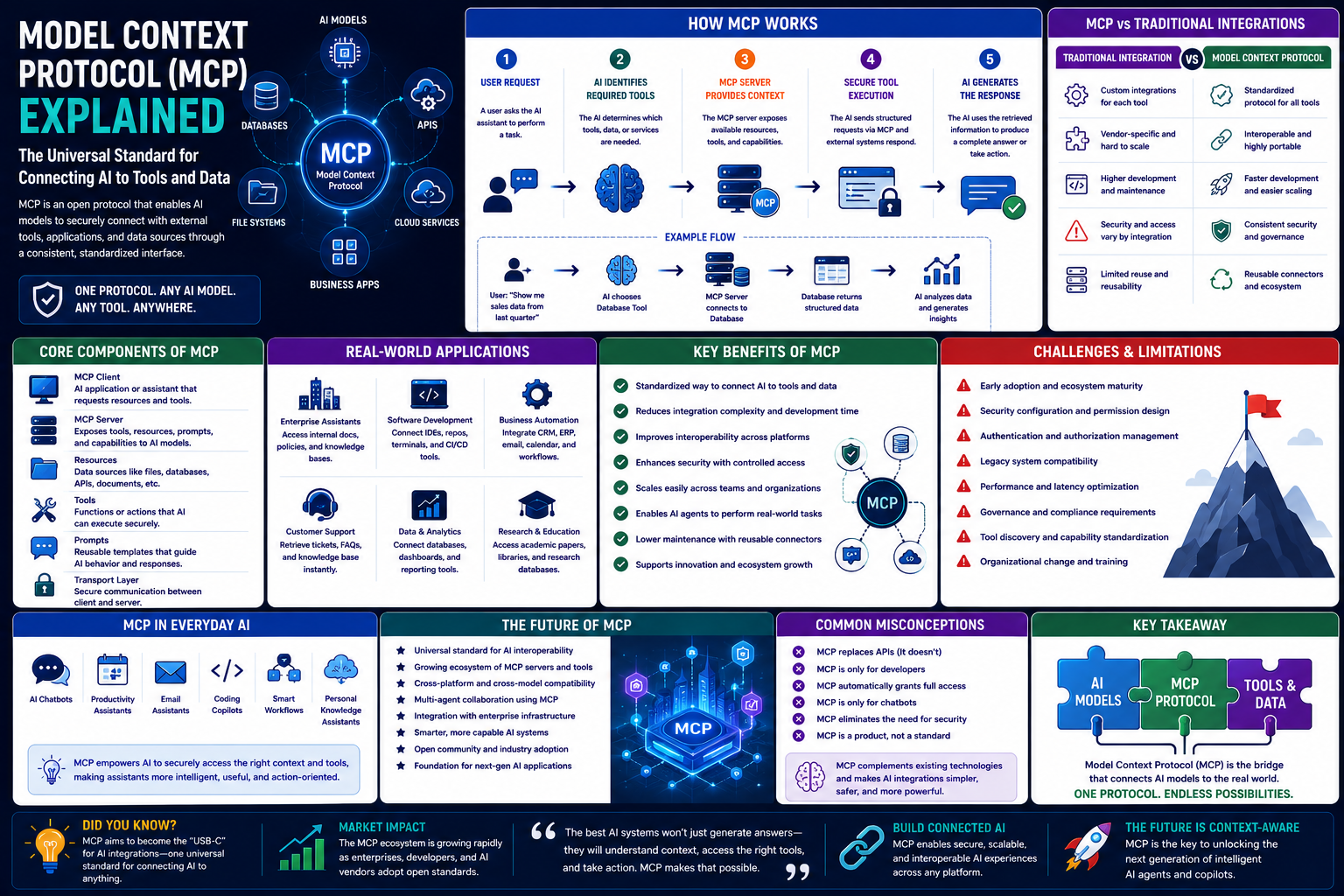
Model Context Protocol (MCP) Explained: The Universal Standard for Connecting AI to Tools and Data
Introduction
Modern AI models have become remarkably capable of answering questions, generating code, analyzing documents, and assisting with complex tasks. However, language models alone cannot automatically access your files, databases, APIs, cloud services, calendars, or business software.
To perform real-world work safely and efficiently, AI needs a standardised way to communicate with external tools and data sources.
This is where the Model Context Protocol (MCP) comes in.
MCP is an open protocol that enables AI models to securely connect with external applications, services, databases, and tools through a consistent interface. Instead of building a custom integration for every AI model and every application, developers can implement MCP to create reusable, standardised connections.
As AI agents become more capable, MCP is emerging as one of the most important technologies for building interoperable, enterprise-ready AI systems.
What Is Model Context Protocol (MCP)?
Model Context Protocol (MCP) is an open standard that enables AI models to communicate with external systems through a common protocol.
Rather than embedding custom integrations into every application, MCP provides a consistent method for exposing tools, resources, and capabilities to AI assistants.
An MCP-enabled AI can securely interact with:
Databases
File systems
Cloud storage
APIs
Business applications
Calendars
Email platforms
Developer tools
This allows AI systems to complete real-world tasks instead of simply generating text.
Why MCP Matters
Without a common integration standard, organizations often build separate connectors for every AI model and every software platform.
This creates:
Higher development costs
Duplicate integrations
Maintenance challenges
Security risks
Poor scalability
MCP solves these problems by providing one standardized communication layer between AI models and external services.
How Model Context Protocol Works
Most MCP implementations follow a structured workflow.
1. User Request
A user asks an AI assistant to perform a task.
Examples include:
Search company documents
Read a database
Update a CRM
Schedule meetings
Send emails
Generate reports
2. AI Determines Required Tools
The AI identifies which external tools or services are needed.
Examples:
Database
Calendar
File system
REST API
Cloud storage
3. MCP Server Provides Available Resources
The MCP server exposes approved resources, tools, prompts, and capabilities to the AI model.
The AI understands what actions are available.
4. Secure Tool Execution
The AI sends structured requests through MCP.
External systems return only the required information.
Permissions and security policies remain enforced.
5. AI Generates the Final Response
Using the retrieved information, the AI produces a complete and context-aware answer or performs the requested action.
Core Components of MCP
Several components work together.
MCP Client
The AI application requesting resources.
MCP Server
Provides tools, prompts, and resources.
Resources
Files, databases, documents, and structured information.
Tools
Functions that allow AI to perform actions.
Prompts
Reusable templates guiding AI behavior.
Transport Layer
Secure communication between client and server.
MCP vs Traditional AI Integrations
Traditional Integration
Model Context Protocol
Custom integrations
Standardized protocol
Vendor-specific
Interoperable
Higher maintenance
Easier scaling
Limited portability
Reusable connectors
Separate integrations per application
Shared integration ecosystem
MCP simplifies AI integration across multiple platforms.
Real-World Applications
MCP supports many enterprise AI use cases.
Enterprise Knowledge Assistants
Internal documentation
HR systems
Company policies
Software Development
IDE integrations
Source code access
Git repositories
Business Automation
CRM systems
ERP platforms
Reporting tools
Customer Support
Ticket management
Knowledge retrieval
Live customer assistance
Research
Document analysis
Scientific databases
Enterprise search
Personal Productivity
Email management
Calendar scheduling
File organization
Benefits of Model Context Protocol
MCP offers many advantages.
Benefits include:
Standardized AI integrations
Reduced development effort
Better interoperability
Improved scalability
Enhanced security
Easier maintenance
Richer AI capabilities
Faster enterprise AI deployment
Organizations increasingly adopt MCP to simplify AI integration projects.
Challenges and Limitations
Despite its benefits, MCP also has challenges.
These include:
Early ecosystem adoption
Security configuration
Authentication management
Tool permission design
Legacy system integration
Governance requirements
Performance optimization
Organizational change management
As adoption grows, tools and best practices are expected to mature.
MCP in Everyday AI
Many future AI assistants are expected to use MCP.
Examples include:
AI coding assistants
Enterprise copilots
Document assistants
Research agents
CRM assistants
Customer support bots
Workflow automation
Personal productivity assistants
MCP makes these systems more capable by enabling secure access to real-world tools and information.
Future of Model Context Protocol
Future developments include:
Universal AI interoperability
Larger ecosystem of MCP servers
Enterprise AI standards
Multi-agent collaboration
Cross-platform automation
Secure AI workflows
Smarter AI assistants
Broader developer adoption
MCP is expected to become a foundational technology for enterprise AI infrastructure.
Common Misconceptions
Several myths surround MCP.
Common misconceptions include:
MCP replaces APIs.
MCP is only for developers.
MCP automatically grants unlimited access to data.
MCP is only useful for chatbots.
MCP eliminates the need for security controls.
In reality, MCP complements existing APIs by providing a standardized, secure way for AI systems to discover and use external tools and resources.
Final Thoughts
Model Context Protocol represents a major step toward making AI more useful beyond conversation. By providing a standardized and secure way to connect AI models with external tools and data, MCP enables intelligent assistants to complete meaningful work across enterprise systems, developer environments, and everyday productivity applications.
As AI agents become more capable and organizations deploy increasingly complex AI workflows, MCP is likely to play a central role in building interoperable, secure, and scalable AI ecosystems.
Frequently Asked Questions
What is Model Context Protocol?
Model Context Protocol (MCP) is an open standard that allows AI models to securely connect with external tools, applications, and data sources.
Why is MCP important?
It simplifies AI integrations, improves interoperability, and enables AI assistants to perform real-world tasks using external systems.
Is MCP only for enterprise AI?
No. While enterprise use is common, MCP can also support developer tools, personal assistants, and productivity applications.
Does MCP replace APIs?
No. MCP works alongside APIs by providing a standardized interface for AI models to discover and interact with them.
What kinds of systems can MCP connect to?
Databases, file systems, cloud storage, APIs, business applications, calendars, email platforms, developer tools, and many other services.
Comments (0)