
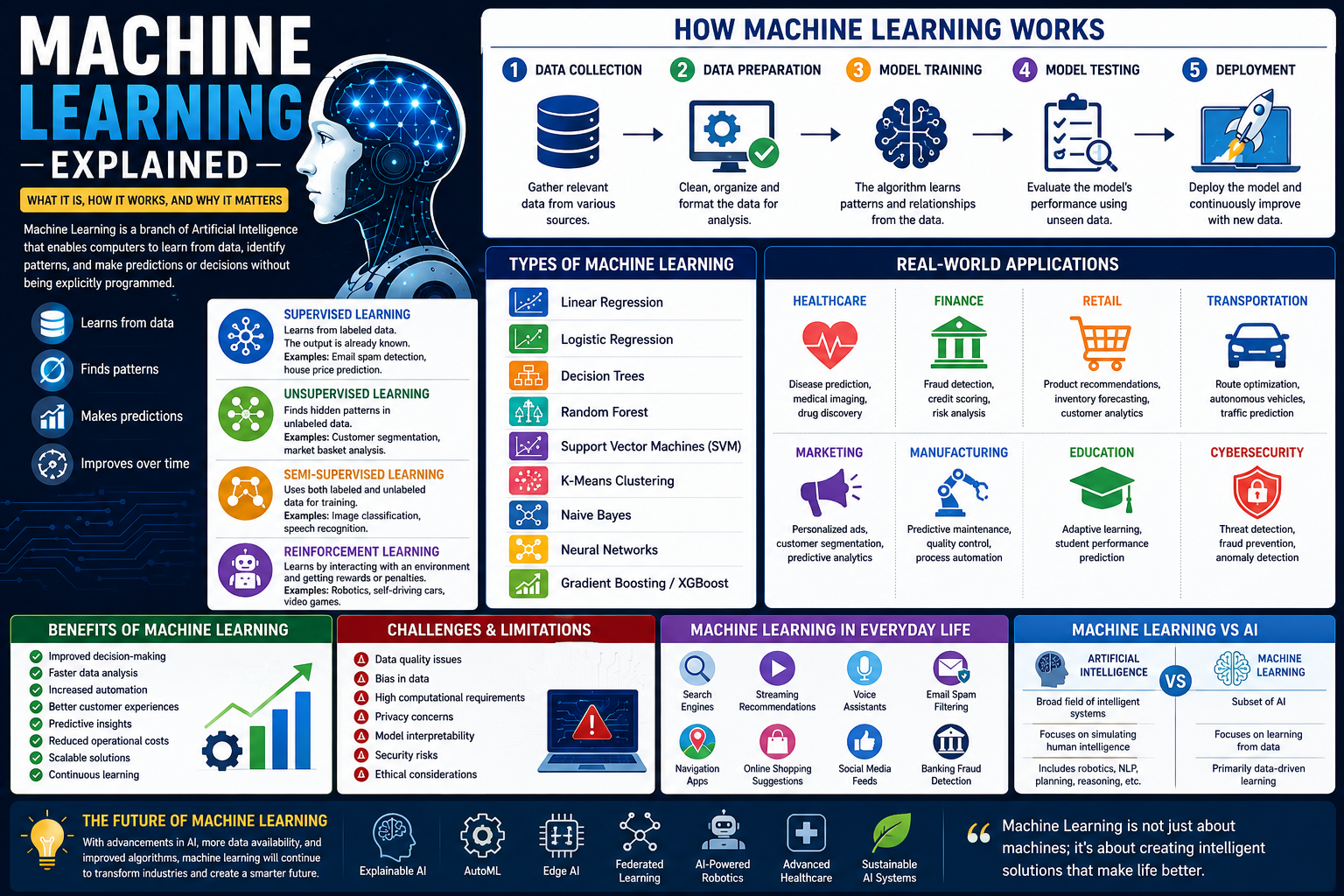
Machine Learning Explained: What It Is, How It Works, and Why It Matters
Introduction
Machine Learning (ML) is one of the fastest-growing fields in modern technology and a key branch of Artificial Intelligence (AI). It enables computers to learn from data, identify patterns, and make predictions or decisions without being explicitly programmed for every task.
From recommendation systems on streaming platforms to fraud detection in banking, medical diagnosis, autonomous vehicles, and predictive analytics, machine learning powers countless technologies that people use every day.
As organizations generate more data than ever before, machine learning has become an essential tool for improving efficiency, automating processes, and uncovering valuable insights.
What Is Machine Learning?
Machine Learning is a branch of Artificial Intelligence that allows computer systems to improve their performance by learning from data rather than relying solely on predefined programming.
Instead of following rigid instructions, ML models identify relationships within datasets and use those patterns to make predictions or classifications.
Machine learning is commonly used for:
Image recognition
Speech recognition
Fraud detection
Recommendation systems
Spam filtering
Medical diagnosis
Predictive analytics
Customer behavior analysis
How Machine Learning Works
Although machine learning models vary in complexity, the basic workflow follows several steps.
1. Data Collection
The process begins by gathering relevant data from various sources.
Examples include:
Customer records
Images
Videos
Sensor data
Website analytics
Financial transactions
2. Data Preparation
Raw data is cleaned and organized before training begins.
This stage may involve:
Removing duplicate records
Correcting errors
Handling missing values
Formatting data
Feature selection
Good data quality is essential for accurate results.
3. Model Training
The machine learning algorithm studies the prepared data and learns relationships between different variables.
The objective is to identify patterns that allow the model to make accurate predictions on new information.
4. Model Testing
The trained model is evaluated using separate data that it has not previously seen.
Testing helps measure:
Accuracy
Precision
Recall
Error rates
Generalization ability
5. Deployment and Continuous Improvement
After successful testing, the model is deployed into real-world applications where it continues to learn from new data and improve over time.
Types of Machine Learning
Machine learning is generally divided into four categories.
Supervised Learning
The algorithm learns using labeled data where the correct answers are already known.
Examples include:
Email spam detection
House price prediction
Customer churn prediction
Unsupervised Learning
The algorithm discovers hidden patterns without predefined labels.
Common applications include:
Customer segmentation
Market basket analysis
Pattern discovery
Semi-Supervised Learning
This approach combines small amounts of labeled data with larger amounts of unlabeled data.
It is commonly used when labeling large datasets is expensive or time-consuming.
Reinforcement Learning
The model learns by interacting with an environment and receiving rewards or penalties for its actions.
Examples include:
Robotics
Self-driving cars
Video game AI
Resource optimization
Machine Learning vs Artificial Intelligence
Although often used interchangeably, they are different concepts.
Artificial Intelligence
Machine Learning
Broad field of intelligent systems
Subset of AI
Focuses on simulating human intelligence
Focuses on learning from data
Includes robotics, NLP, planning, reasoning
Primarily data-driven learning
Every machine learning system is part of AI, but not every AI system relies on machine learning.
Common Machine Learning Algorithms
Popular algorithms include:
Linear Regression
Logistic Regression
Decision Trees
Random Forest
Support Vector Machines (SVM)
K-Means Clustering
Naive Bayes
Neural Networks
Gradient Boosting
XGBoost
Each algorithm is designed for specific types of problems.
Real-World Applications of Machine Learning
Machine learning powers innovation across industries.
Examples include:
Healthcare
Disease prediction
Medical imaging
Drug discovery
Finance
Fraud detection
Credit scoring
Risk analysis
Retail
Product recommendations
Inventory forecasting
Customer analytics
Transportation
Route optimization
Autonomous vehicles
Traffic prediction
Marketing
Personalized advertising
Customer segmentation
Predictive analytics
Benefits of Machine Learning
Machine learning provides significant advantages.
Benefits include:
Improved decision-making
Faster data analysis
Increased automation
Better customer experiences
Predictive insights
Reduced operational costs
Scalable solutions
Continuous learning
Organizations use ML to gain competitive advantages through smarter decision-making.
Challenges and Limitations
Despite its strengths, machine learning also presents challenges.
These include:
Data quality issues
Bias in datasets
High computational requirements
Privacy concerns
Model interpretability
Security risks
Ethical considerations
Responsible development and ongoing monitoring are essential.
Machine Learning in Everyday Life
Many people interact with machine learning every day.
Examples include:
Search engine rankings
Streaming recommendations
Voice assistants
Email spam filtering
Navigation apps
Online shopping suggestions
Social media feeds
Banking fraud detection
Machine learning has become an integral part of modern digital experiences.
Future of Machine Learning
Machine learning continues to evolve rapidly.
Emerging trends include:
Explainable AI
Automated Machine Learning (AutoML)
Edge AI
Federated Learning
AI-powered robotics
Advanced healthcare diagnostics
Sustainable AI systems
As data availability grows, machine learning will continue shaping innovation across industries.
Common Misconceptions
Some widespread myths include:
Machine learning is the same as AI.
ML works without data.
ML models are always accurate.
Only technology companies use ML.
Machine learning replaces all human decision-making.
In reality, successful machine learning systems require quality data, human oversight, and continuous improvement.
Final Thoughts
Machine Learning has become one of the most transformative technologies in the digital era. By enabling computers to learn from data and continuously improve, ML supports innovation across healthcare, finance, transportation, education, manufacturing, and countless other industries.
Whether you're a student, developer, business owner, or technology enthusiast, understanding machine learning provides valuable insight into how modern intelligent systems operate and how they will continue shaping the future.
Frequently Asked Questions
What is Machine Learning?
Machine Learning is a branch of Artificial Intelligence that enables computers to learn from data and improve performance without explicit programming for every task.
Is Machine Learning the same as Artificial Intelligence?
No. Machine Learning is a subset of Artificial Intelligence.
What industries use Machine Learning?
Healthcare, finance, retail, manufacturing, transportation, education, agriculture, cybersecurity, marketing, and many others.
Does Machine Learning require programming?
Developing machine learning models generally involves programming, mathematics, and data analysis, although many low-code tools are also available.
Why is Machine Learning important?
Machine Learning helps organizations automate processes, analyze large datasets, improve decision-making, and create intelligent digital products.
Comments (0)