
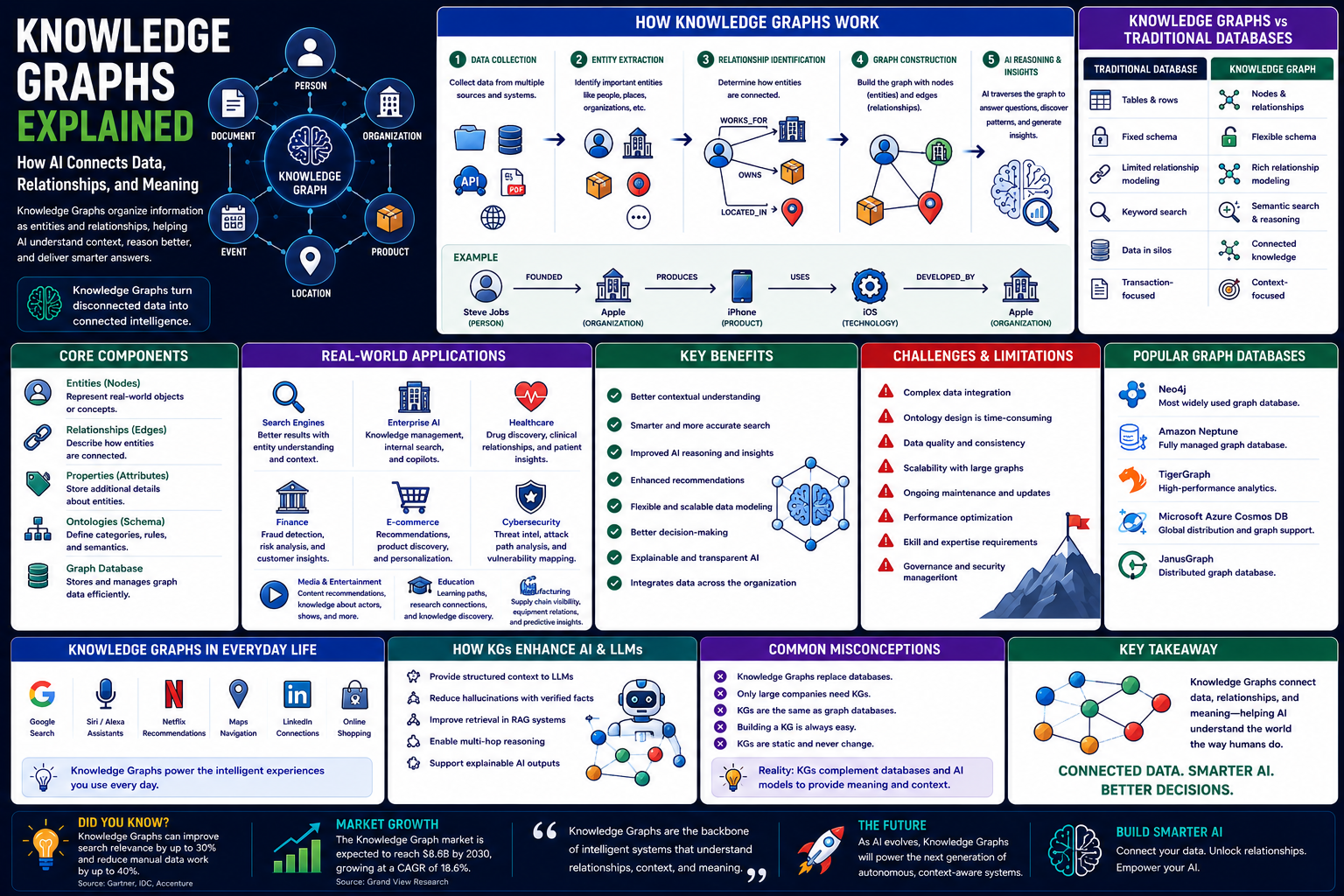
Knowledge Graphs Explained: How AI Connects Data,Relationships, and Meaning
Introduction
Artificial Intelligence is becoming increasingly capable of understanding language, generating content, answering questions, and automating complex tasks. However, many AI systems still need a reliable way to understand how people, places, organizations, products, and concepts are connected.
This is where Knowledge Graphs play a crucial role.
A Knowledge Graph organizes information into a network of entities and relationships, allowing AI systems to understand context instead of treating information as isolated pieces of data.
Rather than storing facts independently, Knowledge Graphs connect them to reveal meaning, relationships, dependencies, and patterns. This enables smarter search engines, enterprise AI assistants, recommendation systems, healthcare platforms, fraud detection, and intelligent business analytics.
As AI continues evolving, Knowledge Graphs are becoming an essential foundation for explainable, context-aware, and enterprise-ready Artificial Intelligence.
What Are Knowledge Graphs?
A Knowledge Graph is a structured representation of information where entities are connected through meaningful relationships.
An entity can represent:
A person
A company
A product
A location
A document
An event
A concept
An organization
Relationships describe how these entities are connected.
For example:
Steve Jobs → Founded → Apple
Apple → Produces → iPhone
iPhone → Uses → iOS
Instead of isolated records, AI understands an interconnected network of knowledge.
Why Knowledge Graphs Matter
Traditional databases store information efficiently but often lack context.
Knowledge Graphs allow AI to understand:
Relationships
Context
Dependencies
Hierarchies
Semantic meaning
Business knowledge
Organizational structures
Real-world connections
This improves search quality, reasoning, and decision-making.
How Knowledge Graphs Work
Most Knowledge Graph systems follow a structured workflow.
1. Data Collection
Information is gathered from multiple sources.
Examples include:
Databases
Documents
APIs
Websites
PDFs
Enterprise systems
CRM platforms
2. Entity Extraction
AI identifies important entities.
Examples:
Customers
Employees
Products
Companies
Cities
Diseases
3. Relationship Identification
The system determines how entities are connected.
Examples:
Works for
Owns
Located in
Purchased
Reports to
Treats
Belongs to
4. Graph Construction
Entities become nodes.
Relationships become edges connecting those nodes.
The graph grows continuously as new information becomes available.
5. AI Reasoning
AI traverses the graph to answer questions, discover hidden relationships, and make intelligent recommendations.
Core Components of a Knowledge Graph
Several elements work together.
Entities
Represent real-world objects or concepts.
Relationships
Describe connections between entities.
Properties
Store additional information about each entity.
Ontologies
Define categories, rules, and semantic meaning.
Graph Database
Stores interconnected information efficiently.
Knowledge Graphs vs Traditional Databases
Traditional Database
Knowledge Graph
Tables and rows
Nodes and relationships
Fixed schema
Flexible structure
Limited relationship modeling
Rich relationship modeling
Keyword retrieval
Semantic understanding
Transaction-focused
Context-focused
Knowledge Graphs excel at representing complex, interconnected information.
Real-World Applications
Knowledge Graphs power many AI solutions.
Search Engines
Better search results
Entity understanding
Semantic search
Enterprise AI
Knowledge management
Internal search
Business intelligence
Healthcare
Disease relationships
Drug interactions
Clinical research
Finance
Fraud detection
Risk analysis
Customer insights
E-commerce
Product recommendations
Customer personalization
Catalog organization
Cybersecurity
Threat intelligence
Attack path analysis
Security monitoring
Benefits of Knowledge Graphs
Knowledge Graphs provide numerous advantages.
Benefits include:
Better contextual understanding
Smarter search
Improved AI reasoning
Enhanced recommendations
Flexible data modeling
Better decision-making
Explainable AI
Enterprise knowledge integration
Organizations use Knowledge Graphs to create more intelligent AI systems.
Challenges and Limitations
Despite their advantages, Knowledge Graphs present challenges.
These include:
Complex data integration
Ontology design
Data consistency
Scalability
Maintenance effort
Graph complexity
Performance optimization
Governance requirements
Proper planning helps maximize long-term value.
Knowledge Graphs in Everyday Life
Many everyday technologies already use Knowledge Graphs.
Examples include:
Search engines
Digital assistants
Recommendation systems
Enterprise chatbots
Navigation applications
Healthcare platforms
Online shopping
Social networking
Knowledge Graphs quietly improve many AI-powered experiences.
Future of Knowledge Graphs
Future developments include:
AI-native knowledge graphs
Graph-powered AI agents
Better enterprise copilots
Real-time graph reasoning
Multimodal knowledge graphs
Scientific knowledge networks
Autonomous decision systems
Graph-enhanced Large Language Models
Knowledge Graphs will remain one of the most valuable foundations of enterprise AI.
Common Misconceptions
Several myths surround Knowledge Graphs.
Common misconceptions include:
Knowledge Graphs replace databases.
Graph databases and Knowledge Graphs are identical.
Only search engines use Knowledge Graphs.
Knowledge Graphs are only for large enterprises.
Knowledge Graphs eliminate the need for AI models.
In reality, Knowledge Graphs complement databases and AI models by providing structured context and relationships.
Final Thoughts
Knowledge Graphs are transforming Artificial Intelligence by helping systems understand relationships rather than isolated facts. By connecting entities through meaningful links, they enable smarter search, richer context, better recommendations, and more explainable AI.
As organizations continue building intelligent assistants, enterprise copilots, semantic search platforms, and autonomous AI systems, Knowledge Graphs will remain a critical technology for creating trustworthy, connected, and context-aware AI solutions.
Frequently Asked Questions
What is a Knowledge Graph?
A Knowledge Graph is a structured network of entities and relationships that enables AI systems to understand context and meaning.
Why are Knowledge Graphs important?
They improve semantic understanding, AI reasoning, search quality, and enterprise knowledge management.
Are Knowledge Graphs the same as graph databases?
No. A graph database stores graph data, while a Knowledge Graph combines structured relationships, semantics, and domain knowledge.
Where are Knowledge Graphs used?
Search engines, enterprise AI, healthcare, finance, cybersecurity, retail, education, and recommendation systems.
Do Knowledge Graphs work with Large Language Models?
Yes. Many modern AI systems combine Knowledge Graphs with LLMs to improve accuracy, reasoning, and explainability.
Comments (0)