Introduction
Search engine optimization is an essential part of building a successful website. Whether you manage a business website, publish blog articles, operate a WooCommerce store, or run a digital marketing agency, improving your online visibility requires continuous attention to content quality, keywords, technical SEO, structured data, internal links, and website performance.
As websites grow, managing these activities manually can become increasingly complicated. A business website may contain hundreds of service pages, a blog may have hundreds of articles, and an online store may manage thousands of product listings.
Each page needs appropriate metadata, relevant keywords, useful content, accurate structured data, and a clear technical structure.
Artificial intelligence can help simplify many of these repetitive SEO activities by providing content recommendations, generating metadata, identifying optimization opportunities, and supporting website-wide SEO workflows.
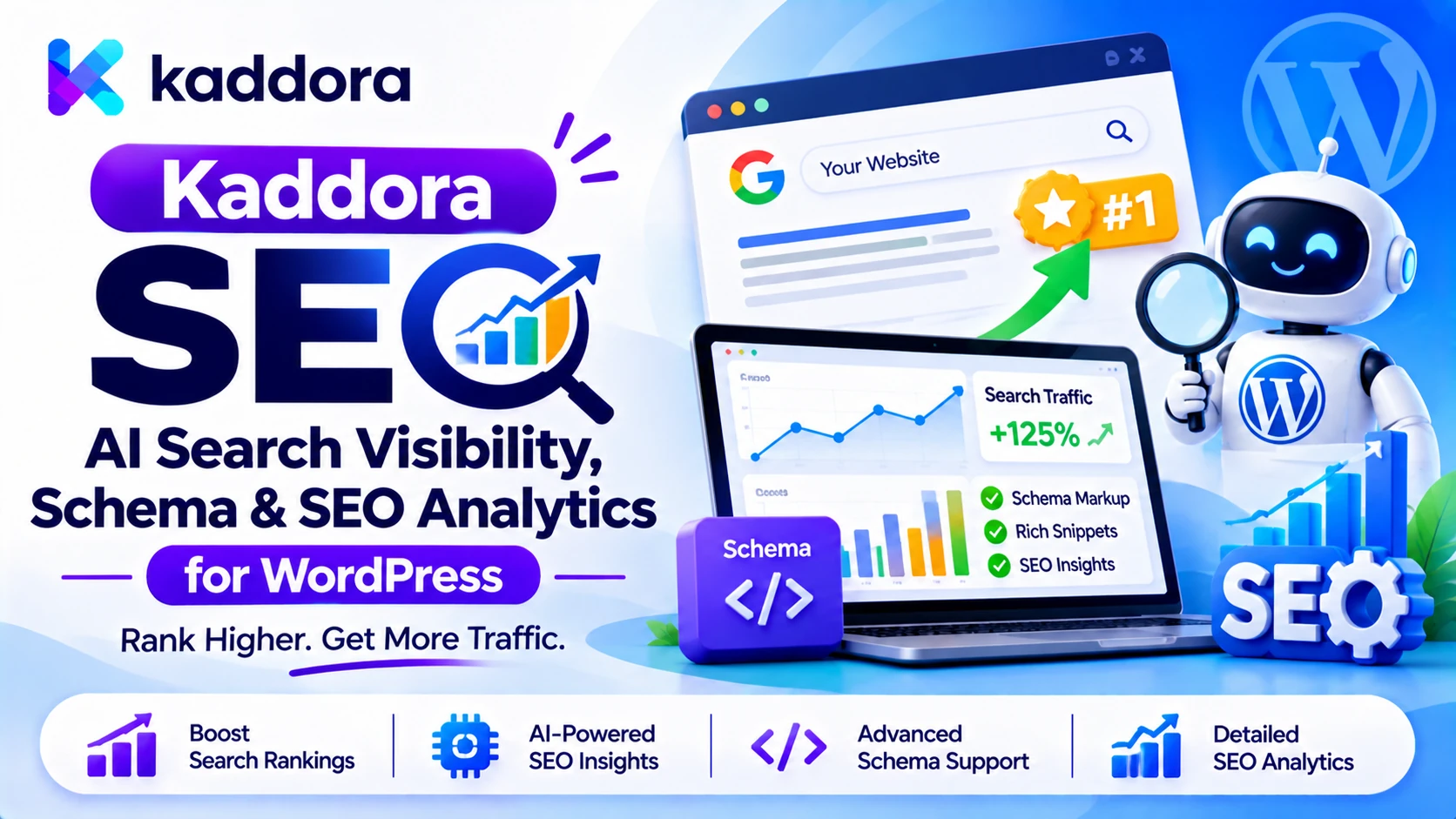
Introducing Kaddora SEO – AI Search Visibility, Schema & SEO Analytics, an AI-powered WordPress SEO solution designed to help website owners manage important search optimization activities through a centralized dashboard.
Built around the capabilities of Kaddora AI SEO Suite, the solution combines AI content analysis, keyword optimization, meta title and description generation, schema markup, XML sitemap management, internal linking recommendations, technical SEO tools, image SEO, WooCommerce optimization, and SEO reports.
Instead of managing every SEO activity through disconnected tools, website owners can organize multiple optimization tasks within one WordPress environment.
Whether you are a blogger, business owner, developer, SEO professional, agency, or eCommerce store administrator, Kaddora provides a practical toolkit for improving website SEO and managing search visibility.
Let's explore its capabilities and how it can support a more organized WordPress SEO strategy.
What Is Kaddora SEO?
Kaddora SEO is an AI-powered WordPress SEO solution designed to simplify website optimization through intelligent recommendations, automation, technical SEO tools, and performance-oriented reporting.
The solution brings multiple SEO activities together, allowing administrators to analyze content, manage keywords, generate metadata, implement schema, improve internal linking, and review technical optimization.
Its key areas include:
AI-powered content analysis.
Smart keyword recommendations.
AI-generated meta titles and descriptions.
SEO scoring and optimization suggestions.
Structured data and schema generation.
XML sitemap management.
Internal linking assistance.
Technical SEO management.
Image SEO optimization.
WooCommerce SEO tools.
Social media metadata.
Bulk SEO management.
SEO reports and analytics.
The goal is to make SEO management more structured and less dependent on repetitive manual work.
Kaddora SEO is suitable for individual websites as well as larger WordPress projects that need organized optimization workflows.
Improve AI Search Visibility With Better SEO Foundations
People increasingly use conversational search experiences to discover information, compare products, research services, and find answers to complex questions.
This makes content clarity, useful information, technical accessibility, and accurate website structure increasingly important.
AI-powered search systems can use content from websites when retrieving and presenting relevant information. However, appearing in an AI-generated answer is not guaranteed by using a particular SEO plugin or adding special markup.
Kaddora SEO helps improve several foundational areas that support search visibility.
Content clarity: Analyze readability, headings, keyword placement, and content structure.
Search intent: Identify relevant keywords and understand the type of information visitors are looking for.
Semantic relevance: Use related terms and topic connections naturally throughout content.
Structured information: Organize website information with appropriate schema markup.
Technical accessibility: Manage important elements such as robots.txt, canonical URLs, redirects, and indexing controls.
Internal discoverability: Identify relevant internal linking opportunities between related pages.
These activities help build an organized website that is easier for visitors and search systems to understand.
Rather than focusing on artificial AI-search tricks, a strong approach is to publish useful information, maintain accurate technical settings, and create clear relationships between website topics.
Analyze Website Content With AI
Content quality plays an important role in SEO.
An article may contain the correct keywords but still have structural problems, poor readability, missing information, or weak topical relevance.
Kaddora SEO includes an AI Content Analyzer designed to help identify opportunities for improvement.
Its content analysis capabilities include:
Readability analysis.
SEO content scoring.
Keyword placement suggestions.
Heading optimization.
Content structure recommendations.
Paragraph optimization.
Duplicate content detection.
AI writing assistance.
These capabilities can help content creators identify areas that deserve attention before publishing or updating an article.
For example, a blog article about WordPress security may require clearer section headings, better keyword placement, and additional explanations around specific security practices.
The content analyzer can support this review process through optimization suggestions.
AI recommendations should be treated as guidance rather than unquestionable instructions. Review important facts, preserve the original meaning, and make sure the final article provides genuine value to readers.
Discover Relevant Keywords and Search Intent
Keyword research helps website owners understand the language people use when searching for information.
However, successful keyword optimization requires more than repeating the same phrase throughout an article.
Kaddora SEO includes an AI Keyword Optimizer with features such as:
Focus Keyword Management: Assign a primary keyword to a page or article.
Multiple Keyword Support: Work with additional relevant keywords.
Keyword Density Analysis: Review the frequency of keyword usage.
Long-Tail Keyword Suggestions: Identify more specific search phrases.
Search Intent Recommendations: Understand whether users are seeking information, comparing options, or looking for a particular service.
Semantic Keyword Support: Identify related terms that help explain the topic more completely.
Related Keyword Suggestions: Discover additional relevant phrases for content planning.
For example, a website publishing an article about WordPress SEO may also target related concepts such as technical SEO, schema markup, XML sitemaps, and content optimization.
These supporting terms should be included naturally where they genuinely improve the article.
The objective is to create comprehensive content rather than force keywords into every paragraph.
Generate SEO Meta Titles and Descriptions
Meta titles and descriptions help communicate what a webpage contains.
They also influence how a page may be presented in search results, although search engines can choose different title links or snippets depending on the query and page content.
Writing unique metadata for every page can become time-consuming on larger websites.
Kaddora SEO includes AI-powered Meta Title and Meta Description Generators.
Its listed capabilities include:
AI-generated SEO titles.
AI-generated meta descriptions.
Character-length validation.
Pixel-width optimization.
Click-friendly suggestions.
Dynamic variables.
Template management.
Bulk optimization.
For example, an online store may have hundreds of product pages that require unique, descriptive metadata.
Instead of manually drafting every title and description, administrators can use generation and bulk optimization workflows as a starting point.
Before publishing, review each suggestion to ensure it accurately describes the page and does not contain misleading claims or unnecessary keyword repetition.
Good metadata should communicate the actual content rather than simply target a high-volume keyword.
Manage Structured Data With the Schema Generator
Structured data helps search engines understand the information presented on a webpage.
For example, an article page may contain information about its author, publication date, and publisher. A local business page may present its name, address, contact information, and opening hours.
Kaddora SEO includes a Schema Markup Generator designed to support different structured-data types.
Supported schema categories include:
Article Schema.
Blog Schema.
Organization Schema.
Website Schema.
Local Business Schema.
Product Schema.
FAQ Schema.
Breadcrumb Schema.
Review Schema.
Event Schema.
Person Schema.
Service Schema.
These schema types can support more structured website information when configured appropriately.
For example, a WooCommerce store can use relevant product information in its product structured data, while a local business website can organize its business identity and location details.
A useful workflow is:
Identify Page Type → Select Appropriate Schema → Generate or Configure Markup → Validate Structured Data → Review Visible Content → Publish
Accuracy is essential.
Schema must reflect the actual information visible to visitors. Do not add fabricated reviews, ratings, product prices, availability, or business information.
Valid structured data can make pages eligible for supported search enhancements, but it does not guarantee rich-result display or better rankings.
Generate and Manage XML Sitemaps
XML sitemaps help search engines discover important website URLs.
This becomes particularly useful for larger websites, blogs, business websites, and online stores with many pages and product listings.
Kaddora SEO includes an XML Sitemap Manager with support for:
XML sitemap generation.
Image sitemaps.
Video sitemaps.
News sitemaps.
Automatic updates.
Custom exclusions.
Priority settings.
Search engine compatibility.
Website owners can use sitemap management to organize URLs that should be available for discovery.
For example, an eCommerce website may need to manage product-related URLs while excluding unnecessary internal pages or duplicate content.
A good sitemap strategy should focus on canonical, indexable URLs that provide value to visitors.
Remember that sitemap inclusion does not guarantee that a search engine will crawl or index every URL.
Improve Website Navigation With Internal Linking
Internal links connect related pages within the same website.
They help visitors discover additional information and provide search engines with useful context about website structure.
Kaddora SEO includes an Internal Linking Assistant that helps identify linking opportunities.
Its listed capabilities include:
AI-Powered Link Suggestions: Discover related pages that may benefit from contextual links.
Smart Anchor Recommendations: Find descriptive anchor text for relevant internal links.
Related Content Suggestions: Identify articles or pages covering connected topics.
Link Opportunity Detection: Highlight possible connections between website content.
Content Organization: Support a clearer relationship between related topics.
For example, an article about WooCommerce security may link naturally to related articles about payment security, customer data protection, and order management.
Relevant internal links help visitors continue exploring the website without interrupting their reading experience.
Avoid adding links simply to increase link counts. Every internal link should be useful and contextually appropriate.
Improve Technical SEO With Centralized Tools
Technical SEO helps search engines access, understand, and process website content.
Even high-quality articles can experience visibility problems when important pages are inaccessible, incorrectly configured, or unnecessarily duplicated.
Kaddora SEO includes a Technical SEO Toolkit with several management capabilities.
Robots.txt Management
The robots.txt file provides instructions about crawling for compatible search engine crawlers.
Use it carefully to control crawler access to appropriate website areas.
Remember that robots.txt is not a reliable mechanism for preventing a page from being indexed or protecting private information.
Canonical URL Management
Canonical URLs help communicate the preferred version of a webpage when similar or duplicate URLs exist.
This can be useful for product variations, filtered pages, and other website structures that create multiple URL versions.
Meta Robots Control
Meta robots directives help manage whether eligible pages should be indexed or followed.
Configure these settings carefully to avoid accidentally excluding important website content.
Redirect Management
Redirects help guide visitors and crawlers from outdated URLs to appropriate destinations.
A well-maintained redirect strategy can help prevent unnecessary broken links and preserve a more consistent website structure.
Crawl Optimization and SEO Diagnostics
Review technical settings, identify possible optimization issues, and maintain a better-organized website.
These tools bring important technical SEO activities into a centralized WordPress workflow.
Optimize Images for Search and Accessibility
Images are an important part of website content.
Product photographs, blog illustrations, service images, and infographics can improve the visitor experience when they are appropriately selected and described.
Kaddora SEO includes an Image SEO Optimizer with capabilities such as:
AI-generated ALT text.
Image title optimization.
Image description suggestions.
Filename recommendations.
Image metadata optimization.
Bulk image SEO.
Accessibility improvements.
For example, a photograph showing a WordPress website dashboard should have descriptive alternative text that explains its relevant content.
ALT text should describe meaningful visual information rather than contain an unnecessary list of keywords.
Decorative images may not need descriptive alternative text, while informative images should have suitable descriptions.
AI-generated suggestions can reduce repetitive work, but review them to make sure they accurately represent the image.
Optimize WooCommerce Products and Categories
Online stores need consistent SEO management across products, categories, and shop pages.
A WooCommerce website may contain hundreds or thousands of products. Each listing can require a suitable title, description, keyword strategy, image information, and structured data.
Kaddora SEO includes WooCommerce SEO tools designed to support optimization of:
Product titles.
Product descriptions.
Product schema.
Category pages.
Shop pages.
Product images.
Product metadata.
Product keywords.
For example, a store selling digital products may have multiple product categories and individual product pages.
The plugin's optimization tools can help review product information and identify opportunities for better metadata and content presentation.
Ensure that AI-generated product descriptions preserve accurate specifications, compatibility information, prices, and product limitations.
Do not publish generated product claims without verification.
Improve Social Media Sharing Metadata
SEO is not the only consideration when publishing website content.
Businesses also share blog articles, products, service pages, and landing pages across social media platforms.
Kaddora SEO includes social metadata management with support for:
Open Graph tags.
Twitter Cards.
Social metadata.
Preview optimization.
Image sharing optimization.
Dynamic social content.
These features help control how supported social platforms interpret and display shared URLs.
For example, a blog article can use a suitable sharing title, description, and preview image instead of relying on automatically selected page content.
Review social previews before publishing important marketing pages and ensure that titles and descriptions accurately represent the shared destination.
Manage Local SEO Information
Local businesses need to communicate accurate information about their identity and location.
A business website may provide services within a particular city, region, or service area.
Kaddora SEO includes Local SEO features such as:
Business schema.
Contact information.
Address optimization.
Opening hours.
Maps integration.
Local search optimization.
These capabilities can help organize important local business information.
For example, a professional consulting company may need consistent business details across its website and local business listings.
Ensure that the business name, address, phone number, operating hours, and location information are accurate.
Do not create location pages for places where the business does not genuinely operate simply to target additional searches.
Monitor SEO Performance With the AI SEO Dashboard
SEO optimization is an ongoing process.
Website owners need to review which areas are optimized, identify technical problems, and determine where additional improvements are required.
Kaddora SEO provides a centralized AI SEO Score Dashboard with information including:
SEO score.
Optimization status.
Keyword analysis.
Content health.
Technical SEO overview.
Internal link statistics.
Metadata analysis.
AI recommendations.
The plugin also includes SEO Reports and Analytics covering SEO overviews, optimization reports, content analysis, technical SEO reports, keyword performance, internal linking reports, and metadata reports.
These reporting capabilities can help administrators understand the website's optimization status and prioritize improvements.
It is important to distinguish between an internal SEO score and actual search performance.
A plugin-generated score evaluates selected optimization criteria. It is not a direct guarantee of search rankings, traffic, or conversions.
For broader search performance measurement, website owners can use appropriate external analytics and search performance platforms alongside their WordPress SEO tools.
Automate Repetitive SEO Workflows
Managing a large website often requires repeating similar optimization tasks across multiple pages.
Kaddora SEO includes bulk SEO management and automation capabilities intended to reduce repetitive work.
Listed bulk operations include:
Bulk title generation.
Bulk meta descriptions.
Bulk ALT text generation.
Bulk schema generation.
Bulk keyword analysis.
Bulk SEO optimization.
Automation features also include scheduled scans, automatic metadata generation, AI optimization, sitemap updates, internal link recommendations, SEO monitoring, and content analysis.
For example, an administrator managing a large content website can use bulk workflows to identify pages that need metadata improvements.
A practical approach is to begin with a small group of pages, review generated suggestions, and then expand the process.
Maintain backups and review sensitive SEO changes before applying them across the entire website.
Developer-Friendly Features for Agencies and Advanced Users
SEO management becomes more complex when agencies and developers handle multiple websites.
Kaddora SEO includes developer-oriented features that can support more flexible workflows.
These include:
REST API Support: Provides an integration interface for supported SEO operations.
WP-CLI Compatibility: Supports command-line workflows for compatible management tasks.
Developer Hooks and Filters: Provide extension opportunities for compatible customizations.
White-Label Capability: Supports agency-oriented product presentation and branding requirements.
Multisite Compatibility: Provides support for WordPress Multisite environments.
Automation Support: Helps organize scheduled and repetitive optimization tasks.
These capabilities can be especially useful for developers managing business websites, client projects, and larger WordPress installations.
Always review the product documentation for the available API operations, CLI commands, hooks, and configuration requirements before integrating them into custom workflows.
How to Get Started With Kaddora SEO
Getting started with Kaddora SEO involves installing the plugin, configuring global preferences, and reviewing your website's existing SEO structure.
Install and Activate the Plugin
Download the Kaddora AI SEO Suite plugin ZIP package.
Log in to your WordPress administration dashboard.
Navigate to:
Plugins → Add New Plugin → Upload Plugin
Select the ZIP package, install it, and activate the plugin.
Open the Kaddora AI SEO Suite menu to access the available SEO tools.
Configure Global SEO Settings
Start by reviewing your website identity, SEO preferences, metadata settings, and other global configuration options.
Check existing SEO configurations before migrating from another plugin to avoid duplicate metadata or conflicting settings.
Configure AI SEO Features
Set up the available AI-powered optimization features according to your website requirements.
Review the relevant provider or service configuration where required.
Configure Schema and Sitemaps
Select relevant schema types and configure XML sitemap preferences.
Verify that structured data reflects the actual page content and that important URLs are included appropriately.
Optimize Important Website Pages
Start with your most important pages, blog articles, service pages, or WooCommerce products.
Use AI content analysis, keyword recommendations, metadata generation, and internal link suggestions to identify improvements.
Review SEO Analytics and Reports
Use the dashboard and reports to review optimization status, content health, metadata, and technical SEO information.
Build a regular review process instead of relying on a single optimization session.
Who Can Benefit From Kaddora SEO?
Kaddora SEO is designed for different types of WordPress website owners and professionals.
Bloggers and Content Creators: Analyze articles, improve metadata, organize keywords, and develop better internal linking.
Business Websites: Manage service-page SEO, local business information, structured data, and technical settings.
WooCommerce Stores: Optimize product information, category pages, images, metadata, and product schema.
SEO Agencies: Organize SEO workflows, reporting, and bulk optimization across client projects.
Digital Marketing Teams: Support content optimization, keyword planning, and website visibility activities.
Developers: Use REST API support, WP-CLI compatibility, hooks, and filters for supported custom workflows.
Educational Websites: Structure course-related content and optimize information pages.
News and Publishing Websites: Manage articles, metadata, sitemaps, and content optimization.
The centralized approach is especially useful for websites where SEO activities need to be performed regularly across many pages.
Why Choose Kaddora SEO?
Managing SEO through separate tools can make it difficult to maintain consistent optimization across a WordPress website.
Kaddora SEO combines several important SEO capabilities into one solution.
AI-Powered SEO Recommendations: Use intelligent suggestions to identify content and optimization opportunities.
Content Analyzer: Review readability, keyword placement, content structure, and SEO scoring.
Keyword Optimizer: Work with focus keywords, related phrases, semantic keywords, and search intent.
Meta Generator: Create and review SEO titles and descriptions with length and template management.
Schema Generator: Manage structured data for articles, products, businesses, services, and other supported content types.
XML Sitemap Manager: Organize website, image, video, and news sitemap configurations.
Internal Link Assistant: Discover contextual linking opportunities between related pages.
Technical SEO Toolkit: Manage canonical URLs, robots directives, redirects, and SEO diagnostics.
Image SEO Optimizer: Improve alternative text, titles, descriptions, and image metadata.
WooCommerce SEO: Support product, category, and shop-page optimization.
SEO Analytics and Reports: Review optimization status, keyword analysis, content health, and technical SEO information.
Automation and Developer Tools: Support bulk operations, scheduled scans, REST API, WP-CLI, and developer extensions.
Kaddora SEO brings these capabilities together to help website owners manage important SEO activities through a centralized WordPress workflow.
Best Practices for Better WordPress Search Visibility
Create useful and original content for your audience.
Assign relevant focus keywords to important pages.
Use semantic and related keywords naturally.
Write unique and accurate meta titles and descriptions.
Apply schema that matches visible page information.
Maintain clean XML sitemaps.
Review robots.txt and indexing directives carefully.
Use canonical URLs where appropriate.
Add meaningful internal links.
Write descriptive image ALT text.
Optimize WooCommerce product information.
Review technical SEO reports regularly.
Validate major SEO changes before publishing.
Monitor real search performance using suitable analytics tools.
Update content when business information or search intent changes.
Why Choose Kaddora?
Kaddora focuses on developing practical WordPress plugins, themes, HTML templates, and digital solutions that help businesses improve their online operations.
With Kaddora SEO, the objective is to simplify the way website owners manage search optimization by bringing AI-assisted content analysis, keyword recommendations, metadata generation, structured data, technical SEO, internal linking, and reporting into one WordPress solution.
ThemeKaddora develops tools that support bloggers, agencies, eCommerce businesses, developers, and website owners in managing their digital projects more effectively.
Whether you operate a content website, a business platform, an online store, or multiple client websites, Kaddora aims to provide useful tools for creating and maintaining a stronger SEO foundation.
Conclusion
Search visibility requires continuous attention to content quality, keywords, metadata, structured data, technical SEO, internal links, and website performance.
Kaddora SEO – AI Search Visibility, Schema & SEO Analytics brings these important activities together through an AI-powered WordPress optimization solution.
With its AI Content Analyzer, Keyword Optimizer, Meta Title and Description Generator, Schema Generator, XML Sitemap Manager, Internal Linking Assistant, Technical SEO Toolkit, Image SEO Optimizer, WooCommerce SEO tools, and SEO reporting capabilities, it provides a centralized approach to managing website optimization.
Whether you manage a blog, business website, WooCommerce store, agency portfolio, or a larger WordPress platform, Kaddora SEO can help organize repetitive SEO work and identify opportunities for improvement.
The best results come from combining AI-assisted recommendations with accurate information, useful content, proper technical implementation, and ongoing performance review.
Build a stronger SEO foundation and manage your WordPress search optimization more efficiently with Kaddora SEO.
Frequently Asked Questions
What is Kaddora SEO?
Kaddora SEO is an AI-powered WordPress SEO solution based on Kaddora AI SEO Suite. It combines content analysis, keyword optimization, metadata generation, schema markup, sitemap management, internal linking, technical SEO, image optimization, WooCommerce SEO, and reporting.
Can Kaddora SEO help improve AI search visibility?
It supports foundational SEO activities such as useful content analysis, semantic keyword optimization, structured data, internal linking, and technical SEO. These practices can help make website information clearer and more accessible, but the plugin cannot guarantee inclusion in AI-generated answers or citations.
Does Kaddora SEO generate schema markup?
Yes. Its Schema Generator supports Article, Blog, Organization, Website, Local Business, Product, FAQ, Breadcrumb, Review, Event, Person, and Service schema types. Generated markup should be checked for accuracy before publishing.
Can Kaddora SEO generate meta titles and descriptions?
Yes. It includes AI-generated meta title and meta description capabilities, along with character-length validation, pixel-width optimization, dynamic variables, templates, and bulk optimization.
Does Kaddora SEO support WooCommerce?
Yes. Its WooCommerce SEO tools support optimization of product titles, descriptions, product schema, category pages, shop pages, product images, metadata, and keywords.
Can I manage XML sitemaps and technical SEO with Kaddora?
Yes. The plugin includes XML sitemap management, image and video sitemap support, custom exclusions, robots.txt management, canonical URLs, meta robots controls, redirects, crawl optimization, and SEO diagnostics.
Does Kaddora SEO include analytics and bulk optimization?
Yes. Its dashboard provides SEO scores, optimization status, content health, keyword analysis, and technical SEO information. It also includes SEO reports and bulk operations for titles, descriptions, ALT text, schema, keywords, and other supported optimization tasks.
Why choose ThemeKaddora?
ThemeKaddora provides WordPress plugins, themes, HTML templates, and digital products designed around practical website and business requirements. Its approach emphasizes useful functionality, customizable solutions, and maintainable development.
Comments (0)