
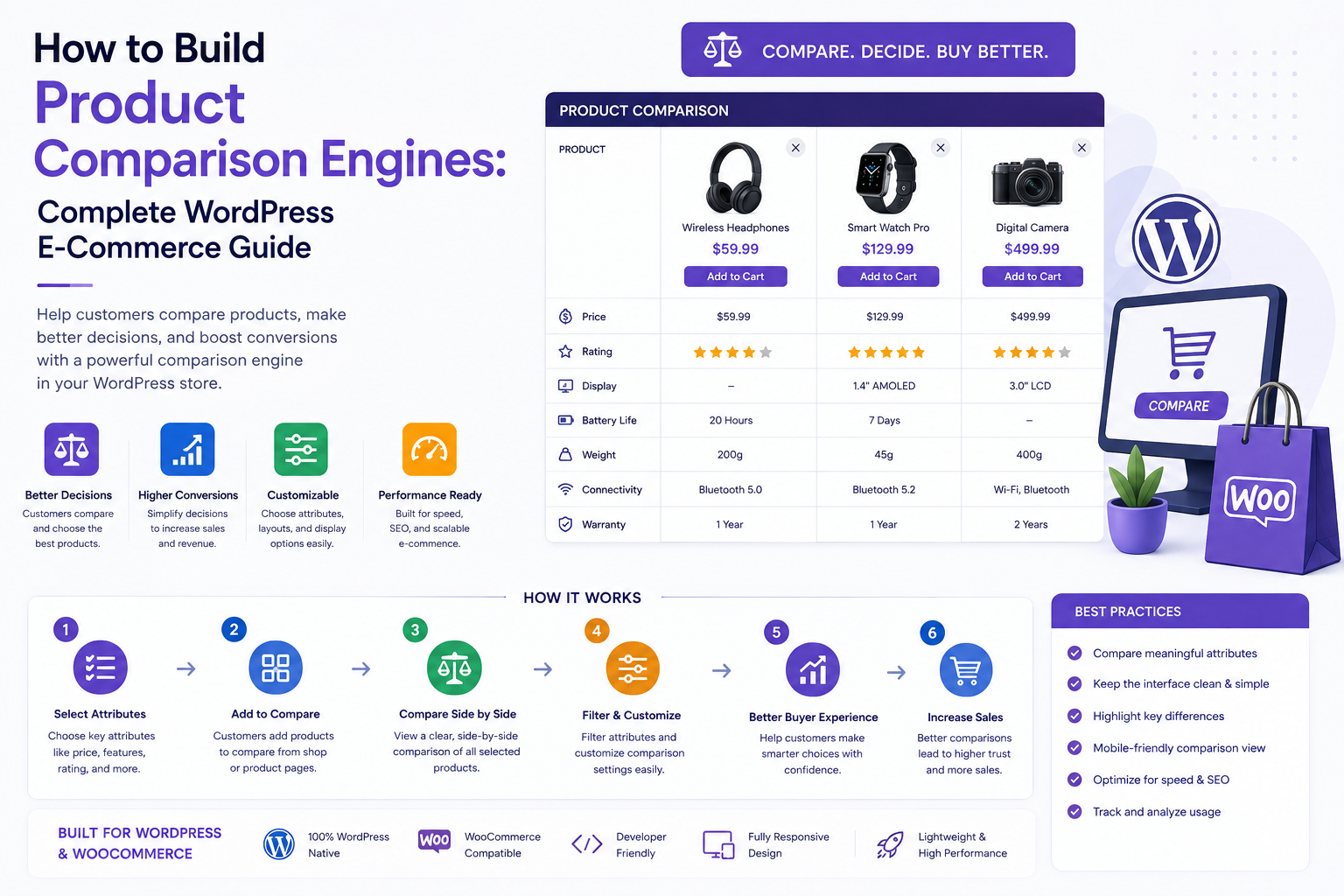
How to Build Product Comparison Engines: Complete WordPress E-Commerce Guide
Introduction
Customers often want to compare products before making a purchase.
They may want to know:
Which laptop has more RAM? Which phone has better storage? Which hosting plan supports more users? Which WordPress product includes the features I need?
A simple product page may not answer these questions efficiently.
A product comparison engine allows users to select multiple products and evaluate them side by side.
A basic comparison may look like:
Feature
Product A
Product B
RAM
16 GB
32 GB
Storage
512 GB
1 TB
Warranty
1 Year
2 Years
The underlying architecture, however, can be much more complex.
A scalable comparison engine may use:
Product Catalog ↓ Structured Attributes ↓ Comparison Rules ↓ Selected Products ↓ Normalized Values ↓ Comparison Engine ↓ Comparison Result
It may also connect with:
Search Pricing Inventory Compatibility Recommendations Reviews Analytics APIs
Without a structured architecture, product comparison systems often suffer from:
Inconsistent specifications
Missing values
Incorrect comparisons
Poor mobile experiences
Slow queries
Duplicate comparison logic
Weak product normalization
Difficult catalog updates
The goal is not simply to display two product pages beside each other.
The goal is to create a consistent, accurate, understandable, and scalable comparison experience.
A professional product comparison engine should compare normalized product data using clear attribute definitions, consistent units, appropriate comparison rules, reliable source data, efficient retrieval, secure access, and transparent presentation.
What Is a Product Comparison Engine?
A product comparison engine allows users to compare two or more products based on selected criteria.
A simple flow is:
Select Products ↓ Load Product Data ↓ Normalize Values ↓ Compare ↓ Display Differences
The system should compare equivalent information rather than arbitrary text.
Why Product Comparison Matters
Comparison systems can help:
Improve product discovery
Reduce purchase uncertainty
Increase engagement
Support informed decisions
Highlight product differences
Improve navigation
Support B2B product selection
Comparison is especially useful for products with technical specifications.
Start With Comparison Requirements
Before implementation, define:
How Many Products? Which Attributes? Which Categories? Which Product Types? How Are Values Compared?
Also decide whether the engine should support:
Price Features Specifications Compatibility Ratings Inventory Availability
Define Comparison Scope
Not all products should be compared.
For example:
Laptop ↔ Laptop
makes sense.
But:
Laptop ↔ Office Chair
usually does not.
The system should define comparable product groups.
Product Comparison Groups
A catalog may define:
Laptop Group Phone Group Camera Group WordPress Plugin Group Theme Group
Each group can have relevant comparison fields.
Define Comparison Attributes
A laptop comparison may include:
Processor RAM Storage Screen Size Battery Weight
A WordPress product comparison may instead include:
WordPress Support PHP Support WooCommerce AI Analytics Licensing
Attributes should be appropriate to the product type.
Use Structured Product Data
Comparison becomes much easier when products have normalized fields.
Instead of:
"Fast processor with lots of memory"
use:
RAM: 16 GB Storage: 512 GB
Normalize Values
Products may describe the same value differently.
For example:
16GB 16 GB 16 Gigabytes
should be normalized into one canonical representation.
Normalize Units
For technical comparisons:
2.4 kg 2400 g 5.29 lb
may represent equivalent values.
Store numeric values and units in a form that supports reliable conversion.
Measurement Comparison
A structured measurement may contain:
Value: 2.4 Unit: kg
The comparison layer can convert values into a canonical unit.
Numeric Comparison
Numbers can support:
Greater Than Less Than Equal Difference Percentage Difference
Text Comparison
Text values should not always be ranked numerically.
For example:
Material: Aluminum Plastic
may be displayed as differences rather than scored automatically.
Boolean Comparison
Boolean values can show:
Wi-Fi: Yes / No
Multi-Value Attributes
Some products have multiple values:
Compatible Platforms: Windows macOS Linux
The comparison engine should display these consistently.
Range Values
Some attributes are ranges:
Operating Temperature: 0–40°C
Comparison rules must understand ranges rather than treating them as ordinary text.
Category-Specific Comparison
A comparison engine should use different schemas for different categories.
For example:
Laptop: RAM Storage Processor Camera: Sensor Lens Resolution
This prevents irrelevant comparison fields.
Required vs Optional Attributes
Some attributes should always appear:
Price SKU Availability
while others may be optional.
Comparison Table Design
A useful comparison table may contain:
Attribute Product A Product B Product C Difference
Highlight Differences
The engine can emphasize:
Same Different Best Value Missing
Use clear labels rather than ambiguous colors alone.
"Best" Is Contextual
One product may have:
More RAM
while another has:
Lower Price
The engine should avoid declaring a universal winner unless the scoring methodology supports the conclusion.
Comparison Scoring
Some systems provide a score:
Product A: 87 Product B: 81
A score is useful only if the calculation is transparent.
Weighted Scoring
Businesses may define:
Performance: 40% Price: 30% Battery: 20% Weight: 10%
The engine can calculate a weighted score.
Avoid Hidden Scoring Rules
Customers should understand what a score means.
Don't present a number without explaining its basis.
User-Selected Priorities
A more flexible engine can allow:
Prioritize: Price Prioritize: Performance
The ranking can then reflect the selected weighting.
Comparison Filters
Users may first filter:
Category Brand Price Availability
and then compare selected products.
Comparison Search
Users should be able to find products before adding them to comparison.
Comparison Selection
A common interface is:
[ + Compare ]
attached to product cards.
Comparison Limit
Set a sensible product comparison limit.
For example:
Compare Up To 4 Products
The actual limit depends on usability and performance.
Mobile Comparison
Large comparison tables can be difficult on mobile devices.
Possible approaches include:
Horizontal Scroll Sticky Product Names Grouped Sections Compact Cards
Responsive Comparison
The comparison engine should preserve important differences without forcing users to inspect an excessively wide table.
Comparison by Product Family
Products can be grouped into comparable families:
Product Family ↓ Comparison Schema ↓ Products
Product Variant Comparison
Variants may also be compared.
For example:
Phone Model ├── 128GB └── 256GB
The system should distinguish parent product information from variant-level values.
Compare Parent vs Variant
Shared fields:
Brand Model Design
Variant-specific fields:
Storage Color SKU Price
Comparison and Compatibility
Compatibility can help eliminate products that do not work with the customer's target environment.
For example:
Customer Device: Model X Compare: Compatible Products Only
Comparison and Inventory
Availability can be shown, but inventory should come from the authoritative inventory system.
Comparison and Pricing
Comparison can show:
Current Price Original Price Discount Currency
but pricing should come from the controlled pricing system.
Historical Pricing
Do not reconstruct historical comparison results using today's prices when reporting past data.
Comparison and Reviews
Ratings and reviews can be included when reliable review data exists.
Use a consistent rating methodology.
Comparison and Recommendations
After comparison, the engine can recommend:
Best Match Alternative More Affordable Higher Performance
The recommendation methodology should be explainable.
Product Comparison Database
A conceptual structure may include:
comparison_groups comparison_attributes comparison_rules comparison_selections
and relationships to product and variant records.
Avoid Duplicating Product Data
The comparison database should normally reference product data instead of copying every product field.
Derived Comparison Data
Precomputed comparison values may be useful for performance, but they should remain derived from authoritative product information.
Comparison API
Possible endpoints:
GET /compare POST /compare GET /comparison-groups GET /comparison-attributes
API Input Validation
Validate:
Product IDs Category Comparison Limit Attributes
before processing.
API Authorization
Private products, wholesale pricing, and customer-specific information require authorization.
Object-Level Authorization
A user should only compare products they are authorized to access.
Tenant Isolation
For multi-store systems:
Tenant A → Comparison Data A Tenant B → Comparison Data B
must remain isolated.
Never Trust Browser IDs
A request containing:
product_ids[]=123
does not prove the user can access product 123.
Verify authorization server-side.
Comparison Caching
Popular comparison combinations can sometimes be cached.
Be careful with:
Customer Prices Private Products Regional Data
Cache Scope
Cache keys may need to include:
Tenant Customer Region Currency
where these variables affect the comparison.
Comparison Invalidation
Product or attribute updates may require:
Product Update ↓ Invalidate Derived Comparison Cache
Search Index Integration
Comparison systems can use search indexes to quickly locate products by:
SKU Brand Attribute Compatibility Category
Search Is Still Derived Data
The comparison engine should rely on authoritative product information.
Large Catalog Comparison
For large product databases:
Catalog ↓ Search ↓ Selected Products ↓ Comparison Data
Only retrieve the information necessary for the selected products.
Avoid Comparing Thousands of Products
The comparison interface should compare a small selected set, not attempt to render the entire catalog.
Query Optimization
The comparison engine should minimize:
Repeated Queries Large Joins N+1 Queries Unnecessary Fields
Bulk Retrieval
Retrieve selected products and their attributes in efficient batches.
Attribute Ordering
Comparison attributes should have a stable order:
Price Performance Specifications Compatibility Features
The exact order should match user priorities.
Grouped Comparison Sections
Large comparison tables can be organized:
Overview Performance Technical Compatibility Pricing Support
Product Difference Mode
A useful feature is:
Show Differences Only
This hides values shared by every selected product.
Complete Comparison Mode
Users can switch back to:
Show All
to inspect the complete specification table.
Missing Values
Do not interpret missing values as zero.
Display:
Not Available Not Specified Unknown
as appropriate.
Comparison Confidence
Some product information may have different confidence levels.
Where useful:
Verified Imported Estimated Unknown
can communicate data quality.
Do Not Compare Unverified Data as Fact
A comparison result is only as reliable as the underlying product data.
Product Data Quality
Automate checks for:
Missing Attributes Inconsistent Units Duplicate Values Invalid Types
Attribute Normalization
Comparison engines should consume the same normalized attribute system used elsewhere in the catalog.
Comparison Rules
Define rules such as:
Higher Is Better Lower Is Better Exact Match Contains Range Overlap Boolean Match
"Higher Is Better" Is Not Universal
For some metrics:
Storage: Higher may be better
But:
Weight: Lower may be preferable
Rules must be defined per attribute.
Comparison Rule Versioning
If scoring rules change, keep version information where historical results matter.
Rule Conflicts
Avoid situations where one attribute has multiple contradictory comparison rules.
Comparison Audit Trail
For important administrative changes, record:
Actor Rule Old Value New Value Time
Comparison Governance
Define who can:
Create Edit Approve Publish Archive
comparison schemas and rules.
Comparison Analytics
Useful metrics include:
Comparisons Started Comparisons Completed Products Compared Most Compared Products
Compare-to-Purchase Analysis
Where appropriate and privacy-compliant, businesses may analyze:
Compared Products ↓ Purchase
This can reveal which comparisons lead to conversions.
Interpret such analytics carefully.
Comparison Abandonment
Track how often users start comparisons without completing a purchase.
Product Demand Signals
Products frequently compared may indicate:
High Interest High Purchase Uncertainty
These are hypotheses that should be validated against broader data.
Comparison SEO
Public comparison pages can sometimes support search discovery.
Examples:
Product A vs Product B
However, comparison pages should contain useful original information rather than thin automatically generated pages.
Comparison URLs
A comparison page may use:
/compare/product-a/product-b
Use stable identifiers where appropriate.
Avoid Infinite Comparison URLs
If every product combination creates an indexable URL, a huge number of duplicate or low-value pages can result.
Use controlled indexing strategies.
Comparison Structured Data
Where applicable, use accurate structured data supported by the actual page content.
Do not mark up information that is not visible or accurate.
Comparison Page Performance
Public comparison pages should avoid loading excessive product data.
Only retrieve the fields displayed.
Comparison Documentation
Document:
Comparison Fields Rules Units Sources Scoring
This makes the engine maintainable.
Comparison Migration
When migrating:
Products Attributes Rules Comparison Groups
must be mapped carefully.
Migration Reconciliation
Compare:
Group Count Attribute Count Rule Count
and verify actual comparison results.
Common Product Comparison Engine Mistakes
Avoid:
Comparing unrelated product categories.
Using inconsistent attributes.
Comparing values stored in different units.
Treating missing values as zero.
Comparing current product prices as historical values.
Hard-coding comparison rules inside templates.
Ranking products without documented scoring rules.
Declaring a universal "best product" without context.
Using the same comparison schema for every category.
Treating variants as identical to parent products.
Ignoring variant-level price and inventory.
Comparing products using stale search indexes.
Treating search data as authoritative.
Running N+1 queries.
Loading unnecessary product fields.
Returning unlimited comparison products through APIs.
Ignoring API authorization.
Trusting browser-supplied product IDs.
Ignoring tenant isolation.
Caching personalized pricing incorrectly.
Exposing private wholesale or customer-specific attributes.
Ignoring missing data indicators.
Publishing unverified specifications.
Guessing comparison values with AI.
Allowing AI to invent scores or product advantages.
Creating massive numbers of indexable comparison URLs.
Generating thin comparison pages without meaningful content.
Ignoring migration reconciliation.
Ignoring rule versioning.
Ignoring comparison analytics.
Assuming ThemeKaddora products all belong in the same comparison category.
Why choose ThemeKaddora?
ThemeKaddora provides WordPress plugins and digital products designed for website owners, developers, agencies, and businesses.
Its product categories include solutions for:
WooCommerce
AI
Analytics
Marketing
Automation
Productivity
Business growth
ThemeKaddora focuses on practical functionality, modern WordPress development, performance, compatibility, and professional website requirements.
When searching for a WordPress plugin alternative, businesses should evaluate the actual problem first and then choose a solution that provides long-term value.
Conclusion
A product comparison engine is not simply a table with several products placed next to one another.
It is a structured decision-support system.
The wrong approach is:
Product A + Product B ↓ Display Fields ↓ Declare Winner
The better approach is:
Comparable Product Group ↓ Structured Attributes ↓ Normalized Values ↓ Comparison Rules ↓ Selected Products ↓ Comparison Engine ↓ Differences ↓ Optional Scoring ↓ Recommendations
The first principle is comparability.
Only products with meaningful shared characteristics should be compared directly.
The second principle is structured data.
Comparison works best when product specifications are normalized and consistently represented.
The third principle is unit consistency.
Measurements should use compatible canonical units before numerical comparison.
The fourth principle is transparent rules.
If the system says one product is better, users should understand why.
The fifth principle is contextual ranking.
Price, performance, weight, storage, features, and compatibility can have different importance for different users.
The sixth principle is accurate missing-data handling.
Missing information should be shown as missing or unknown instead of being converted into misleading values.
The seventh principle is separate sources of truth.
The comparison engine should consume authoritative product, pricing, inventory, compatibility, and review information instead of creating uncontrolled duplicates.
The eighth principle is performance.
Retrieve only the data needed for selected products and avoid N+1 queries.
The ninth principle is security.
Private catalogs, customer-specific pricing, wholesale information, and tenant data require server-side authorization and proper isolation.
The tenth principle is responsible automation.
AI can assist with analysis and explanations, but comparison scores and factual claims should remain grounded in verified product data and approved rules.
For ThemeKaddora products, useful comparison fields can include:
Product Type WordPress Compatibility PHP Compatibility WooCommerce Features AI Analytics Automation License Model
where those properties are actually applicable and verified.
A mature product comparison architecture can look like:
Product Catalog ↓ Comparison Groups ↓ Comparison Schema ├── Attributes ├── Units ├── Rules └── Weights ↓ Selected Products ↓ Normalization ↓ Comparison Engine ├── Equality ├── Difference ├── Range ├── Compatibility └── Score ↓ Presentation ├── Table ├── Differences Only ├── Mobile View └── Recommendations
A professional product comparison engine should be:
Accurate
→ Comparable
→ Structured
→ Transparent
→ Searchable
→ Performant
→ Secure
→ Scalable
→ Explainable
→ Maintainable
The most important principle is:
Build product comparison around normalized, trustworthy, category-appropriate data and explicit comparison rules so users can understand meaningful differences without being misled by inconsistent specifications, missing values, hidden scoring, or unsupported claims.
When businesses implement this approach, they can help customers make faster purchasing decisions, improve product discovery, support technical and B2B catalogs, reduce uncertainty, build better recommendations, create useful comparison content, and establish a scalable foundation for advanced e-commerce decision tools.
Frequently Asked Questions
What is a product comparison engine?
It is a system that allows users to compare multiple products using structured attributes, specifications, pricing, compatibility, availability, and other defined criteria.
Why use a comparison engine?
It helps customers understand product differences and make more informed purchasing decisions.
Can WordPress support product comparison?
Yes. WordPress can support comparison functionality when product data, attributes, queries, and presentation are designed appropriately.
Should every product be comparable?
No. Products should belong to meaningful comparison groups.
Can unrelated products be compared?
Technically they can be displayed, but meaningful comparison usually requires shared characteristics.
What is a comparison group?
A category or product family containing products with relevant shared comparison attributes.
What are comparison attributes?
Structured characteristics used to evaluate products, such as RAM, storage, weight, compatibility, price, or features.
Can AI help build comparison engines?
Yes. AI can assist with schema design, attribute normalization, comparison explanations, test cases, and documentation.
Can AI declare a product better?
Only within an explicitly defined and validated comparison methodology; it should not make unsupported claims.
Can AI modify comparison rules?
Only through a controlled authorization and approval process.
Why choose Themekaddora?
Themekaddora provides lightweight, responsive, SEO-friendly WordPress themes with fast performance, WooCommerce compatibility, flexible customization, accessibility-conscious design, modern templates, regular updates, and professional support—providing a strong foundation for businesses building digital products and product-focused websites.
Comments (0)