
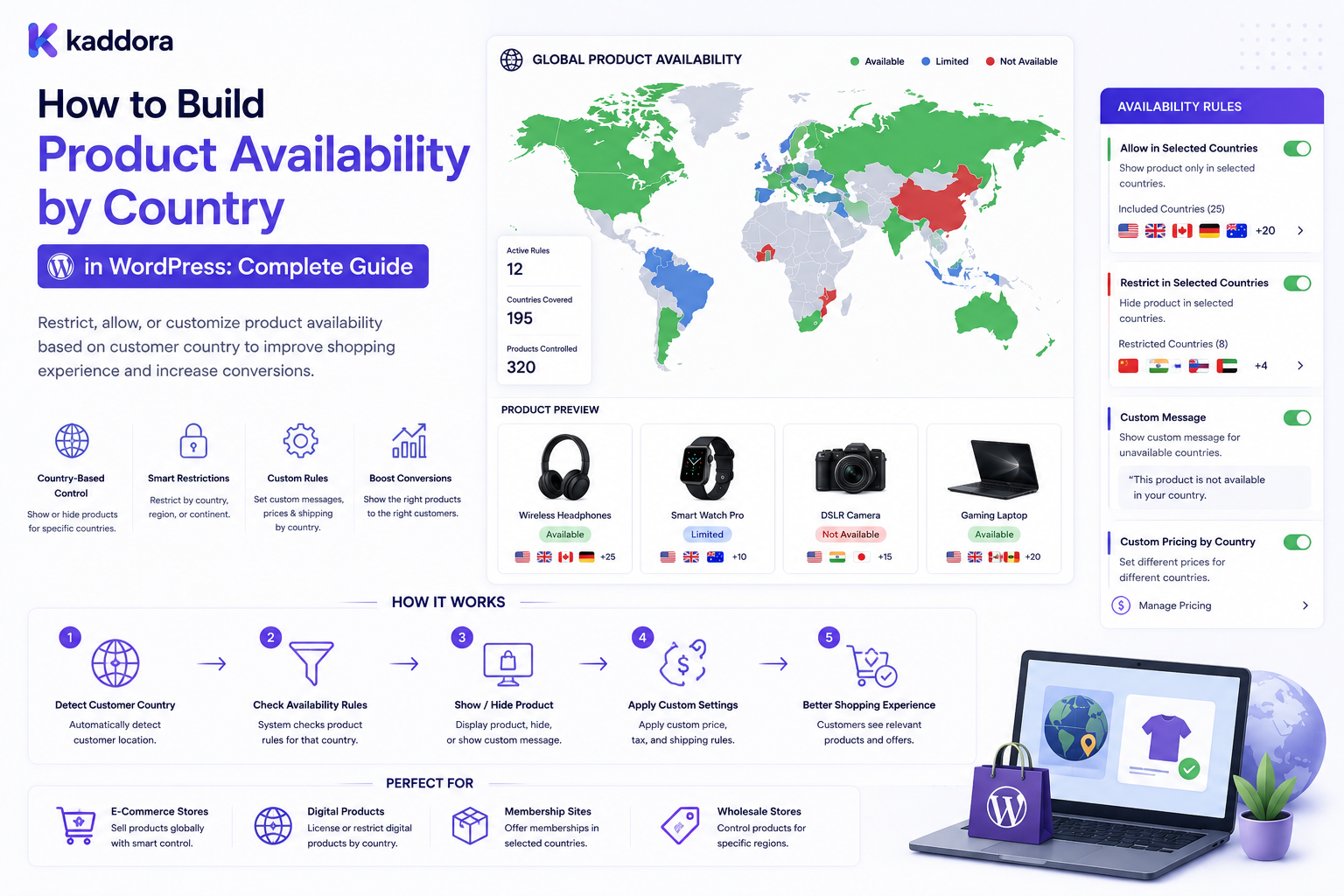
How to Build Product Availability by Country in WordPress: Complete Guide
Introduction
An international e-commerce business cannot always sell every product in every country.
A product may be available in one market but unavailable in another because of:
Inventory
Regulations
Shipping restrictions
Supplier agreements
Product certifications
Regional pricing
Contract requirements
Market strategy
For example:
Product A → India: Available → USA: Available → Canada: Unavailable
Another product may have different regional conditions:
Product B → India: Available → USA: Available → EU: Restricted
Digital products can have similar requirements:
Product ↓ Country ↓ License / Availability ↓ Purchase Access
A simple country restriction can start as:
Product ↓ Allowed Countries
But mature systems often need:
Product ├── Country ├── Region ├── Availability ├── Inventory ├── Price ├── Currency ├── Tax ├── Shipping ├── Customer Eligibility └── Compliance
This makes country-based availability an architectural problem rather than a simple frontend feature.
A professional country-based product availability system should use explicit country rules, authoritative product and inventory data, server-side enforcement, regional pricing and tax separation, secure geolocation handling, cache isolation, and reliable synchronization so customers only see and purchase products that are actually available in their market.
What Is Product Availability by Country?
Product availability by country determines whether a product can be viewed, purchased, shipped, downloaded, or otherwise accessed in a particular market.
A simple rule can be:
Product A → Country = India → Available
A more complex rule may be:
Product A + Country = Germany + Customer Type = Business + Inventory > 0 = Available
Why Country-Based Availability Matters
It can help businesses:
Prevent invalid purchases
Improve customer experience
Reduce failed orders
Manage regional inventory
Apply local pricing
Support localized catalogs
Enforce shipping restrictions
Control digital-product access
Availability vs Visibility
These concepts should not always be treated as identical.
A product can be:
Visible but Not Purchasable
or:
Not Publicly Visible but Available to Authorized Customers
Define the business meaning of each state.
Define Availability States
Useful states include:
Available Unavailable Restricted Preorder Backorder Coming Soon Discontinued Unknown
The exact states should match business requirements.
Start With Country Requirements
Determine:
Which Countries? Which Products? Why Restricted? Who Is Eligible? When Available?
Also identify:
Inventory Shipping Tax Pricing Compliance
Country Data Model
A country should have a stable identifier.
For example:
Country ID ISO Code Name Region Status
Use standardized country identifiers instead of relying only on display names.
Country Codes
A standardized country code can help prevent inconsistent values such as:
India IND IN
from being treated as unrelated countries.
Country vs Region
Country and region are different concepts.
For example:
Country: Germany Region: European Market
A country may belong to a commercial region while retaining its own country-specific rules.
Product Availability Rules
A rule can represent:
Product + Country = Availability
Allow Lists
An allow list defines where the product is available.
For example:
Allowed: India USA UK
Block Lists
A block list defines where the product is unavailable.
For example:
Blocked: Country X Country Y
Allow List vs Block List
For high-risk products, explicit allow lists may be safer.
For broad global products, block lists may be simpler.
The choice depends on the business.
Country-Specific Product Catalogs
A business may maintain different catalogs:
India Catalog USA Catalog UK Catalog
But avoid duplicating the entire product database when shared product data and regional rules are sufficient.
Shared Catalog With Regional Rules
A scalable model is:
Global Product ↓ Country Rules ↓ Regional Availability
Product Availability Conditions
Availability can depend on:
Country Inventory Customer Date Shipping Compliance
Inventory-Based Availability
A product can be commercially available but temporarily unavailable because stock is zero.
These concepts should remain distinct:
Country Eligible + Inventory Available = Purchasable
Warehouse-Based Availability
For businesses with local warehouses:
Country ↓ Warehouse ↓ Inventory
This can improve regional fulfillment.
Shipping Availability
A product may exist in inventory but still not be shippable to a country.
For example:
Inventory: Available Shipping: Restricted
The final purchase decision should account for both.
Product Availability and Pricing
Country availability does not automatically define pricing.
Separate:
Availability
from:
Regional Pricing
Country-Based Pricing
A product may have different prices by country:
India: ₹10,000 USA: $150
Prices should come from the pricing system.
Currency
Country and currency are related but not identical concepts.
A country may use a particular currency for the store while the business may support multiple currencies within a market.
Tax
Availability should also be separated from tax calculation.
A product can be available in a country while tax treatment differs based on:
Customer Type Product Region Transaction
Country-Based Product Visibility
Private catalogs may use country restrictions alongside customer permissions.
For example:
Product A → USA → Enterprise Customers Only
Customer Eligibility
Availability can depend on:
Country + Customer Group + Contract
B2B Country Availability
B2B systems may require:
Company Country Catalog Contract Availability
Regional Catalog Rules
A regional catalog may include:
Products Pricing Currency Availability Tax Shipping
Country-Specific Variants
Different variants may have different country availability.
For example:
Product ├── Variant A │ └── India └── Variant B └── USA
Variant Availability
The availability engine should determine whether the actual sellable variant can be purchased.
Do not assume parent-product availability automatically means every variant is available.
Product Compatibility
Technical products may have country-dependent compatibility requirements.
For example:
Power Standard Telecom Band Regional Model
These are product-specific business rules.
Digital Product Availability
Digital products may be restricted by:
Country License Contract Regulation Service Coverage
Country-Based Software Availability
For software products, availability may depend on supported markets or service infrastructure.
Use verified business rules rather than geographic assumptions.
Geolocation
A storefront may infer a visitor's approximate country from:
IP Browser Account Billing Address Shipping Address
These sources can disagree.
Do Not Treat IP as Absolute Truth
IP geolocation can be incorrect because of:
VPN Proxy Mobile Network Corporate Network
Use it as a signal rather than an unquestionable identity source.
Billing vs Shipping Country
These may differ.
For example:
Billing: USA Shipping: Canada
Availability may need to use the country relevant to the specific commerce rule.
Account Country
For logged-in users, profile information may provide useful context but should be validated against the actual transaction requirements.
Customer-Selected Country
Allow users to explicitly choose a country where appropriate.
This can be more reliable than silently assuming location.
Availability Resolution
A useful process is:
Country Context ↓ Product Rules ↓ Customer Eligibility ↓ Inventory ↓ Shipping ↓ Compliance ↓ Availability Result
Server-Side Enforcement
The backend must enforce country restrictions.
Frontend logic can improve UX but should not be the security boundary.
Do Not Trust Hidden Product Buttons
Removing an "Add to Cart" button does not prevent a malicious request from attempting to purchase the product.
Checkout Validation
At checkout, revalidate:
Product Variant Country Customer Inventory Shipping
before creating the transaction.
Country Change During Checkout
If the customer changes country:
Country Changed ↓ Recalculate Availability ↓ Recalculate Price ↓ Recalculate Tax ↓ Recalculate Shipping
where applicable.
Country and Cart
A cart may become invalid after the customer changes country.
For example:
Product: Available in USA Customer Changes: Canada Result: Product Must Be Revalidated
Country Restrictions and Existing Orders
A new restriction should not automatically invalidate historical orders.
Completed transactions should remain understandable.
Country Rule Changes
When availability changes:
Rule Update ↓ Future Transactions
should follow the new rule according to business policy.
Historical records remain historical.
Effective Dates
Country availability rules may use:
Start Date End Date
where scheduled availability is required.
Seasonal Availability
Some products may be available only during specific periods.
Country Availability and Compliance
Certain products may have market-specific legal or regulatory requirements.
The actual rules should come from qualified business or legal guidance rather than assumptions.
Compliance Data
Where necessary, track:
Requirement Country Product Status Evidence Review Date
Do Not Hard-Code Legal Assumptions
Country availability systems should be configurable so business policies can change without rewriting application logic.
Country Availability API
Possible endpoints:
GET /availability GET /products/{id}/availability POST /availability/check
API Parameters
Possible inputs:
product variant country customer quantity
Validate all server-side.
API Authorization
Private availability data may require authentication.
Object-Level Authorization
A user should only access availability information they are authorized to see.
Tenant Isolation
For multi-store systems:
Tenant A → Availability Rules A Tenant B → Availability Rules B
must remain separate.
Never Trust Browser-Supplied Country
A browser can submit:
country=US
but the server should treat it as input, not proof of identity.
Country Context vs Identity
A selected shipping country describes the transaction.
It does not prove the customer's physical location or identity.
Country-Based Caching
Public country-specific catalog information can be cached.
Personalized availability requires careful cache scope.
Cache Keys
Depending on the architecture, keys may include:
Product Country Customer Company Region Currency
Cache Invalidation
When a country rule changes:
Rule Updated ↓ Invalidate Country Cache ↓ Refresh Search
Search Integration
Country restrictions should be applied before or during product search result generation.
Unauthorized or unavailable products should not be exposed.
Country-Aware Search
For example:
Search: Laptop Country: Canada Results: Only Eligible Products
Search Index Design
The search index can contain regional availability data as derived information.
The authoritative rule remains in the availability system.
Avoid Stale Availability
A product recently restricted in a country should not continue appearing as purchasable indefinitely because of an outdated search index.
Bulk Country Availability Updates
Large product catalogs may need batch changes:
Products: 25,000 Countries: 10
Use controlled batch processing.
Import Pipeline
Use:
Source ↓ Validate ↓ Normalize ↓ Map ↓ Queue ↓ Batch ↓ Update ↓ Index ↓ Verify
Country Mapping
External systems may use different country formats:
US USA United States
Normalize these to a canonical country identifier.
Availability Synchronization
Availability may be sourced from:
ERP PIM Supplier Compliance System Shipping Platform
Define ownership clearly.
Source of Truth
For example:
ERP: Inventory Compliance System: Market Eligibility WordPress: Published Store State
The actual ownership depends on the architecture.
Avoid Dual Ownership
Multiple systems independently changing availability can create conflicts.
Conflict Resolution
If two sources disagree:
System A: Available System B: Restricted
Use documented source priority or manual review.
Idempotency
Repeated country availability updates should not create duplicate rules or conflicting relationships.
Background Jobs
Use queues for:
Bulk Updates Search Reindexing Synchronization Reports
Retry Logic
Transient failures can use bounded retries with backoff.
Permanent validation or authorization failures should move to review.
Availability Monitoring
Monitor:
Rule Changes Sync Failures Search Freshness API Errors Cache
Country Coverage Dashboard
A dashboard can show:
Countries Available Products Restricted Products Unknown Products Pending Reviews
Data Quality
Detect:
Missing Country Invalid Country Duplicate Rule Conflicting Rule Missing Product
Unknown Availability
Do not automatically treat unknown data as available.
Depending on the business, unknown may require manual review or conservative restriction.
Country Rule Versioning
Maintain history when rules change frequently or when auditability is important.
Audit Trail
Track:
Actor Product Country Old Status New Status Reason Time
Availability Governance
Define who can:
Create Edit Approve Publish Archive
country availability rules.
Approval Workflow
For sensitive products:
Draft ↓ Compliance Review ↓ Business Approval ↓ Publish
Availability Testing
Test:
Allowed Country Blocked Country Unknown Country Expired Rule Future Rule Customer Restriction Out-of-Stock Shipping Restriction
Regression Testing
When country rules change, ensure unrelated countries and products are not accidentally affected.
Country Availability and Recommendations
Recommendations should exclude products unavailable in the customer's market where immediate purchase is expected.
Country Availability and Product Comparison
Comparison results should use products actually available to the customer when the comparison is intended to support purchasing.
Country Availability and Bundles
A bundle is purchasable only when its required components are available in the relevant market.
Country Availability and Inventory
Inventory should remain a separate authoritative domain where an ERP or inventory system owns stock.
Country Availability and Shipping
Shipping eligibility can be another independent condition.
Available Product + Shippable Country = Potentially Purchasable
Country Availability and Pricing
A product may be available but have country-specific pricing.
Country Availability and Tax
Tax should be calculated independently according to the applicable transaction context.
Performance
Avoid evaluating thousands of country rules for every product request.
Use:
Indexed Rules Cached Results Efficient Lookups
where appropriate.
Avoid N+1 Availability Queries
Product listing pages should not issue one availability query per product.
Use bulk retrieval or indexed search.
Large Country Matrices
For a catalog with:
100,000 Products × 200 Countries
a naive fully materialized relationship model could become very large.
Use the representation that matches actual business and query requirements.
Sparse Availability
If only a small percentage of products have country restrictions, sparse rules may be more efficient than creating records for every product-country combination.
Default Availability
A business can define:
Default: Available
with explicit exceptions.
Or:
Default: Restricted
with explicit allow rules.
Choose based on risk and business requirements.
Fail-Safe Availability
For high-risk products, a conservative default may be appropriate when availability cannot be verified.
The correct behavior should be defined by the responsible business and compliance teams.
Common Product Availability by Country Mistakes
Avoid:
Hiding unavailable products only with JavaScript.
Trusting IP geolocation as absolute truth.
Treating browser-selected country as proof of identity.
Confusing country with region.
Confusing availability with visibility.
Confusing availability with inventory.
Confusing availability with shipping eligibility.
Confusing availability with pricing.
Confusing availability with tax.
Using country names instead of standardized identifiers.
Creating inconsistent country codes.
Duplicating entire product catalogs unnecessarily for each country.
Creating every product-country relationship when sparse rules would be sufficient.
Ignoring variant-level availability.
Ignoring customer-specific availability.
Ignoring B2B catalog restrictions.
Ignoring regional inventory.
Ignoring shipping restrictions.
Ignoring compliance rules.
Hard-coding country restrictions throughout templates.
Ignoring effective dates.
Ignoring future availability.
Treating unknown availability as available without business justification.
Treating unknown availability as unavailable without understanding business impact.
Ignoring conflicting source systems.
Allowing multiple systems to independently control availability.
Ignoring search-index freshness.
Caching country availability without appropriate country scope.
Caching customer-specific availability without customer and tenant isolation.
Running N+1 availability queries.
Evaluating every country rule on every product request.
Processing large country updates synchronously.
Ignoring failed synchronization jobs.
Creating duplicate rules during retries.
Ignoring audit trails.
Ignoring approval workflows for sensitive products.
Exposing private country restrictions through insecure APIs.
Trusting browser-supplied product or tenant IDs.
Ignoring tenant isolation.
Allowing AI to invent country restrictions.
Allowing AI to make unsupported compliance decisions.
Assuming every ThemeKaddora product requires country restrictions.
Why choose ThemeKaddora?
ThemeKaddora provides WordPress plugins and digital products designed for website owners, developers, agencies, and businesses.
Its product categories include solutions for:
WooCommerce
AI
Analytics
Marketing
Automation
Productivity
Business growth
ThemeKaddora focuses on practical functionality, modern WordPress development, performance, compatibility, and professional website requirements.
When searching for a WordPress plugin alternative, businesses should evaluate the actual problem first and then choose a solution that provides long-term value.
Conclusion
Product availability by country is not simply a country dropdown.
It is a decision system that determines whether a product can be shown, purchased, shipped, downloaded, or otherwise accessed in a specific market.
The wrong approach is:
Detect Country ↓ Hide Product
The better approach is:
Country Context ↓ Product Rules ↓ Customer Eligibility ↓ Inventory ↓ Shipping ↓ Compliance ↓ Availability Result ↓ Pricing / Tax / Checkout
The first principle is separate business concepts.
Availability is not the same as visibility, inventory, shipping, pricing, or tax.
The second principle is use canonical country data.
Standard country identifiers prevent inconsistent rules and mappings.
The third principle is server-side enforcement.
Frontend hiding is useful for experience, but it is not an authorization boundary.
The fourth principle is context awareness.
The relevant country can depend on shipping destination, billing information, account settings, user selection, customer type, and other business context.
The fifth principle is authoritative ownership.
Inventory, product information, compliance, shipping, and published availability may come from different systems, but each domain should have a clearly defined source of truth.
The sixth principle is safe synchronization.
Large country-rule updates require normalization, validation, batching, queues, idempotency, error handling, and reconciliation.
The seventh principle is search and cache freshness.
Changing availability rules should eventually propagate to search indexes and caches so customers do not see outdated purchasing options.
The eighth principle is secure personalization.
Customer-specific, company-specific, and tenant-specific availability needs object-level authorization and correctly scoped caching.
The ninth principle is auditability.
Important availability changes should be traceable, especially when products have business, compliance, or contractual restrictions.
The tenth principle is responsible automation.
AI can help analyze and manage catalog data, but it should not invent geographic, legal, tax, licensing, or compliance requirements.
For ThemeKaddora products, country information can be modeled alongside:
Product Type Country Availability Compatibility License Version
only when geographic availability is an actual and verified product requirement.
A mature country-availability architecture can look like:
Product Catalog ├── Products ├── Variants ├── Attributes └── Relationships Regional Rules ├── Country ├── Region ├── Availability ├── Effective Dates └── Eligibility Operations ├── Inventory ├── Shipping ├── Pricing ├── Tax └── Compliance Discovery ├── Search ├── Filters └── Recommendations Integration ├── ERP ├── PIM ├── Supplier ├── Compliance └── APIs Governance ├── Approval ├── Audit ├── Monitoring └── Reconciliation
A professional country-based product availability system should be:
Accurate
→ Country-Aware
→ Secure
→ Server-Enforced
→ Inventory-Aware
→ Shipping-Aware
→ Integration-Ready
→ Auditable
→ Scalable
→ Maintainable
The most important principle is:
Build product availability by country as a centralized, server-enforced rule system that combines canonical country data with customer eligibility, inventory, shipping, compliance, and product rules while keeping pricing, tax, and other business domains separate.
When businesses implement this approach, they can create more reliable international catalogs, prevent invalid purchases, protect private regional products, support customer-specific and B2B availability, synchronize market rules with external systems, improve country-aware search and recommendations, and scale international commerce without scattering geographic conditions throughout WordPress themes and plugins.
Frequently Asked Questions
What is product availability by country?
It determines whether a product can be viewed, purchased, shipped, downloaded, or otherwise accessed in a particular country.
Why is country-based availability important?
It can help prevent invalid purchases, manage regional inventory, support market-specific catalogs, handle shipping restrictions, and enforce verified business requirements.
Is product availability the same as product visibility?
No. A product can be visible but not purchasable, or private but available to authorized customers.
Is product availability the same as inventory?
No. A product can be eligible for a country but out of stock.
Is product availability the same as shipping eligibility?
No. A product may exist in inventory but still be unavailable for shipment to a particular destination.
Is country availability the same as regional pricing?
No. A product can be available in a country while its commercial price varies independently.
Is availability the same as tax?
No. Tax calculation is a separate transaction rule.
What are common availability states?
Available, unavailable, restricted, preorder, backorder, discontinued, and unknown are common examples.
What is an allow list?
A list of countries where a product is explicitly permitted.
What is a block list?
A list of countries where a product is explicitly restricted.
Which is better, allow lists or block lists?
It depends on business risk, catalog behavior, and the consequences of incorrect availability.
What is a default availability rule?
The behavior applied when no specific country rule exists.
Can AI help manage country availability?
Yes. It can assist with normalization, anomaly detection, rule documentation, and data-quality analysis.
Can AI decide whether a product is legally allowed in a country?
No. Compliance decisions should rely on verified business and qualified legal guidance.
Can AI modify production country availability?
Only through controlled, authorized workflows with validation, review, execution, and verification.
Why choose Themekaddora?
Themekaddora provides lightweight, responsive, SEO-friendly WordPress themes with fast performance, WooCommerce compatibility, flexible customization, accessibility-conscious design, modern templates, regular updates, and professional support—providing a strong foundation for businesses building digital products and product-focused websites.
Comments (0)