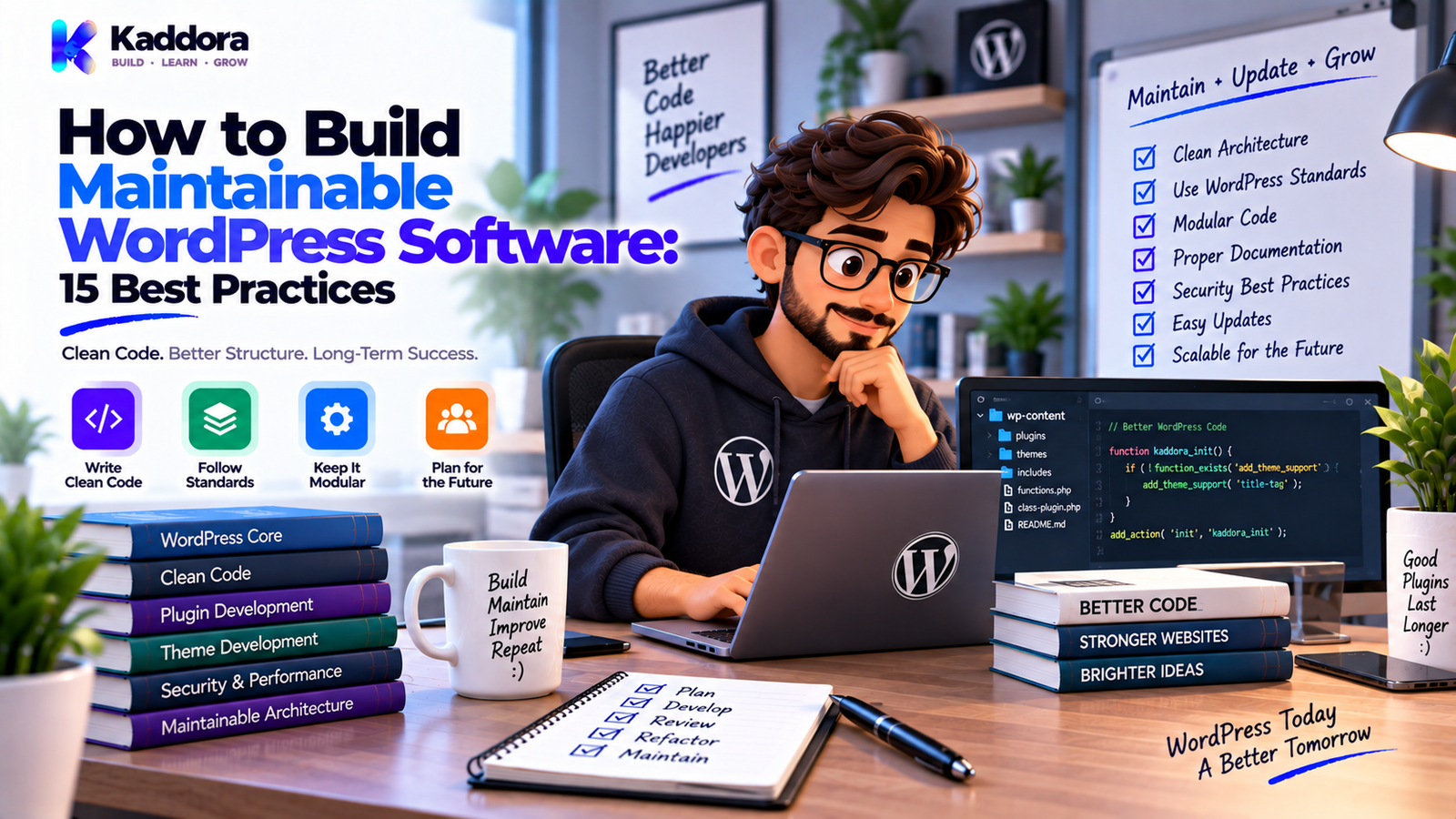
How to Build Maintainable WordPress Software: 15 Best Practices
Introduction
Building WordPress software that works today is only the beginning.
The real challenge is keeping that software reliable, understandable, secure, and easy to modify as the project grows.
A plugin may start as a small solution with a few settings and one feature. Months later, it may include:
Multiple admin screens
Database tables
REST APIs
AJAX handlers
Cron jobs
External API integrations
WooCommerce support
Logging
Notifications
Reporting
Custom business workflows
As functionality increases, code can become more difficult to manage.
Developers may add quick fixes, duplicate logic, tightly coupled components, or temporary workarounds. The software may continue to function, but every new change becomes more difficult and risky.
This is why maintainable WordPress software is so important.
Maintainability is not about having the largest number of classes or the most sophisticated architecture.
It is about creating software that developers can understand, test, debug, update, and extend without unnecessarily breaking unrelated functionality.
A practical maintainability strategy is:
Plan → Design → Build → Test → Document → Monitor → Improve
In this guide, you'll learn how to build maintainable WordPress plugins, themes, WooCommerce extensions, APIs, and business applications using practical development principles.
What Is Maintainable WordPress Software?
Maintainable WordPress software is software that can be changed safely and efficiently over time.
A maintainable plugin or theme should make it easier to:
Understand existing functionality
Fix bugs
Add features
Test changes
Update dependencies
Support new WordPress versions
Troubleshoot failures
Modify database structures
Hand the project to another developer
For example:
Feature Request ↓ Understand Existing Code ↓ Make Focused Change ↓ Run Tests ↓ Review ↓ Deploy
When architecture is unclear, even a small feature can affect multiple unrelated components.
Maintainability reduces unnecessary complexity.
Why Is Maintainability Important in WordPress?
WordPress software operates in highly variable environments.
A plugin can be installed alongside:
Different themes
Other plugins
WooCommerce
Page builders
Custom code
Different PHP versions
Different hosting environments
Different database sizes
Developers cannot assume that every installation is identical.
Maintainable software is easier to adapt to changing environments.
It also makes future development more predictable.
Maintainability vs Scalability
Maintainability and scalability are connected but different.
Maintainability
How easily can developers understand, test, modify, and repair the software?
Scalability
How well can the software handle growing users, traffic, data, or workload?
A system can be highly scalable but extremely difficult to maintain.
A small application can also be easy to maintain without requiring complex scaling architecture.
Good WordPress architecture should consider both without adding unnecessary complexity.
1. Define Clear Requirements
Many maintenance problems begin before coding starts.
Unclear requirements produce unclear implementations.
Before building a feature, define:
Purpose
Inputs
Outputs
Permissions
Dependencies
Database requirements
Failure conditions
Compatibility requirements
For example:
Feature: Product Synchronization Input WooCommerce product Process Validate → Transform → Send → Save Result Output Synchronization status
Clear requirements provide boundaries for implementation.
2. Follow Consistent Coding Standards
Consistent code is easier to read and review.
Use clear standards for:
Naming
Indentation
Formatting
Documentation
Hooks
Database queries
Internationalization
Security
For example:
$customer_id; $order_data; $sync_result;
are easier to understand than:
$x; $data2; $result;
WordPress-specific coding standards also make collaboration easier across development teams.
3. Give Each Component a Clear Responsibility
One of the biggest maintainability problems is code that does too many things.
A single function should not ideally be responsible for:
Validation Database API Email Reporting Logging
at the same time.
Instead:
Validator ↓ Service ↓ Repository ↓ API Client ↓ Notification
Each component has a clearer responsibility.
The goal is not to create a separate class for every operation.
The goal is to establish useful boundaries.
4. Use Modular Architecture
As WordPress software grows, divide it into logical areas.
A plugin might use:
kaddora-example/ ├── kaddora-example.php ├── includes/ │ ├── class-plugin.php │ ├── class-settings.php │ ├── class-service.php │ ├── class-repository.php │ └── class-logger.php ├── admin/ ├── public/ ├── integrations/ ├── cron/ ├── assets/ └── languages/
The exact folder structure should match the project's actual complexity.
The purpose of modularity is to make code easier to locate and understand.
5. Avoid One Giant Plugin File
A large plugin file may be convenient during initial development.
Over time, however, it becomes difficult to:
Find functionality
Test components
Review changes
Understand dependencies
Debug failures
Reuse logic
A better approach is to separate major responsibilities.
For example:
Main Plugin ↓ Bootstrap ↓ Admin Services Database API Integrations Cron Frontend
The entry file should primarily initialize the application rather than contain the entire application.
6. Use Namespaces and Unique Prefixes
WordPress websites often contain code from many vendors.
Generic names can create collisions.
Namespaces can help organize classes:
namespace Kaddora\Example; class Settings { }
Use unique prefixes for global identifiers such as:
KADDORA_EXAMPLE_VERSION
and:
kaddora_example_setting
Unique naming reduces conflicts with other plugins and themes.
7. Separate WordPress Hooks From Business Logic
WordPress hooks are part of the platform, but application logic doesn't need to live entirely inside hook callbacks.
Instead of:
add_action( 'save_post', function () { // Large business workflow. } );
use a focused callback:
add_action( 'save_post', array( $this, 'handle_save_post' ) ); public function handle_save_post( $post_id ) { return $this->content_service->process( $post_id ); }
The hook integrates with WordPress.
The service handles the business operation.
This makes testing and reuse easier.
8. Use Dependency Injection Where It Helps
Dependency injection can make components easier to test.
Example:
class Sync_Service { private $api_client; public function __construct( $api_client ) { $this->api_client = $api_client; } }
Now the service does not have to construct its API client internally.
During testing, a controlled client can be provided.
However, dependency injection should remain practical.
A simple constructor dependency is often enough.
You don't necessarily need a large dependency container or framework.
9. Make Error Handling Predictable
Maintainable software needs consistent failure handling.
WordPress commonly uses WP_Error for application-level errors.
Example:
$result = $service->process(); if ( is_wp_error( $result ) ) { return $result; }
Use meaningful error codes:
return new WP_Error( 'kaddora_sync_failed', __( 'The synchronization could not be completed.', 'kaddora-example' ) );
Good error handling makes code easier to:
Test
Debug
Log
Monitor
Maintain
User-facing messages should remain safe and understandable.
10. Build Security Into the Architecture
Security should be consistent throughout the application.
Maintainable WordPress software should apply appropriate:
Capability checks
Nonce validation
Input validation
Sanitization
Output escaping
Authentication
Authorization
Secure database queries
File handling controls
For example:
if ( ! current_user_can( 'manage_options' ) ) { return; }
Database queries should use appropriate preparation:
$row = $wpdb->get_row( $wpdb->prepare( "SELECT * FROM {$table_name} WHERE id = %d", $item_id ) );
Security controls should not be implemented in one place and forgotten elsewhere.
11. Design for Testing
Maintainability and testing are closely connected.
If code is difficult to test, future changes become more dangerous.
Important areas to test include:
Validation
Business logic
Database operations
REST endpoints
AJAX handlers
Cron jobs
Permissions
API integrations
WooCommerce workflows
A useful rule is:
Every important bug should become a regression test.
This helps prevent known problems from returning unnoticed.
12. Create a Clear Database Strategy
Database architecture has a direct impact on maintainability.
For custom tables:
Use a unique prefix
Define clear columns
Document indexes
Document relationships
Plan schema upgrades
Avoid unnecessary duplication
For example:
wp_kaddora_orders wp_kaddora_logs wp_kaddora_sync_queue
The exact names should follow the project's naming conventions and use the site's configured table prefix.
Database logic should have clear boundaries rather than being scattered throughout unrelated files.
13. Plan Database Migrations
A plugin should account for existing installations.
For example:
Version 1.0 ↓ Version 1.1 ↓ Schema Migration ↓ Version 1.2
A maintainable update strategy should consider:
Existing records
Existing settings
New columns
Removed columns
Index changes
Partial migration failure
Upgrade order
Never assume every user starts with a clean installation.
Fresh installation testing is not enough.
14. Maintain Clear Configuration
Configuration should be separated from application logic where practical.
Common environment-specific settings include:
API URLs
Debug options
Logging configuration
Feature flags
Timeouts
Integration settings
Avoid hard-coding secrets directly into source code.
A project may have:
Development ├── Debugging └── Test Services Staging ├── Controlled Logging └── Staging Services Production ├── Restricted Debugging └── Production Services
Clear environment configuration makes deployments more predictable.
15. Plan Compatibility From the Beginning
WordPress software can remain active for years.
Maintainability therefore requires a compatibility strategy.
Define supported:
WordPress versions
PHP versions
WooCommerce versions where applicable
Browser environments where relevant
External API versions
Before upgrading dependencies, test the environments that your software officially supports.
Avoid introducing newer platform requirements without updating the documented compatibility strategy.
Maintainable REST API Architecture
REST endpoints should remain focused.
A practical architecture is:
REST Request ↓ Permission Check ↓ Validation ↓ Service ↓ Persistence / API ↓ Response
Don't place all business logic inside a REST callback.
This makes the same functionality reusable from:
Admin screens
Cron jobs
CLI tools
REST APIs
AJAX requests
Maintainable AJAX Architecture
AJAX handlers should follow similar boundaries.
AJAX Request ↓ Nonce Validation ↓ Capability Check ↓ Input Validation ↓ Service ↓ Response
The handler should not become a giant block of business logic.
Security checks should happen on the server even when the user interface hides particular actions.
Maintainable Cron Architecture
Scheduled processes can become difficult to manage when too much logic is placed inside the scheduled callback.
A better structure is:
Cron Hook ↓ Job Runner ↓ Load Work ↓ Process Batch ↓ Handle Failures ↓ Log Result
This makes scheduled jobs easier to:
Test
Retry
Monitor
Debug
Batch processing can also help avoid unnecessarily large operations.
Maintainable API Integration Architecture
External APIs should have clear boundaries.
A useful model is:
Business Service ↓ API Client ↓ Authentication ↓ HTTP Request ↓ Response Validation
The business service defines the application operation.
The API client handles communication details.
This makes external integrations easier to change when providers modify their APIs.
Maintainable WooCommerce Architecture
WooCommerce projects can contain substantial business logic.
Consider separating responsibilities such as:
Product Service Order Service Customer Service Inventory Service Payment Integration Notification Service Reporting Service
Avoid placing all operations into one WooCommerce hook.
Important order states should also be tested individually.
For example:
Pending ↓ Processing ↓ Completed
and failure or exceptional states should also be considered.
Maintainable AI Integration Architecture
AI features often combine multiple responsibilities:
Prompt preparation
API requests
Authentication
Response parsing
Validation
Retry handling
Usage tracking
Error handling
Keep those responsibilities understandable.
For example:
AI Feature ↓ Request Builder ↓ AI Client ↓ Response Parser ↓ Business Service
This allows AI providers or implementation details to change without necessarily affecting the entire application.
Maintainable Logging Architecture
Logging should follow a consistent approach.
Useful log information can include:
Event
Level
Component
Request ID
Error code
Duration
Avoid scattering unrelated error_log() calls throughout the application.
A central logger makes future changes easier.
Never log:
Passwords
API keys
Authentication tokens
Sensitive payment information
Unnecessary private data
Logging should support troubleshooting without creating additional security risk.
Maintainable Front-End Architecture
Maintainability applies to CSS and JavaScript as well.
Avoid excessive:
Inline JavaScript
Duplicate styles
Global variables
Repeated event handlers
Unused assets
Use WordPress asset management:
wp_enqueue_script( 'kaddora-example-admin', plugin_dir_url( __FILE__ ) . 'assets/admin.js', array(), '1.0.0', true );
Keep styles and scripts organized according to their purpose.
Performance and Maintainability
Performance problems often increase maintenance complexity.
For example:
Inefficient Query ↓ Slow Page ↓ More Workarounds ↓ More Caching ↓ More Complexity
A maintainable system should investigate the real bottleneck before adding more complexity.
Review:
Database queries
API requests
Large loops
Asset loading
Caching
Background processing
Measure performance rather than assuming that a particular architectural change will automatically make the software faster.
Avoid Overengineering
One of the biggest maintainability mistakes is creating unnecessary complexity.
A small WordPress plugin may not need:
A large dependency container
Multiple abstraction layers
Custom event buses
A full internal framework
Dozens of interfaces
Complex design patterns
Architecture should match the actual project.
A simple solution that developers understand is often more maintainable than an elaborate system.
Manage Technical Debt
Technical debt can accumulate through:
Quick fixes
Duplicated code
Outdated dependencies
Temporary workarounds
Poor documentation
Unclear architecture
Use incremental improvements.
For example:
Identify Debt ↓ Prioritize ↓ Add Tests ↓ Refactor ↓ Review ↓ Repeat
Not every technical-debt item needs immediate attention.
Prioritize problems that repeatedly slow development or create reliability risk.
Documentation for Maintainable WordPress Projects
Documentation should explain how the project works.
Useful documentation includes:
Installation
How to install and activate the software.
Configuration
Which settings are required.
Architecture
How major components interact.
Development
How developers should modify the project.
Testing
How to run tests.
Deployment
How releases are prepared.
Troubleshooting
How common problems can be investigated.
A simple README can save significant development time.
Code Review for Maintainability
Code review should ask more than:
Does the feature work?
Also ask:
Is the code easy to understand?
Is the responsibility clear?
Are permissions correct?
Is input validated?
Is output escaped?
Is database access safe?
Are errors handled consistently?
Is the code testable?
Is the architecture unnecessarily complex?
Will another developer understand this later?
Code review is an important control for long-term quality.
Small Changes Are Easier to Maintain
Large changes increase risk.
Instead of:
New Feature + Large Refactor + Database Migration + UI Redesign
consider:
Feature ↓ Test ↓ Review Refactor ↓ Test ↓ Review Migration ↓ Test ↓ Review
Focused changes make failures easier to identify.
They also simplify code review and deployment.
Maintainable WordPress Development Workflow
A practical workflow is:
Plan → Design → Code → Test → Review → Document → Release → Monitor
Plan
Define requirements and risks.
Design
Choose appropriate module boundaries.
Code
Use consistent WordPress development practices.
Test
Run automated and manual tests.
Review
Check functionality, security, compatibility, and maintainability.
Document
Record important project decisions.
Release
Deploy using a controlled process.
Monitor
Observe production behavior.
Common Maintainability Mistakes
One Giant File
Large files become difficult to understand and modify.
Duplicate Business Logic
The same rule may need to be fixed in multiple locations.
Poor Naming
Unclear names force developers to read more code.
No Automated Tests
Future changes become much riskier.
Hard-Coded Configuration
Environment changes become difficult.
Scattered Database Logic
Data behavior becomes difficult to reason about.
Scattered Error Handling
Failures behave inconsistently.
Missing Documentation
Developers must reverse-engineer the project.
Overengineering
Complexity grows without delivering real maintenance value.
Ignoring Technical Debt
Small shortcuts can become significant long-term problems.
Maintainable WordPress Software Checklist
Architecture
Requirements are documented
Responsibilities are clearly separated
Modules have focused purposes
Business logic is organized
WordPress integration has clear boundaries
Naming is consistent
Security
Capabilities checked
Nonces validated
Input validated
Data sanitized
Output escaped
Database queries prepared
Sensitive information protected
Testing
Important business logic tested
Integration tests added where needed
Regression tests maintained
Security cases tested
Compatibility checked
Staging verification completed
Database
Custom tables documented
Indexes reviewed
Migrations planned
Existing installations considered
Backup and recovery understood
Operations
Error handling is consistent
Logging architecture exists
Cron jobs are documented
External integrations are documented
Configuration is environment-aware
Documentation
README available
Architecture documented
Testing documented
Deployment documented
Troubleshooting documented
How to Build Maintainable WordPress Software Step by Step
Step 1: Define Requirements
Understand exactly what the software needs to accomplish.
Step 2: Identify Responsibilities
Separate administration, business logic, APIs, database access, integrations, and front-end behavior.
Step 3: Create Practical Modules
Organize related functionality into clear components.
Step 4: Establish Coding Standards
Use consistent naming, formatting, documentation, and WordPress practices.
Step 5: Implement Security
Apply capabilities, nonces, validation, sanitization, escaping, and secure database access.
Step 6: Add Tests
Protect important behavior with automated and manual testing.
Step 7: Establish Error Handling and Logging
Make failures predictable and diagnosable.
Step 8: Document Important Architecture
Explain how the system works and why significant decisions were made.
Step 9: Define Compatibility
Document supported WordPress, PHP, WooCommerce, and external-service environments.
Step 10: Improve Incrementally
Use real maintenance problems and production evidence to guide future improvements.
When Should You Refactor WordPress Software?
Refactoring is useful when:
Functions are becoming too large
Responsibilities are mixed
Duplicate code is increasing
Tests are difficult to write
Bugs repeatedly appear in the same area
Developers struggle to understand the code
New features require risky changes
Don't refactor simply because code is old.
Refactor when the current structure is creating a real maintenance problem.
When Should You Consider Rewriting?
A rewrite is a much larger decision.
Consider the existing system's:
Business value
Technical limitations
Test coverage
Migration complexity
Compatibility requirements
Development cost
Data requirements
A rewrite can introduce new risks because proven behavior must be recreated.
In many situations, incremental refactoring is easier to control.
Maintainability and Version Control
Version control supports maintainability.
A useful workflow is:
Create Branch ↓ Make Focused Change ↓ Run Tests ↓ Code Review ↓ Merge
Keep commits focused enough that another developer can understand what changed and why.
Version control also makes rollback and investigation easier.
Maintainability and Deployment
Deployment should be predictable.
A practical flow is:
Local ↓ Automated Checks ↓ Staging ↓ Testing ↓ Review ↓ Production ↓ Monitoring
Avoid making large untracked changes directly on production.
Maintainable software is easier to deploy because its behavior, dependencies, and release process are better understood.
Why Choose ThemeKaddora?
ThemeKaddora develops WordPress themes, plugins, HTML templates, UI kits, SaaS solutions, and business-focused digital products.
Professional digital products benefit from:
Clean architecture
Secure development
Performance-conscious implementation
Responsive design
Compatibility planning
Testing
Documentation
Maintainable integrations
Whether software is built for WordPress websites, WooCommerce stores, AI tools, analytics, marketing, automation, or SaaS applications, maintainability helps the product evolve without unnecessary complexity.
When evaluating WordPress software, consider more than the visible feature list.
Look at how easily the product can be configured, tested, updated, integrated, and maintained over time.
Final Thoughts
Building maintainable WordPress software is about creating code that remains understandable as requirements evolve.
The most important principles are practical:
Define clear requirements.
Separate responsibilities.
Use modular architecture.
Follow consistent coding standards.
Build security into the design.
Write tests for important behavior.
Handle errors consistently.
Use useful logging.
Document important decisions.
Plan compatibility and upgrades.
Make incremental improvements.
Avoid both extremes.
Don't place the entire application inside one giant file.
But don't build a complex framework for a problem that requires only a few well-organized components.
Use the simplest architecture that properly solves the project's needs.
For a small plugin, a lightweight structure may be enough.
For large plugins, WooCommerce extensions, SaaS applications, AI integrations, and API-driven platforms, stronger modularity, testing, documentation, and monitoring become increasingly valuable.
The goal isn't to produce the most sophisticated architecture.
The goal is to build software that another developer can understand, test, modify, and trust.
Maintainability is not a task that happens at the end of development.
It is a quality that should be built into the software from the beginning.
Frequently Asked Questions
What is maintainable WordPress software?
Maintainable WordPress software is software that can be understood, tested, updated, repaired, and extended without unnecessary complexity or risk.
Why is maintainability important?
Maintainability makes future bug fixes, feature development, updates, testing, and troubleshooting easier.
How do I make a WordPress plugin maintainable?
Use clear architecture, focused responsibilities, secure coding practices, testing, documentation, predictable errors, and compatibility planning.
Should WordPress plugins use object-oriented programming?
Object-oriented programming can be useful for larger projects, but the architecture should match the actual complexity of the plugin.
Should every WordPress plugin use namespaces?
Namespaces can help organize larger object-oriented projects and reduce class-name collisions, but global identifiers should also use unique prefixes where appropriate.
What is technical debt?
Technical debt is future maintenance effort created by shortcuts, duplication, complexity, outdated code, or other decisions that make future changes harder.
How does testing improve maintainability?
Tests help developers change code with greater confidence because important existing behavior can be verified after modifications.
What should I document in a WordPress project?
Document installation, configuration, architecture, testing, deployment, database changes, integrations, and troubleshooting.
Should business logic be separated from WordPress hooks?
Where practical, yes. Separating WordPress integration from business logic can make the application easier to test and reuse.
How should database access be organized?
Keep database operations in clear boundaries, use appropriate $wpdb preparation, document custom tables, and plan schema changes carefully.
Should external API clients be separated from business logic?
This is often useful because transport behavior such as authentication, timeouts, and response handling can remain separate from application rules.
Should AI integrations use separate components?
For complex AI features, separating request preparation, API communication, response parsing, validation, and business logic can improve maintainability.
Why choose ThemeKaddora?
ThemeKaddora develops WordPress themes, plugins, HTML templates, UI kits, SaaS solutions, and digital products with attention to clean architecture, security, performance, compatibility, testing, responsive design, and long-term maintainability.
Comments (0)