
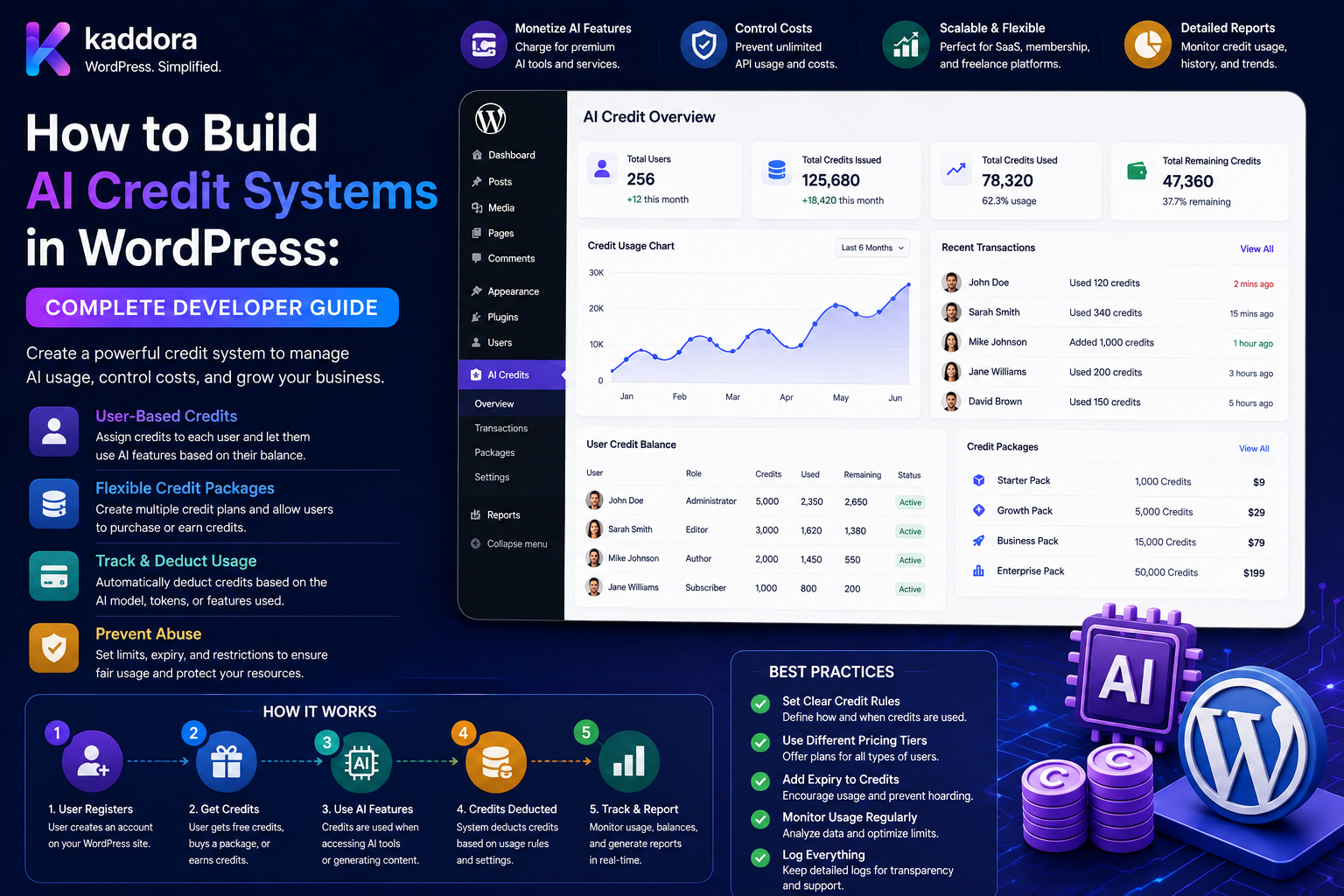
How to Build AI Credit Systems in WordPress: Complete Developer Guide
Introduction
AI-powered WordPress plugins often need a reliable way to control and measure how much AI processing users consume.
A simple request counter might work for a small plugin:
100 AI Requests
But different AI features can have very different costs.
For example:
Generate Short Title: 1 Credit Analyze Full Article: 5 Credits Process PDF: 20 Credits Advanced AI Workflow: 50 Credits
This is where an artificial intelligence AI credit system becomes useful.
Instead of exposing provider-specific billing details such as tokens or model charges, the plugin can give users an understandable usage unit:
AI Credits
The architecture can then map each feature or model to a credit cost.
A production system may contain:
User ↓ Plan ↓ Credit Balance ↓ Quota ↓ Credit Reservation ↓ AI Task ↓ Provider ↓ Actual Usage ↓ Credit Finalization ↓ Ledger
A robust credit platform should support:
Credit Grants Reservations Consumption Releases Refunds Expiration Rollover Usage Tracking Plan Limits Purchases Admin Adjustments Concurrency Audit Logs
The key principle is:
Treat AI credits as a server-controlled financial or quasi-financial resource with atomic accounting, explicit transaction states, clear expiration rules, and auditable changes.
What Is an AI Credit System?
An AI credit system is an application-level usage mechanism that converts AI activity into a controlled unit.
For example:
Simple AI Task: 1 Credit Document Analysis: 20 Credits Advanced Reasoning: 10 Credits
The exact values depend on:
Provider Cost Model Task Complexity Product Pricing Expected Usage
Credits are not the same thing as provider tokens.
AI Credits vs Tokens
Tokens
Tokens are typically units used by AI providers to measure model input and output usage.
AI Credits
Credits are an application-level abstraction.
For example:
10,000 Credits
may represent access to several different AI features.
The application decides what each feature consumes.
Why Use Credits?
Credits can:
Simplify billing
Hide provider complexity
Support multiple AI providers
Support different models
Create predictable plan limits
Enable feature-specific pricing
Support prepaid balances
Improve usage transparency
Credit System Architecture
A scalable system can use:
Credit Account ↓ Credit Ledger ↓ Usage Policy ↓ AI Task ↓ Cost Resolver ↓ AI Provider
Supporting components:
Reservations Refunds Expiration Audit Reporting
Credit Account
A user can have:
User: John Available: 5,000 Credits
But the balance should not be the only source of truth.
Use a ledger for transactions.
Credit Ledger
A ledger can contain:
Credit Granted Credit Reserved Credit Consumed Credit Released Credit Refunded Credit Expired Credit Adjusted
This provides traceability.
Why a Ledger Matters
Suppose a user reports:
"I had 1,000 credits yesterday. Why do I have 650 today?"
A ledger can explain:
Grant: 1,000 Consumed: 200 Reserved: 100 Refund: 50 Current: 750
Without transaction history, debugging becomes difficult.
Credit Balance vs Ledger Balance
The application can maintain a fast balance:
available_credits = 750
while the ledger stores:
All Transactions
For high-volume systems, this combination can provide both speed and auditability.
Credit Transaction Types
Define explicit transaction types:
grant reserve consume release refund expire adjustment purchase
Avoid ambiguous transaction names.
Credit Status
Transactions can use:
pending completed released failed reversed
according to the workflow.
Credit Grant
Credits can come from:
Subscription Purchase Promotion Administrator Referral Trial Bonus
Store the source.
Subscription Credits
A plan may provide:
Pro: 10,000 Credits / Cycle
At the start of a billing period:
Grant: 10,000
Purchased Credits
Users may purchase additional credits:
Extra Pack: 5,000 Credits
The ledger should record:
Source: Purchased
Promotional Credits
A campaign may grant:
Bonus: 1,000 Credits
Promotional credits can have different expiration rules.
Trial Credits
A trial account may receive:
500 Credits
with an expiration date.
Expiring Credits
Credits can have:
expires_at
This allows:
Monthly Credits: Expire at Cycle End
Credit Rollover
A product may allow unused credits to carry over.
Example:
Current: 2,000 Unused New Cycle: 10,000 Total: 12,000
Or rollover can be capped.
Rollover Limits
For example:
Maximum Rollover: 2,000 Credits
This prevents indefinite accumulation.
Credit Bucket Model
Instead of one balance, maintain buckets:
Included Credits Purchased Credits Bonus Credits
Each bucket can have different:
Expiration Priority Restrictions
Credit Consumption Priority
For example:
Use Expiring Credits First
then:
Use Purchased Credits
The rule should be deterministic.
Credit Cost Mapping
A feature can map to a credit cost:
seo_title: 1 Credit article_analysis: 5 Credits pdf_analysis: 20 Credits
Model-Based Credit Cost
Alternatively:
Efficient Model: 1 Credit Advanced Model: 5 Credits
The actual mapping should reflect current AI operating costs.
Task-Based Credit Cost
A more flexible system can calculate:
Task + Model + Input Size
to determine cost.
Dynamic Credit Costs
For example:
PDF: 1–10 Pages: 10 Credits 11–50 Pages: 30 Credits 51–100 Pages: 60 Credits
This is useful when processing cost varies significantly.
Input-Based Pricing
A task can estimate:
Input Size
before execution.
The plugin should clearly explain how credits are calculated.
Output-Based Pricing
If output size materially affects provider cost:
Generated Output
can contribute to actual usage accounting.
Estimated vs Actual Credits
A useful architecture distinguishes:
Estimated Credit Cost
from:
Actual Credit Usage
This is especially useful when provider usage becomes known only after execution.
Credit Reservation
Before starting an expensive job:
Check Balance ↓ Reserve Credits ↓ Execute
This prevents concurrent jobs from spending the same balance.
Why Reservation Matters
Suppose:
Balance: 100 Credits
Two requests each cost:
80 Credits
Without reservation:
Both see 100 → Both execute
The account overspends.
With atomic reservation:
Request A: Reserve 80 Request B: Only 20 Available → Rejected / Queued
Atomic Credit Reservation
Use a transaction-safe operation to:
Read Balance + Reserve Credits
as one logical operation.
Do not split this into unsafe independent steps.
Credit Reservation States
A reservation can use:
reserved consumed released expired
Reservation Expiration
If a worker crashes after reserving credits:
Reservation: 100 Worker: Dead
the reservation should eventually expire or be recovered.
Credit Finalization
After AI execution:
Estimated: 100 Actual: 65
the system can:
Consume: 65 Release: 35
according to the credit policy.
Fixed-Cost Credits
A simpler model can charge:
Task: 20 Credits
regardless of actual provider usage.
This is easier for customers to understand.
Variable-Cost Credits
A variable system can calculate:
Credits = Task Cost + Usage Cost
This can more closely track provider economics.
Hybrid Credit Model
For example:
Base Task: 5 Credits Large Input: +2 Credits Advanced Model: +5 Credits
This allows more precise cost allocation.
Credit Refunds
A failed operation may require:
Refund
But don't refund automatically for every error.
Define policies based on:
Provider Charge Failure Stage Customer Policy
Provider Failure
If:
Provider: Unavailable No AI Processing: Completed
a reserved amount may be released.
Partial Failure
If the provider processed the request but WordPress failed to save the result:
AI: Completed Database: Failed
the plugin should avoid running the AI request again unnecessarily.
Usage should be reconciled according to actual processing.
Retry and Credits
Suppose:
Attempt 1: Failed Attempt 2: Success
The application should define whether:
One Logical Task
consumes credits or each provider attempt is separately accounted for.
Logical Job Identity
Use:
job_id
to associate:
Retries Fallbacks Usage Result
with one logical operation.
Credit Accounting for Fallbacks
If:
Model A → Failure → Model B
decide whether the customer is charged:
One Task Cost
or:
Actual Provider Usage
The policy should be transparent.
Cache Hits and Credits
A cache hit may avoid provider usage:
Cache Hit → No AI Request
The business can decide whether this consumes credits.
Possible policy:
Cache Hit: 0 Credits
This can encourage efficient reuse.
Credit System and Caching
Only validated AI results should normally be treated as successful cached results.
The credit policy should be independent from cache correctness.
AI Credit API
A WordPress plugin may expose:
GET /ai/credits
returning information such as:
{ "available": 5000, "reserved": 250, "expires_at": "2026-09-15T00:00:00Z" }
The exact API contract depends on the application.
Credit API Security
Credit endpoints must enforce:
Authentication Authorization User Ownership Tenant Scope
Never allow a customer to change their own balance through a public request.
Purchase Credits API
A credit-purchase flow can be:
Checkout ↓ Payment ↓ Payment Confirmation ↓ Credit Grant
Do not grant purchased credits before payment confirmation according to the payment integration's reliable confirmation mechanism.
Payment Webhook Idempotency
If a payment provider sends:
payment.success
more than once, the plugin must not grant credits twice.
Use the provider's event ID or another idempotency mechanism.
Credit Purchase Audit
Record:
Payment ID Credit Amount Currency User Tenant Timestamp
where required.
Subscription Renewal Credits
A recurring plan may trigger:
Billing Renewal ↓ Grant Monthly Credits
This grant should be idempotent.
Prevent Duplicate Credit Grants
Store a unique reference such as:
subscription_cycle_id
to ensure one cycle cannot grant credits twice.
Credit Expiration Jobs
Expired credits can be processed through:
Scheduled Job ↓ Find Expired Buckets ↓ Expire Credits ↓ Create Ledger Entry
Avoid Silent Balance Changes
Every balance-changing operation should create a corresponding ledger record.
Manual Credit Adjustments
Administrators may need:
+500 Credits
or:
-200 Credits
These changes should require authorization and a reason.
Credit Adjustment Audit
Record:
Changed By Amount Reason Reference Timestamp
Admin Credit Dashboard
Show:
Total Credits Granted Total Consumed Active Balances Expired Credits Top Users Top Tenants
User Credit Dashboard
Show:
Available Reserved Used Purchased Bonus Expires
This makes consumption easier to understand.
Credit History
Display:
August 20: +1,000 Subscription August 21: -50 Document AI August 22: -5 SEO Analysis
Credit Balance Calculation
Conceptually:
Balance = Granted + Purchased + Bonus + Refunded − Consumed − Expired − Reserved
The actual accounting should be implemented from authoritative ledger/state transitions rather than recalculating ad hoc in multiple places.
Reserved Credits
Available credits should generally exclude active reservations.
For example:
Total: 1,000 Reserved: 200 Available: 800
This distinction is important for concurrency.
Negative Balances
Avoid negative balances unless the product intentionally supports controlled postpaid overage.
For prepaid systems:
Available: 0
should normally prevent further credit-consuming operations.
Grace Overage
A SaaS product may intentionally allow:
Credit: 0 Grace: 100
This should be an explicit commercial policy.
Credit Overdraft Risk
Never allow:
Balance: 10 Request: 100 Result: Balance: -90
unless the product explicitly supports overdraft billing.
Feature-Level Credit Policies
Examples:
SEO: 1 Credit Document: 20 Credits Chat: Variable
This prevents all features from using identical economics.
Model-Level Credit Policies
For example:
Efficient: 1 Advanced: 5
This enables cost-aware routing.
Plan-Level Credit Policies
For SaaS:
Free: 500 Credits Pro: 10,000 Enterprise: Custom
User-Level Credit Limits
Even within a plan:
Tenant: 100,000 User: 10,000
can limit individual consumption.
Tenant Credit Accounts
A company account can have:
Tenant Credits: 100,000
and allocate:
User A: 20,000 User B: 10,000
Parent-Child Credit Hierarchy
A robust system can support:
Platform ↓ Tenant ↓ Site ↓ User ↓ Feature
Each level can have limits.
Credit Reservation Across Hierarchy
A large task may need to reserve:
Tenant Budget + User Budget + Feature Budget
atomically.
Multi-Tenant Isolation
Never allow:
Tenant A
to consume:
Tenant B Credits
by changing a client-provided tenant ID.
Resolve ownership server-side.
Credit Ledger Database Design
A basic table could contain:
ai_credit_ledger ├── id ├── user_id ├── site_id ├── tenant_id ├── transaction_type ├── amount ├── reference_type ├── reference_id ├── status └── created_at
Credit Bucket Table
A separate table may store:
ai_credit_buckets ├── id ├── owner_id ├── source ├── original_amount ├── remaining_amount ├── expires_at └── priority
This is useful when different credit sources have different expiration rules.
Usage Table
Usage records can contain:
ai_usage ├── id ├── job_id ├── user_id ├── tenant_id ├── feature ├── model ├── provider ├── credits ├── input_usage ├── output_usage └── created_at
Credit and AI Usage Separation
Keep:
Credit Accounting
separate from:
AI Provider Usage
One describes product consumption; the other describes infrastructure usage.
Provider Cost Reconciliation
At the end of a billing period, compare:
Provider Cost vs Credits Consumed
This helps evaluate whether the credit economy is sustainable.
Unit Economics
For example:
AI Provider Cost: ₹20,000 Customer Credit Revenue: ₹50,000
The difference must cover:
Infrastructure Support Payment Fees Development Margin
The exact economics depend on the business model.
Credit Pricing
A product may sell:
1,000 Credits: ₹499 5,000 Credits: ₹1,999
Pricing should reflect expected AI costs and customer value.
Credit Consumption Rules
Write clear rules:
SEO Analysis: 1 Credit PDF: 20 Credits Cache Hit: 0 Credits Failed Provider Request: Release Reservation
This reduces billing disputes.
Credit Transparency
A user should be able to understand:
Why were credits consumed?
For important tasks, show the feature and credit amount.
Credit Calculation Preview
Before expensive tasks:
Estimated Cost: 20 Credits Current Balance: 150 After Reservation: 130
This improves user confidence.
Large AI Task Confirmation
For expensive operations:
Analyze 500 Documents Estimated Usage: 10,000 Credits
the UI can require confirmation.
Batch Credit Estimation
For:
1,000 Products × 2 Credits
estimate:
2,000 Credits
before queueing.
Partial Batch Consumption
If 950 jobs succeed and 50 fail:
Usage
should reflect the actual policy.
Do not blindly consume the estimated full amount if the product charges based on actual work.
Credit Refund for Cancellation
If a queued job has not started:
Cancel → Release Reservation
If execution already began:
Refund Policy
should determine what happens.
Credit Expiration and Active Reservations
If credits are near expiration while reserved:
Reservation: 100 Expires: Tonight
define whether the reservation:
Uses Original Bucket
or:
Requires Renewal
This prevents ambiguous accounting.
Credit Consumption Order
A common strategy:
1. Expiring Included Credits 2. Bonus Credits 3. Purchased Credits
The exact order should match product policy.
Credit Refund Allocation
When refunding credits:
Refund: 50
define which bucket receives the refund.
For example, refund into the original bucket where practical.
Credit Ledger Immutability
Prefer append-only transactions.
Avoid repeatedly rewriting historical ledger rows.
Corrections can use:
Reversal + Replacement Entry
This preserves audit history.
Credit Transaction Idempotency
Every external or asynchronous credit operation should have a unique reference.
For example:
subscription_cycle_123 payment_event_456 job_789
This prevents duplicate grants or deductions.
Credit Concurrency
Use database transactions, atomic updates, or another concurrency-safe mechanism when modifying balances.
Credit Race Condition Test
Suppose:
Balance: 100 Request A: 60 Request B: 60
Only one should consume the full requested amount if overspending is not supported.
Credit API Authorization
Test:
User A → Own Credits User A → User B Credits
The second request must fail.
Credit Admin Authorization
Test:
Administrator → Adjust Credits Editor → Cannot Adjust
Credit Purchase Testing
Test:
Successful Payment Duplicate Webhook Failed Payment Refunded Payment
and verify credit grants remain correct.
Subscription Testing
Test:
Initial Grant Renewal Failed Renewal Cancellation Upgrade Downgrade
Expiration Testing
Test:
Before Expiration At Expiration After Expiration
Reservation Testing
Test:
Reserve Consume Release Expire Cancel Worker Failure
Retry Testing
Test:
Success Timeout Retry Fallback
and verify credits are not duplicated or lost.
Cache Testing
Test:
Cache Hit Cache Miss Cache Invalidation
and verify credit policy is applied consistently.
Multi-Tenant Testing
Test:
Tenant A vs Tenant B
for:
Balances Ledger Usage Reservations Purchases
Common AI Credit System Mistakes
Storing Only One Balance
Without a ledger, adjustments become difficult to explain.
No Atomic Reservations
Concurrent requests can overspend.
Treating Credits Like Tokens
Credits are an application-level unit and need their own product policy.
No Expiration Rules
Customers may not understand when credits disappear.
No Rollover Rules
Unused credits can create ambiguity.
No Retry Accounting
Retries can consume unexpected amounts.
Granting Credits Before Payment Confirmation
This can create fraudulent balances.
Duplicate Payment Webhooks
Credits may be granted more than once.
Allowing Negative Balances Accidentally
Prepaid systems can lose money.
Client-Controlled User IDs
Users can target another account.
Client-Controlled Tenant IDs
Cross-tenant credit theft becomes possible.
No Audit Trail
Administrative changes become impossible to investigate.
No Usage Transparency
Customers cannot understand why credits were consumed.
No Concurrency Testing
Race conditions remain hidden.
Mixing Product Credits With Provider Costs
This makes unit economics difficult to manage.
AI Credit System Checklist
- [ ] Define credit unit - [ ] Define task costs - [ ] Define model costs - [ ] Define plan allocations - [ ] Define user limits - [ ] Define tenant limits - [ ] Define site limits - [ ] Define feature limits - [ ] Define expiration - [ ] Define rollover - [ ] Define bucket priority - [ ] Build credit account - [ ] Build credit ledger - [ ] Build credit buckets - [ ] Add reservations - [ ] Add atomic accounting - [ ] Add idempotency - [ ] Add refunds - [ ] Add expiration jobs - [ ] Add purchase integration - [ ] Add payment webhook handling - [ ] Add subscription grants - [ ] Add usage tracking - [ ] Add retry accounting - [ ] Add cache policy - [ ] Add concurrency controls - [ ] Add user dashboard - [ ] Add admin dashboard - [ ] Add alerts - [ ] Add audit logs - [ ] Add budget controls - [ ] Add anomaly detection - [ ] Test race conditions - [ ] Test duplicate webhooks - [ ] Test expiration - [ ] Test refunds - [ ] Test plan changes - [ ] Test cross-tenant access
Best Practices for Building AI Credit Systems in WordPress
A professional AI credit system should:
Define credits as an application-level unit rather than confusing them with provider tokens.
Establish clear credit costs for every AI task or model category.
Maintain a ledger of all grants, reservations, consumption, releases, refunds, expirations, purchases, and adjustments.
Use separate credit buckets when included, purchased, promotional, and expiring credits have different rules.
Define deterministic consumption priority across credit buckets.
Use atomic reservations before expensive AI processing to prevent concurrent requests from overspending.
Give reservations expiration or recovery behavior so crashed workers do not permanently lock credits.
Distinguish estimated credit cost from actual provider usage where necessary.
Define clearly how retries, fallback models, cache hits, cancellations, and partial batch failures affect credit consumption.
Make all payment-related credit grants idempotent.
Do not grant purchased credits before reliable payment confirmation.
Handle duplicate subscription renewals and payment webhooks without duplicate credit grants.
Keep credit accounting separate from provider usage accounting.
Reconcile provider cost against credit consumption to monitor product unit economics.
Enforce credits server-side and never trust frontend balances, user IDs, tenant IDs, or requested credit amounts.
Combine credits with rate limits, concurrency controls, request-size limits, and feature permissions.
Support user, site, tenant, plan, and feature-level budgets when required.
Protect administrative credit adjustments with strong authorization and audit logging.
Provide users with transparent dashboards showing available, reserved, used, expired, and expiring credits.
Define reset, rollover, expiration, refund, and cancellation rules before implementation.
Keep ledger history append-oriented and use reversal transactions instead of rewriting historical accounting records.
Use unique references and idempotency keys for asynchronous and external operations.
Test simultaneous consumption, duplicate payment events, subscription renewals, reservations, worker failures, refunds, expiration, retries, cache hits, plan changes, and cross-tenant access.
Why choose ThemeKaddora?
ThemeKaddora provides WordPress plugins and digital products designed for website owners, developers, agencies, and businesses.
Its product categories include solutions for:
WooCommerce
AI
Analytics
Marketing
Automation
Productivity
Business growth
ThemeKaddora focuses on practical functionality, modern WordPress development, performance, compatibility, and professional website requirements.
When searching for a WordPress plugin alternative, businesses should evaluate the actual problem first and then choose a solution that provides long-term value.
Conclusion
An AI credit system gives WordPress plugins a practical way to control AI consumption without exposing users to complicated provider-specific billing models.
A robust architecture is:
User ↓ Plan / Entitlement ↓ Credit Account ↓ Policy ↓ Reservation ↓ AI Task ↓ Provider Usage ↓ Finalization ↓ Credit Ledger ↓ Reporting
The first principle is define what a credit means.
A credit should be an understandable product-level unit tied to actual feature economics.
The second principle is use a ledger.
A mutable balance alone is not sufficient for reliable accounting.
The third principle is reserve before expensive work.
Atomic reservations prevent concurrent requests from spending the same credits.
The fourth principle is separate estimated usage from actual usage.
Some AI tasks can be priced in advance while others need post-processing based on provider consumption.
The fifth principle is make external events idempotent.
Payment webhooks and subscription renewals must never grant the same credits twice.
The sixth principle is define expiration and rollover explicitly.
Users should know when credits expire and whether unused balances carry forward.
The seventh principle is account for retries and fallbacks.
A single logical AI task can involve multiple provider attempts, so usage accounting must remain consistent.
The eighth principle is separate credits from provider costs.
Credits define customer consumption; provider usage measures infrastructure cost.
The ninth principle is protect credits as valuable resources.
Authentication, authorization, tenant isolation, atomic transactions, and audit logs are essential.
The tenth principle is make consumption transparent.
Customers should be able to understand how many credits they have, how many are reserved, where they were spent, and when they expire.
For ThemeKaddora, a complete AI credit platform can support:
Subscription Credits Purchased Credits Bonus Credits Credit Buckets Feature-Based Costs Model-Based Costs AI Reservations Usage Tracking Credit Refunds Rollover Expiration Plan Limits Tenant Budgets AI Cost Reporting Payment Integration Subscription Grants AI Queues Audit Logs
The most important principle is:
Build AI credits as an atomic, auditable accounting system with explicit cost policies, reservations, expiration, refunds, idempotency, and strict server-side enforcement.
A professional WordPress AI credit system should be:
Atomic
→ Auditable
→ Idempotent
→ Quota-Aware
→ Cost-Aware
→ Transparent
→ Tenant-Safe
→ Concurrency-Safe
→ Payment-Aware
→ Scalable
When these principles are followed, WordPress plugins and SaaS platforms can offer AI features through predictable credit-based plans while protecting provider budgets, preventing abuse, handling retries and refunds correctly, and giving customers a clear understanding of their AI consumption.
Frequently Asked Questions
What is an AI credit system in WordPress?
An AI credit system is a WordPress-based usage mechanism that assigns customers a defined number of credits and deducts credits when they use AI-powered features.
Are AI credits the same as tokens?
No. Tokens are typically provider-level usage units, while credits are an application-level abstraction defined by the plugin or SaaS product.
Why should I use credits instead of requests?
Credits allow different AI features to have different costs. One simple request can use one credit while a large document analysis can consume many more.
How should I calculate the cost of one AI credit?
Base it on expected provider costs, task frequency, model usage, support costs, payment fees, infrastructure, and desired product margin.
Should credits be fixed-cost or usage-based?
Either can work. Fixed-cost credits are easier for customers to understand, while usage-based credits can track variable provider costs more closely.
What is a credit reservation?
A reservation temporarily holds credits before an AI task starts so concurrent requests cannot spend the same available balance.
Why are atomic credit reservations important?
Without atomic reservations, two simultaneous requests can both see the same remaining balance and overspend the account.
What happens when an AI job fails?
Depending on the stage and provider usage, reserved credits may be released or actual consumption may be recorded according to the product's refund policy.
Should retries consume more credits?
There is no universal rule. Define whether the product charges per logical task or based on actual provider operations and make the policy explicit.
Why choose Themekaddora?
Themekaddora provides lightweight, responsive, SEO-friendly WordPress themes with fast performance, WooCommerce compatibility, flexible customization, accessibility-conscious design, modern templates, regular updates, and professional support—providing a strong foundation for businesses building digital products and product-focused websites.
Comments (0)