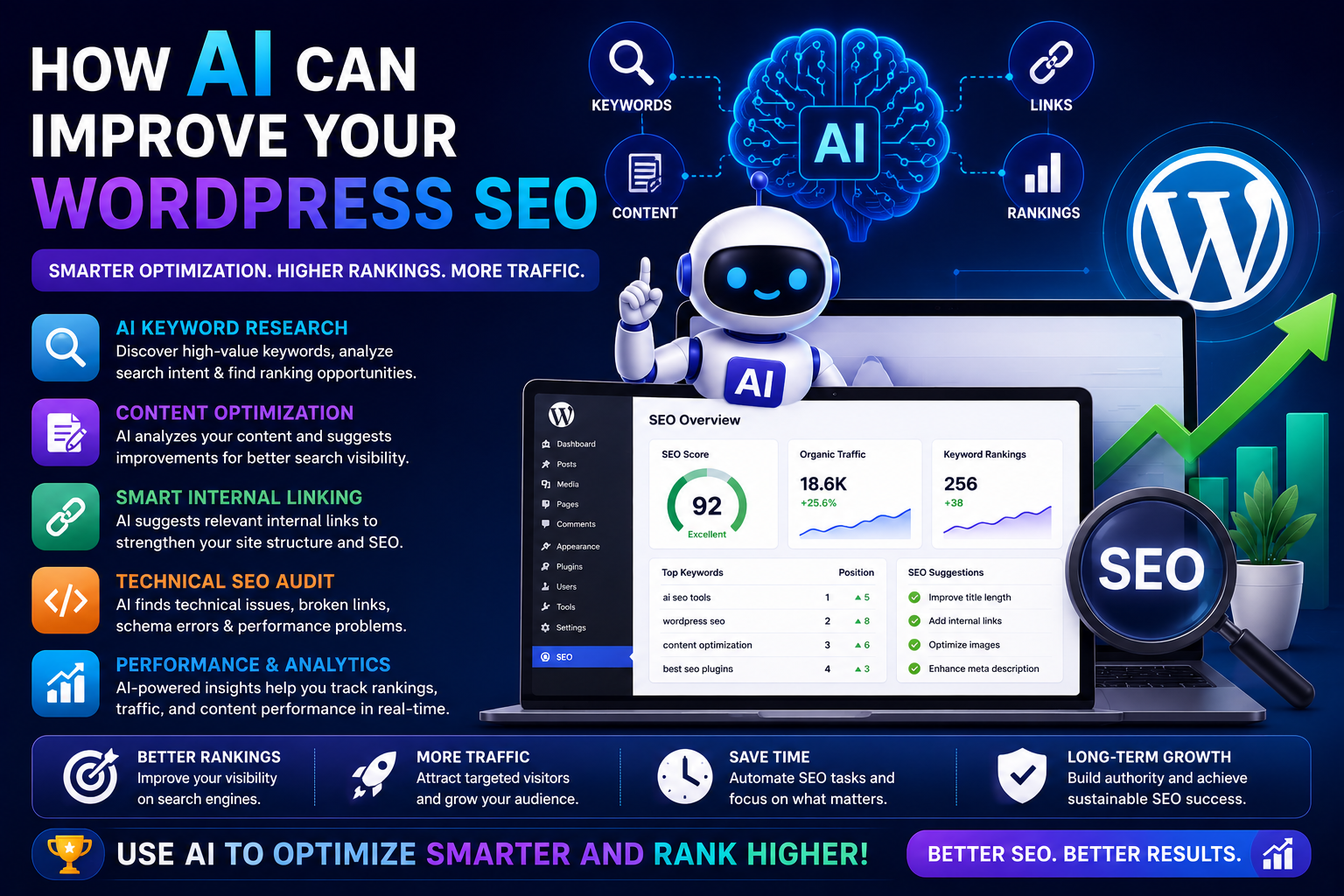
How AI Can Improve Your WordPress SEO
Search Engine Optimization (SEO) has become more competitive than ever before. Modern search engines evaluate hundreds of ranking factors, including content quality, search intent, user experience, website performance, internal linking, structured data, and topical authority.
For many WordPress website owners, keeping up with these constantly evolving SEO requirements can be challenging and time-consuming.
Artificial Intelligence (AI) is changing the way websites approach SEO. Instead of spending hours performing manual research and optimization, AI-powered tools can analyze data, identify opportunities, automate repetitive tasks, and provide actionable recommendations that improve search visibility.
Whether you're a blogger, freelancer, business owner, digital marketer, agency, or WooCommerce store owner, AI can help simplify your SEO workflow while allowing you to focus on creating valuable content.
In this guide, we'll explore how AI improves WordPress SEO and why AI-powered optimization has become an essential part of modern digital marketing.
Why Use AI for WordPress SEO?
Traditional SEO requires ongoing effort and manual analysis.
Tasks such as keyword research, content optimization, technical audits, metadata creation, competitor research, and internal linking often consume significant time.
Artificial Intelligence helps automate many of these processes while providing data-driven insights that improve decision-making.
Benefits include:
Faster SEO optimization
Better keyword research
Improved content quality
Smarter internal linking
Automated metadata generation
Technical SEO recommendations
Better website performance
Increased organic traffic
Higher search visibility
Time savings
Rather than replacing SEO professionals, AI enhances their productivity and efficiency.
Features to Look for in an AI SEO Tool
Before choosing an AI SEO solution, look for features such as:
Keyword research
AI content optimization
Meta title generation
Meta description generation
Internal linking suggestions
Schema markup
XML Sitemap support
SEO scoring
Technical SEO audits
Image optimization
WooCommerce SEO support
Analytics and reporting
Choosing the right combination of features ensures long-term SEO success.
1. AI Keyword Research
Keyword research is the foundation of every successful SEO strategy.
AI tools analyze large amounts of search data to identify valuable keyword opportunities.
They help discover:
Long-tail keywords
Semantic keywords
Search intent
Trending topics
Related searches
Low-competition opportunities
Instead of relying only on search volume, AI helps you target keywords that better match what users are actually searching for.
2. AI Content Optimization
Creating great content is only part of SEO.
AI analyzes existing pages and recommends improvements such as:
Better headings
Improved keyword placement
Readability improvements
Content expansion
Missing subtopics
Better formatting
User intent alignment
These recommendations help create more comprehensive content that satisfies both users and search engines.
3. AI Meta Title and Description Generation
Writing optimized metadata for hundreds of pages can become overwhelming.
AI can generate:
SEO titles
Meta descriptions
Open Graph titles
Social media descriptions
Well-written metadata improves click-through rates while helping search engines understand page content.
4. AI Internal Linking
Internal links improve navigation while strengthening topical authority.
AI analyzes your content and suggests relevant internal links based on:
Keywords
Topics
User intent
Existing articles
Content relationships
A stronger internal linking strategy improves crawling and distributes page authority more effectively.
5. AI Technical SEO Analysis
Technical SEO often requires specialized knowledge.
AI simplifies this by detecting issues such as:
Broken links
Missing alt text
Duplicate metadata
Slow-loading pages
Redirect chains
Crawl errors
Missing schema
Mobile usability issues
Fixing these issues improves website health and search engine performance.
6. AI Schema Markup
Structured data helps search engines better understand your website.
AI-powered plugins can recommend or automatically generate schema for:
Articles
FAQs
Products
Reviews
Organizations
Local Businesses
Breadcrumbs
Events
Proper schema increases your chances of earning rich search results.
7. AI Image SEO
Images are an important part of modern SEO.
AI helps optimize images by generating:
Image alt text
Image captions
File name suggestions
Accessibility improvements
Compression recommendations
Optimized images improve user experience while supporting image search visibility.
8. AI for WooCommerce SEO
WooCommerce websites often manage hundreds or thousands of products.
AI simplifies optimization by helping generate:
Product titles
Product descriptions
Product schema
Category descriptions
SEO metadata
Internal product links
Related products
This makes it easier to maintain SEO quality as your store grows.
9. AI Content Gap Analysis
AI compares your content with competitors and identifies opportunities for improvement.
It can reveal:
Missing topics
Weak content
Untapped keywords
Content gaps
Topical authority opportunities
Publishing content around these opportunities strengthens your website's authority.
10. AI SEO Analytics
Understanding SEO performance is essential for continuous improvement.
AI analytics help monitor:
Organic traffic
Keyword rankings
Click-through rates
User engagement
Conversion rates
High-performing pages
Pages losing traffic
These insights help prioritize future optimization efforts.
Benefits of AI-Powered SEO
Website owners using AI often experience:
Better rankings
More organic traffic
Faster optimization
Higher productivity
Improved content quality
Better user experience
Stronger topical authority
Reduced manual work
As websites grow larger, AI becomes increasingly valuable for maintaining SEO consistency.
Best Practices for Using AI in SEO
To achieve the best results:
Use AI for research and optimization.
Review AI-generated content before publishing.
Focus on search intent instead of keyword stuffing.
Update older content regularly.
Build topical authority through internal linking.
Combine AI insights with human expertise.
The most successful websites use AI as an assistant—not a replacement for thoughtful SEO strategy.
Common Mistakes to Avoid
Avoid these common errors:
Publishing AI content without editing
Ignoring technical SEO
Overusing keywords
Forgetting internal links
Skipping schema markup
Neglecting image optimization
Ignoring user experience
Human oversight remains essential for creating trustworthy, valuable content.
Final Thoughts
Artificial Intelligence is transforming WordPress SEO by helping website owners automate repetitive tasks, improve content quality, strengthen technical SEO, and make smarter optimization decisions.
From keyword research and metadata generation to schema markup and content analysis, AI provides practical tools that save time while improving search performance.
The best results come from combining AI-powered recommendations with high-quality content, strategic planning, and a strong understanding of your audience.
As search engines continue evolving, AI will become an increasingly important part of every successful WordPress SEO strategy.
Frequently Asked Questions
Can AI improve WordPress SEO?
Yes. AI helps with keyword research, content optimization, metadata generation, internal linking, schema markup, technical SEO, and analytics.
Does AI guarantee higher rankings?
No. AI provides recommendations and automation, but rankings also depend on content quality, website authority, competition, and user experience.
Can beginners use AI SEO plugins?
Absolutely. Most AI SEO plugins are designed with beginner-friendly interfaces and provide easy-to-follow optimization suggestions.
Is AI useful for WooCommerce SEO?
Yes. AI can optimize product titles, descriptions, metadata, schema, category pages, and internal linking for WooCommerce stores.
Should I rely only on AI for SEO?
No. AI should support your SEO strategy, while human expertise ensures originality, accuracy, and long-term authority.
Comments (0)