
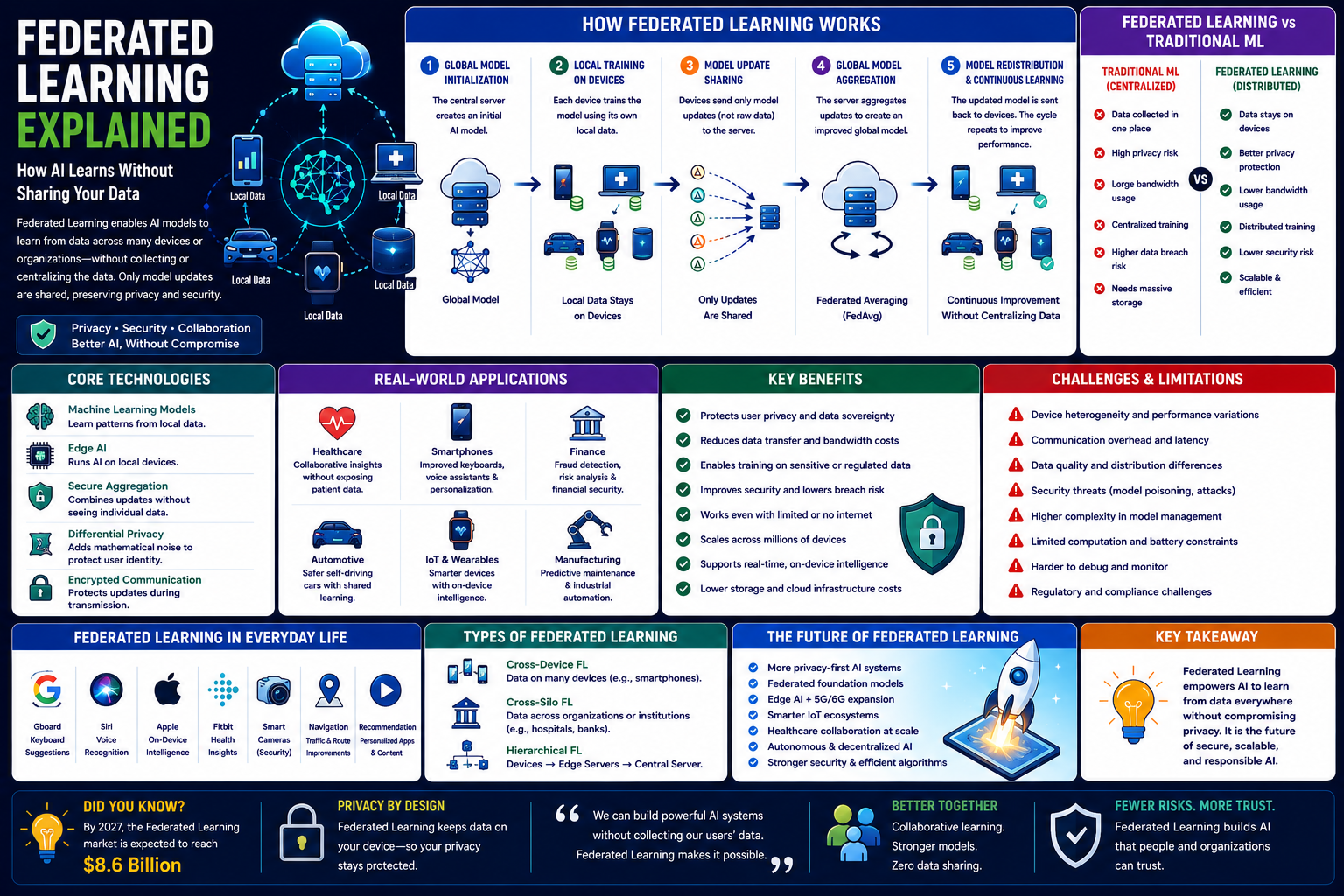
Federated Learning Explained: How AI Learns Without Sharing Your Data
Introduction
Artificial Intelligence depends on data to learn and improve. Traditionally, machine learning models are trained by collecting massive amounts of user data and sending it to centralized cloud servers. While this approach has produced powerful AI systems, it also raises serious concerns about privacy, security, bandwidth, and regulatory compliance.
Federated Learning offers a different approach.
Instead of moving user data to the cloud, Federated Learning allows AI models to train directly on users' devices. Only the model updates—not the raw personal data—are shared with a central server. This enables collaborative learning while keeping sensitive information on the device where it was created.
Today, Federated Learning is becoming increasingly important in healthcare, finance, smartphones, autonomous vehicles, IoT, and enterprise AI, where protecting user privacy is just as important as improving model accuracy.
What Is Federated Learning?
Federated Learning is a machine learning technique that trains AI models across multiple devices or organizations without transferring the underlying data to a central location.
Instead of collecting personal information, the system shares only model improvements.
This approach helps organizations:
Protect privacy
Reduce data transfer
Improve security
Meet compliance requirements
Train AI collaboratively
Scale across millions of devices
Federated Learning enables AI to learn from distributed data while keeping that data local.
How Federated Learning Works
Most Federated Learning systems follow a structured workflow.
1. Global Model Initialization
A central server creates an initial AI model and distributes it to participating devices.
Examples include:
Smartphones
Hospitals
Banks
IoT devices
Vehicles
Edge servers
2. Local Model Training
Each device trains the model using its own local data.
Examples include:
User typing patterns
Medical records
Sensor readings
Financial transactions
Camera images
The raw data never leaves the device.
3. Model Update Sharing
Instead of sending personal information, each device sends only model parameters or gradients back to the server.
These updates contain learning—not the original data.
4. Global Model Aggregation
The server combines updates from thousands or millions of devices into an improved global model.
This process is often called Federated Averaging (FedAvg).
5. Continuous Improvement
The updated model is redistributed to participating devices, repeating the learning cycle.
The model becomes smarter over time without centralized data collection.
Federated Learning vs Traditional Machine Learning
Traditional Machine Learning
Federated Learning
Data sent to cloud
Data remains on device
Centralized training
Distributed training
Higher privacy risks
Better privacy protection
Large bandwidth usage
Lower bandwidth usage
Easier centralized management
More complex coordination
Federated Learning prioritizes privacy while enabling collaborative model improvement.
Core Technologies Behind Federated Learning
Several technologies work together.
Machine Learning Models
Train on local datasets.
Edge AI
Runs AI directly on user devices.
Secure Aggregation
Combines updates without exposing individual contributions.
Differential Privacy
Adds mathematical protections to reduce privacy risks.
Encrypted Communication
Protects model updates during transmission.
Real-World Applications
Federated Learning is transforming many industries.
Healthcare
Medical diagnosis
Hospital collaboration
Disease prediction
Smartphones
Predictive keyboards
Voice assistants
Personalized recommendations
Finance
Fraud detection
Risk assessment
Banking security
Automotive
Autonomous driving improvements
Driver behavior analysis
Fleet optimization
Manufacturing
Predictive maintenance
Equipment monitoring
Industrial automation
Smart Cities
Traffic optimization
Environmental monitoring
Public safety systems
Benefits of Federated Learning
Federated Learning provides numerous advantages.
Benefits include:
Better privacy
Reduced data transfer
Stronger security
Regulatory compliance
Faster local AI
Collaborative learning
Lower cloud storage requirements
Scalable AI training
Organizations increasingly adopt Federated Learning for privacy-sensitive AI applications.
Challenges and Limitations
Despite its advantages, Federated Learning presents challenges.
These include:
Device variability
Communication overhead
Model synchronization
Data quality differences
Security attacks
Hardware limitations
Energy consumption
Complex deployment
Research continues improving efficiency and scalability.
Federated Learning in Everyday Life
Many AI-powered products already use Federated Learning.
Examples include:
Smartphone keyboards
Voice assistants
Wearable health devices
Smart cameras
Banking apps
Healthcare systems
Smart home devices
Recommendation systems
Most users benefit from Federated Learning without realizing it.
Future of Federated Learning
Future developments include:
Smarter Edge AI
Privacy-first AI systems
Enterprise federated analytics
Cross-industry collaboration
AI-powered healthcare networks
Secure IoT ecosystems
Federated foundation models
Better decentralized AI
Federated Learning will become increasingly important as privacy regulations continue evolving.
Common Misconceptions
Several myths surround Federated Learning.
Common misconceptions include:
Federated Learning eliminates all privacy risks.
It completely replaces cloud AI.
Only smartphones use Federated Learning.
It is slower than all centralized training.
Small organizations cannot use Federated Learning.
In reality, Federated Learning complements cloud AI and provides a practical balance between collaboration and privacy.
Final Thoughts
Federated Learning is changing how Artificial Intelligence is trained by allowing models to improve without requiring users to share their personal data. By combining distributed learning, privacy-preserving techniques, and collaborative model updates, Federated Learning offers a powerful solution for building intelligent systems while respecting user privacy.
As organizations seek more secure and responsible AI solutions, Federated Learning will play a central role in enabling scalable, privacy-first Artificial Intelligence across industries.
Frequently Asked Questions
What is Federated Learning?
Federated Learning is a machine learning technique that trains AI models across multiple devices without moving the underlying data to a central server.
Why is Federated Learning important?
It improves privacy, reduces data transfer, and enables collaborative AI training while keeping sensitive information local.
Does Federated Learning improve privacy?
Yes. Raw user data remains on participating devices, reducing the need for centralized data collection.
What industries use Federated Learning?
Healthcare, finance, manufacturing, automotive, telecommunications, consumer electronics, and smart cities.
Is Federated Learning related to Edge AI?
Yes. Federated Learning often works together with Edge AI because both process data locally on devices.
Comments (0)