
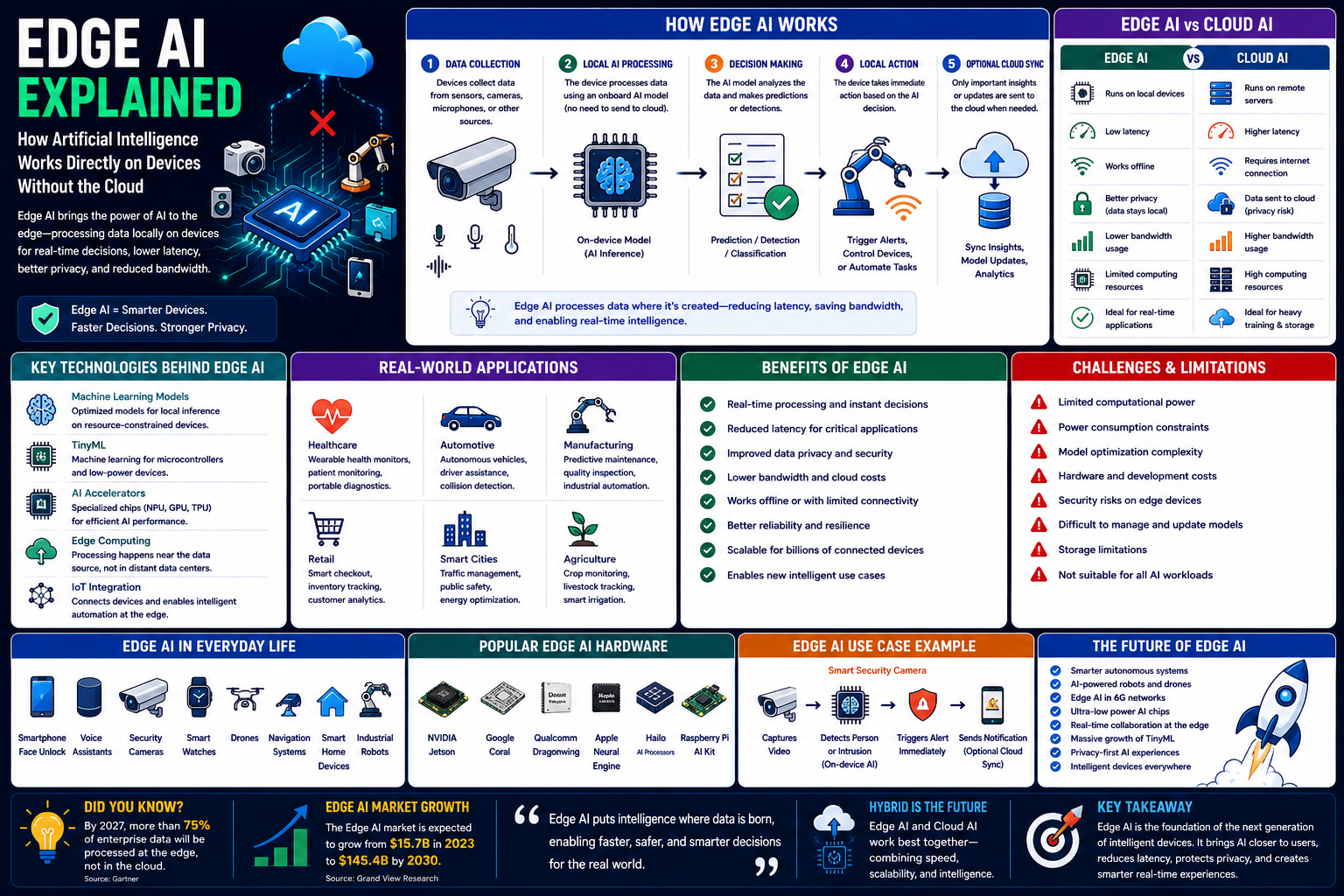
Edge AI Explained: How Artificial Intelligence Works Directly on Devices Without the Cloud
Introduction
Artificial Intelligence has traditionally relied on powerful cloud servers to process data, make predictions, and generate responses. While cloud AI provides impressive capabilities, it also introduces challenges such as network latency, internet dependency, privacy concerns, and bandwidth limitations.
Edge AI solves these challenges by bringing AI directly to the devices where data is created. Instead of sending information to remote servers for processing, Edge AI enables smartphones, cameras, robots, vehicles, industrial machines, and IoT devices to analyze data locally in real time.
As billions of connected devices continue generating massive amounts of information, Edge AI is becoming one of the most important technologies driving faster, safer, and more efficient intelligent systems.
What Is Edge AI?
Edge AI is the deployment of Artificial Intelligence models directly on edge devices, allowing data to be processed locally instead of relying entirely on cloud infrastructure.
Edge devices include:
Smartphones
Security cameras
Drones
Autonomous vehicles
Smart speakers
Industrial robots
Medical devices
IoT sensors
Processing data locally enables faster decisions while reducing dependence on internet connectivity.
How Edge AI Works
Most Edge AI systems follow a structured workflow.
1. Data Collection
The device continuously gathers information.
Examples include:
Camera images
Voice recordings
Sensor readings
GPS data
Temperature measurements
Motion detection
2. Local AI Processing
Instead of sending raw data to the cloud, the device processes it using an onboard AI model.
Common hardware includes:
NPUs (Neural Processing Units)
GPUs
AI accelerators
Embedded processors
Edge TPUs
3. Decision Making
The AI model analyzes the data and generates predictions.
Examples include:
Face recognition
Object detection
Voice recognition
Anomaly detection
Navigation decisions
4. Local Action
The device immediately performs the required action.
Examples:
Unlock a smartphone
Detect an intruder
Stop an industrial machine
Alert a driver
Trigger an alarm
5. Optional Cloud Synchronization
Only essential information may be sent to cloud services for storage, analytics, or model updates.
This hybrid approach improves efficiency while protecting privacy.
Edge AI vs Cloud AI
Edge AI
Cloud AI
Runs on local devices
Runs on remote servers
Low latency
Higher latency
Works offline
Requires internet connection
Better privacy
Data sent to cloud
Lower bandwidth usage
Higher bandwidth usage
Many modern systems combine both Edge AI and Cloud AI for optimal performance.
Core Technologies Behind Edge AI
Several technologies enable Edge AI.
Machine Learning Models
Provide prediction and decision-making capabilities.
TinyML
Optimizes AI models for small, low-power devices.
AI Accelerators
Specialized chips designed for efficient AI inference.
Edge Computing
Processes data near its source rather than in centralized data centers.
IoT Integration
Connects intelligent devices into larger ecosystems.
Real-World Applications
Edge AI powers intelligent systems across industries.
Healthcare
Wearable health monitors
Portable diagnostic devices
Patient monitoring
Automotive
Driver assistance systems
Autonomous vehicles
Collision detection
Manufacturing
Predictive maintenance
Quality inspection
Industrial automation
Retail
Smart checkout
Inventory tracking
Customer analytics
Agriculture
Crop monitoring
Livestock tracking
Smart irrigation
Smart Cities
Traffic management
Public safety
Energy optimization
Benefits of Edge AI
Edge AI offers numerous advantages.
Benefits include:
Real-time processing
Reduced latency
Improved privacy
Lower cloud costs
Better reliability
Reduced bandwidth consumption
Offline functionality
Faster decision-making
Organizations increasingly adopt Edge AI for mission-critical applications.
Challenges and Limitations
Despite its advantages, Edge AI faces challenges.
These include:
Limited computing resources
Power consumption constraints
Model optimization complexity
Hardware costs
Device security
Software updates
Storage limitations
Model deployment management
Continuous innovation is improving Edge AI hardware and software.
Edge AI in Everyday Life
Many everyday devices already use Edge AI.
Examples include:
Smartphone face unlock
Voice assistants
Smartwatches
Security cameras
Smart home devices
Fitness trackers
Navigation systems
Drones
Edge AI is becoming increasingly common in consumer electronics.
Future of Edge AI
Future developments include:
Smarter autonomous robots
AI-powered factories
Edge AI in 6G networks
Intelligent healthcare devices
Personalized on-device assistants
AI-enabled smart cities
Energy-efficient AI chips
Real-time collaborative edge intelligence
Edge AI will play a major role in the future of connected and autonomous systems.
Common Misconceptions
Several myths surround Edge AI.
Common misconceptions include:
Edge AI completely replaces cloud AI.
Edge AI only works on smartphones.
Edge AI requires expensive hardware.
Edge AI cannot run advanced models.
Only technology companies benefit from Edge AI.
In reality, Edge AI complements cloud AI and is increasingly accessible across industries.
Final Thoughts
Edge AI is transforming how Artificial Intelligence is deployed by moving intelligence closer to where data is generated. Instead of depending entirely on cloud infrastructure, Edge AI enables devices to process information locally, respond instantly, and operate more securely.
From smart homes and autonomous vehicles to healthcare devices and industrial automation, Edge AI is making intelligent systems faster, more private, and more reliable. As AI hardware and edge computing continue advancing, Edge AI will become an essential foundation for the next generation of connected technologies.
Frequently Asked Questions
What is Edge AI?
Edge AI is the deployment of AI models directly on local devices, enabling real-time processing without relying entirely on cloud servers.
Why is Edge AI important?
It reduces latency, improves privacy, lowers bandwidth usage, and enables offline AI capabilities.
What devices use Edge AI?
Smartphones, cameras, vehicles, industrial machines, medical devices, IoT sensors, robots, and wearables.
Does Edge AI require internet access?
Not always. Many Edge AI applications can operate offline after the model is deployed.
Is Edge AI the future?
Yes. As connected devices continue growing, Edge AI is expected to become a key technology for intelligent, real-time decision-making.
Comments (0)