
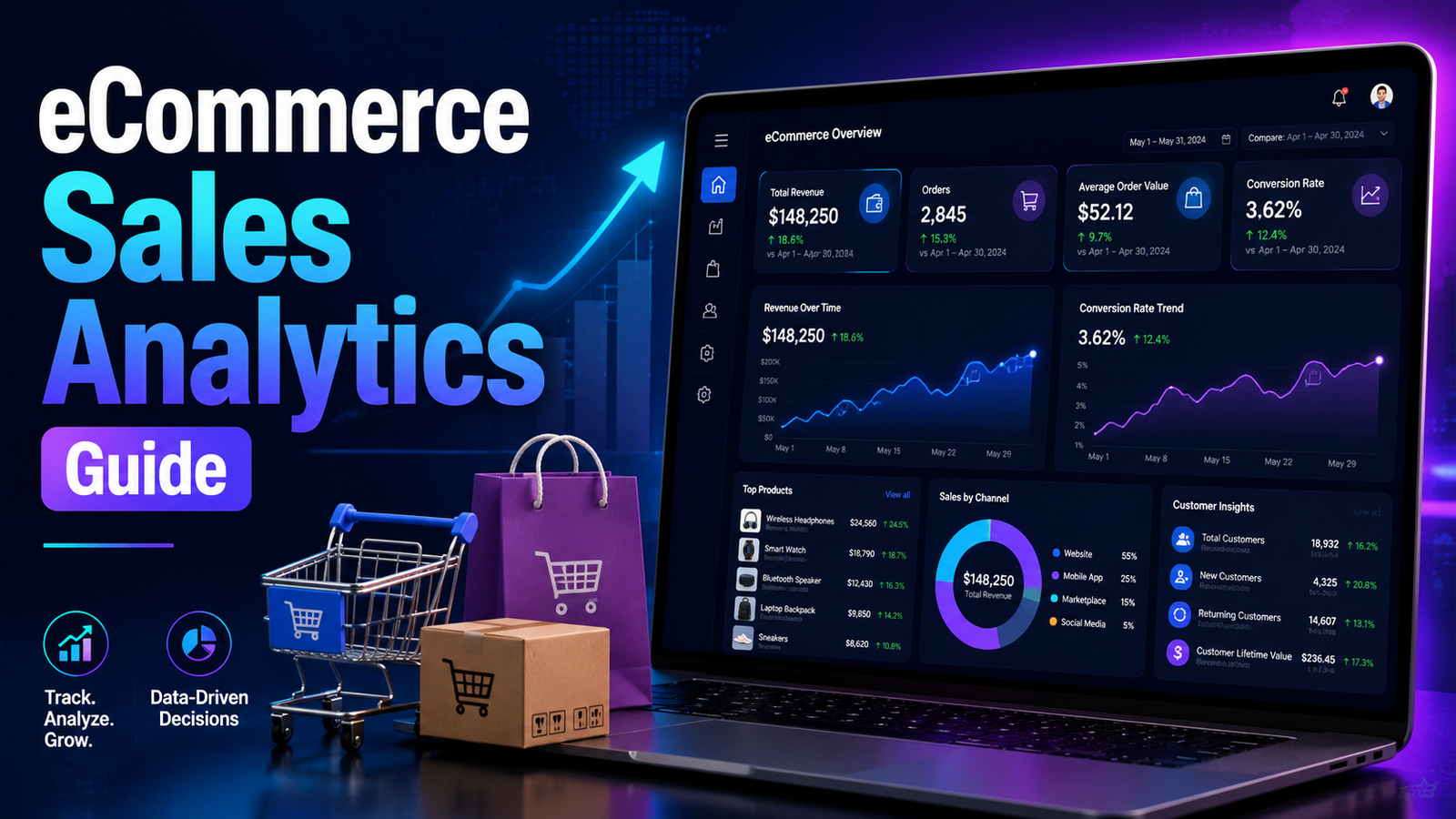
eCommerce Sales Analytics Guide
Every successful eCommerce business is powered by data. While attracting visitors and generating orders are important, long-term growth depends on understanding what your data is telling you.
Questions like these determine how effectively you can scale your business:
Which products generate the highest profits?
Why do some customers buy repeatedly while others never return?
Which marketing campaigns deliver the best return on investment?
Which products should you promote or discontinue?
Without sales analytics, these answers are often based on guesswork.
With modern analytics, every sale becomes an opportunity to improve your business.
In this guide, you'll learn what eCommerce sales analytics is, why it matters, the metrics you should track, common mistakes to avoid, and how AI-powered analytics helps online stores grow faster.
Quick Answer
What is eCommerce sales analytics?
eCommerce sales analytics is the process of collecting, analyzing, and interpreting sales data from an online store to measure business performance, understand customer behavior, optimize marketing efforts, and increase revenue.
Why Sales Analytics Matters
Sales analytics helps you replace assumptions with facts.
Instead of wondering why sales increased or decreased, analytics gives you measurable insights that support better business decisions.
Benefits include:
Better revenue tracking
Improved marketing performance
Smarter inventory planning
Stronger customer retention
Faster business growth
Better forecasting
More profitable decisions
What Data Should You Track?
Modern eCommerce analytics covers multiple areas of your business.
Revenue Metrics
Monitor:
Total revenue
Monthly revenue
Revenue growth
Profit trends
These metrics show your store's overall financial performance.
Customer Metrics
Understanding customers is just as important as tracking sales.
Important metrics include:
Customer Lifetime Value (CLV)
Repeat purchase rate
Average purchase frequency
Customer acquisition trends
Returning vs. new customers
These insights help improve retention and lifetime value.
Product Metrics
Track:
Best-selling products
Low-performing products
Category performance
Product revenue
Product profitability
This helps optimize inventory and merchandising.
Marketing Metrics
Evaluate which channels generate the best results.
Examples include:
Organic search
Paid advertising
Email marketing
Social media
Referral traffic
Comparing channels allows you to invest your marketing budget more effectively.
Conversion Metrics
Monitor how efficiently visitors become customers.
Important KPIs include:
Conversion rate
Cart abandonment rate
Checkout completion rate
Average Order Value (AOV)
Improving these metrics often leads to significant revenue growth.
Essential eCommerce KPIs
Every online business should monitor:
Revenue
Orders
Average Order Value (AOV)
Conversion Rate
Customer Lifetime Value (CLV)
Repeat Purchase Rate
Refund Rate
Gross Profit
Best-Selling Products
Sales Growth
Rather than tracking dozens of numbers, focus on the KPIs that directly influence business outcomes.
Common Analytics Mistakes
Many businesses collect data but fail to use it effectively.
Avoid these mistakes:
❌ Tracking only revenue
❌ Ignoring customer behavior
❌ Not comparing historical performance
❌ Reviewing reports too infrequently
❌ Focusing on vanity metrics
❌ Using disconnected reporting tools
❌ Making decisions without data
Best Practices for eCommerce Sales Analytics
Review Performance Regularly
Weekly and monthly reviews help identify opportunities before they become problems.
Monitor Trends Instead of Individual Numbers
A single day's revenue rarely tells the full story.
Look for long-term patterns rather than isolated events.
Segment Your Customers
Analyze customers based on:
Purchase frequency
Spending habits
Geographic location
Product preferences
Segmentation supports more personalized marketing.
Use Dashboards
A centralized dashboard makes it easier to monitor business performance without switching between multiple reports.
Let AI Identify Opportunities
Artificial intelligence can analyze large volumes of sales data much faster than manual reporting.
AI can:
Detect trends
Forecast demand
Highlight anomalies
Recommend products to promote
Predict customer behavior
Why AI is Transforming eCommerce Analytics
Traditional reports tell you what happened.
AI helps answer:
Why did it happen?
What is likely to happen next?
What action should you take?
AI-powered analytics enables proactive decision-making instead of reactive reporting.
This gives growing businesses a significant competitive advantage.
How Kaddora AI Sales Analytics Helps
As online stores scale, spreadsheets and standard reports often become difficult to manage.
Key Features
AI-powered business insights
Real-time sales dashboard
Revenue analysis
Customer behavior analytics
Product performance tracking
KPI monitoring
Automated reports
Sales forecasting
WooCommerce integration
Instead of spending hours analyzing reports, you receive meaningful insights that help you make faster and more confident business decisions.
eCommerce Analytics Checklist
✅ Track Revenue
✅ Monitor Orders
✅ Review Customer Behavior
✅ Analyze Product Performance
✅ Measure Conversion Rate
✅ Monitor AOV
✅ Compare Historical Data
✅ Review KPIs Weekly
✅ Use AI-Powered Analytics
Frequently Asked Questions
What is eCommerce sales analytics?
eCommerce sales analytics is the process of analyzing sales, customer, product, and marketing data to improve business performance and increase revenue.
Which KPIs should online stores monitor?
Key metrics include revenue, orders, conversion rate, average order value, customer lifetime value, repeat purchases, and product performance.
Why is AI useful in sales analytics?
AI identifies patterns, predicts trends, automates reporting, and provides actionable recommendations that help businesses make smarter decisions.
How often should analytics reports be reviewed?
Weekly operational reviews and monthly strategic reviews are recommended for most online stores.
Which analytics tool is suitable for WooCommerce?
Businesses looking for AI-powered dashboards, real-time reporting, and advanced insights can benefit from Kaddora AI Sales Analytics.
Final Thoughts
Data is one of the most valuable assets your eCommerce business generates every day. The challenge isn't collecting it—it's turning that information into meaningful action.
By tracking the right KPIs, reviewing reports consistently, and using AI-powered analytics, you can make better decisions, improve customer experiences, and build a more profitable online store.
Comments (0)