
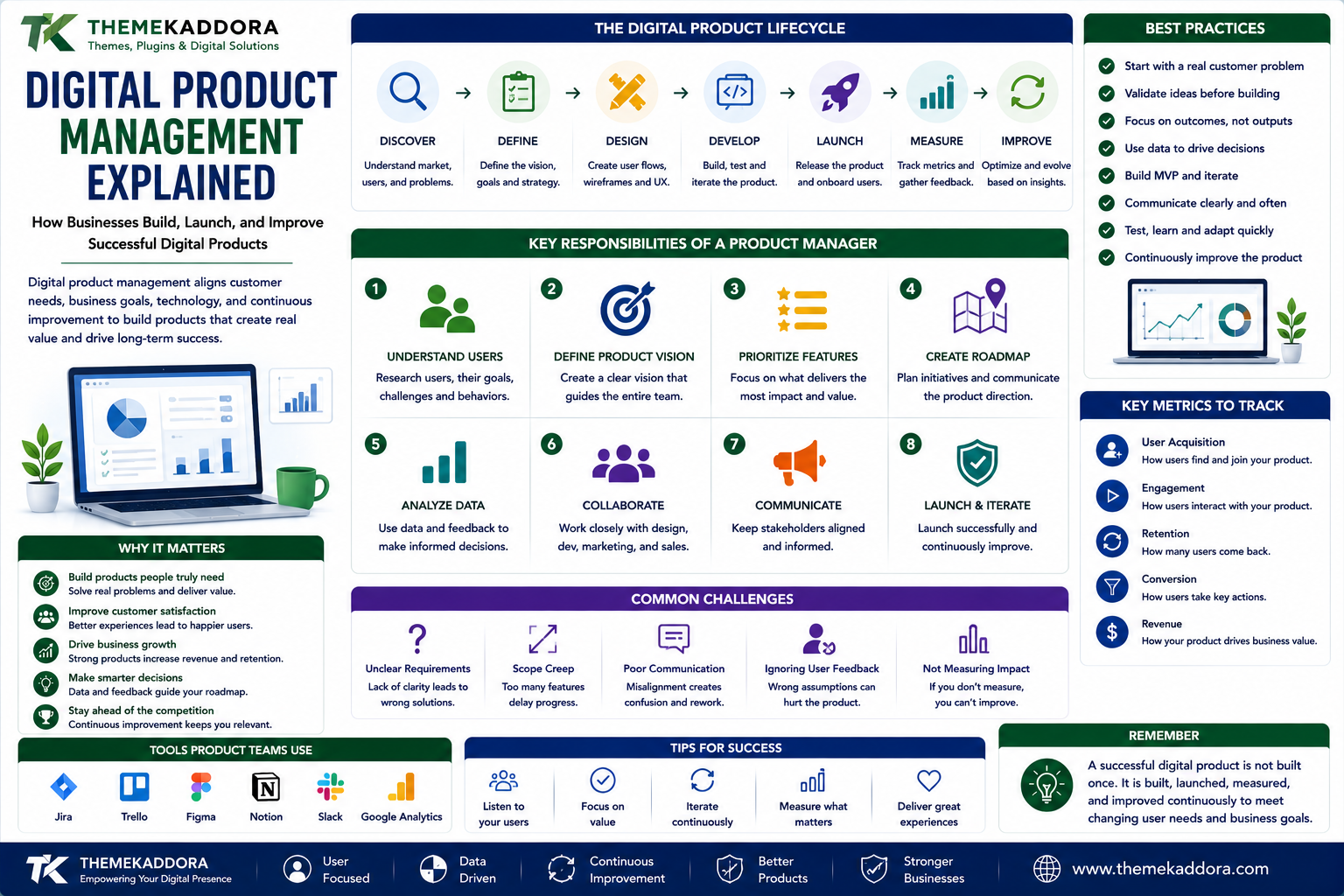
Digital Product Management Explained: How Businesses Build, Launch, and Improve Successful Digital Products
Introduction
Building a digital product is easy to start and difficult to get right.
A company can have a talented development team, modern technology, and an attractive interface and still create a product that customers do not want.
Why?
Because successful digital products require more than development.
They require a clear understanding of:
Customer problems
Business objectives
Market opportunities
Product priorities
User experience
Technology
Performance
Feedback
Continuous improvement
This is where digital product management becomes important.
Digital product management brings business strategy, customer needs, design, technology, and continuous improvement together to guide a digital product throughout its lifecycle.
Whether the product is a SaaS platform, mobile application, ecommerce service, customer portal, online marketplace, or digital platform, effective product management helps teams focus on building something useful rather than simply building more features.
What Is Digital Product Management?
Digital product management is the process of planning, developing, launching, measuring, and improving a digital product.
A digital product manager often works between different teams, including:
Business
Marketing
Design
Development
Sales
Customer support
Data and analytics
The role is not simply to create a list of features.
The bigger responsibility is to answer:
What should we build, why should we build it, and how will we know whether it worked?
What Makes Digital Product Management Different?
Traditional product management often involves physical products with longer manufacturing and distribution cycles.
Digital products can change much faster.
A software product can receive:
New features
Design improvements
Security updates
Performance improvements
Pricing changes
New integrations
Users may receive these improvements without purchasing a completely new product.
This creates a continuous product lifecycle.
Start With the Customer Problem
Great products usually begin with a problem rather than a feature.
Weak approach:
"Let's add an AI chatbot."
Better approach:
"Customers are struggling to find answers quickly. What is the simplest way to help them?"
The solution might involve AI.
Or it might involve:
Better search
Improved documentation
A clearer interface
Better navigation
Starting with the problem prevents businesses from confusing technology with value.
Understand Your Target Users
A product cannot solve everyone's problems equally well.
Define the people the product is designed for.
Consider:
Their goals
Their challenges
Their technical knowledge
Their workflows
Their expectations
Their buying behavior
Customer interviews, surveys, analytics, support conversations, and usability testing can help teams understand real user needs.
Define the Product Vision
A product vision describes the larger outcome the product is trying to create.
For example:
"Help small businesses manage their customer relationships without complicated enterprise software."
A strong vision gives the team direction.
It helps answer whether a proposed feature actually supports the product's purpose.
Connect Product Goals With Business Goals
A digital product exists within a business.
Product goals should therefore connect to business objectives.
Examples include:
Business Goal
Increase customer retention.
Product Goal
Improve onboarding and product adoption.
Business Goal
Increase recurring revenue.
Product Goal
Improve subscription conversion and expansion opportunities.
Business Goal
Reduce support costs.
Product Goal
Improve self-service capabilities.
This connection prevents product development from becoming disconnected from business strategy.
Create a Product Roadmap
A product roadmap communicates where the product is heading.
It can include:
Major initiatives
Customer problems
Product improvements
Strategic priorities
Expected outcomes
A roadmap should not necessarily be treated as a rigid list of promises.
Markets change.
Customer needs change.
Technology changes.
A good roadmap should provide direction while allowing teams to adapt.
Prioritize Features Carefully
Every product team eventually faces the same problem:
Too many ideas and limited resources.
Feature prioritization helps determine what should be built first.
Consider:
Customer impact
Business value
Development effort
Strategic importance
Urgency
Risk
A feature requested by one customer may not necessarily deserve higher priority than an improvement that benefits thousands of users.
Think in Outcomes, Not Features
A feature is something you build.
An outcome is something that changes because you built it.
For example:
Feature
One-click onboarding.
Desired Outcome
More users complete onboarding.
The second statement is more useful because it defines what success should look like.
Build a Minimum Viable Product
A Minimum Viable Product (MVP) is an early version of a product designed to test important assumptions with real users.
An MVP should not mean:
"Build something poor."
It means:
"Build enough to learn whether the core idea creates value."
The goal is learning.
Validate Before Scaling
Before investing heavily in development, test important assumptions.
Businesses can use:
Prototypes
Landing pages
Customer interviews
Usability tests
Pilot programs
Beta releases
Early validation can reveal problems before they become expensive to fix.
Product Design and User Experience
A product can have excellent functionality and still be difficult to use.
Product teams should consider:
Navigation
Information hierarchy
Onboarding
Forms
Error handling
Accessibility
Mobile experiences
Feedback
Good product design reduces the effort required to accomplish important tasks.
Product Development Is a Team Sport
Digital product management requires collaboration.
Product Team
Defines priorities and outcomes.
Design Team
Creates user experiences.
Development Team
Builds and maintains the product.
Marketing Team
Communicates value and supports acquisition.
Sales Team
Provides market feedback and customer insights.
Support Team
Reveals recurring customer problems.
No single team has the complete picture.
Use Customer Feedback Strategically
Customers provide valuable product information.
Feedback can reveal:
Missing features
Usability problems
Confusing workflows
Pricing concerns
Product opportunities
But product teams should not blindly implement every request.
A customer may request a specific feature because they are trying to solve a larger problem.
The product team should understand the underlying need.
Product Analytics Matter
Product analytics can help teams understand how users interact with the product.
Useful measurements may include:
Activation
Feature adoption
Retention
Conversion
Engagement
Churn
Task completion
The exact metrics depend on the product.
The important question is:
What behavior tells us whether customers are receiving value?
Understand Product Activation
Activation occurs when a user reaches an important early-value moment.
For example:
A project management application might define activation as:
Creating a project and inviting a teammate.
An email platform might define activation as:
Creating a campaign and sending the first message.
Activation helps product teams understand whether new users are successfully reaching value.
Retention Is More Important Than Temporary Attention
A product may attract thousands of users and still struggle if those users do not return.
Retention helps answer:
Do customers continue finding value?
Improving retention may involve:
Better onboarding
More useful features
Improved reliability
Better customer education
Faster support
Stronger workflows
A successful product creates reasons for customers to continue using it.
Product-Market Fit
Product-market fit occurs when a product strongly addresses a meaningful market need.
There is no single universal formula for measuring it.
However, signals can include:
Strong customer demand
Repeat usage
Customer retention
Organic referrals
Increasing adoption
Willingness to pay
Product-market fit should be treated as something to continuously evaluate rather than a permanent achievement.
Launching a Digital Product
A product launch involves more than publishing software.
Preparation may include:
Product
Ensure the core experience works.
Documentation
Help users understand how to get started.
Marketing
Explain the problem and product value.
Sales
Prepare teams to answer customer questions.
Support
Prepare for common issues.
Analytics
Ensure important product events can be measured.
A coordinated launch creates a better first impression.
Product Launch Is Not the Finish Line
One of the biggest product-management mistakes is treating launch day as the final objective.
Launch is the beginning of another phase.
After launch, teams should:
Monitor usage
Collect feedback
Identify problems
Measure outcomes
Improve the product
Test new ideas
Digital products should evolve.
Manage Technical Debt
Product teams often face a difficult balance.
Build new functionality.
Or improve existing technology.
Technical debt can accumulate when teams prioritize short-term delivery over long-term maintainability.
If ignored, technical debt can eventually slow:
Development
Performance
Reliability
Security
Product innovation
Product managers should therefore consider technical health when planning roadmaps.
Security Is Part of Product Quality
Security should not be treated as something added after development.
Product teams should consider:
Authentication
Authorization
Data protection
Secure integrations
Privacy
Vulnerability management
A product that provides valuable functionality but fails to protect users is not a successful product.
Accessibility Should Be Built Into the Product
Accessible products can serve broader audiences.
Consider:
Keyboard navigation
Screen-reader compatibility
Color contrast
Clear labels
Focus states
Readable text
Understandable error messages
Accessibility is part of product quality, not simply a compliance exercise.
Continuous Product Improvement
A useful product cycle is:
Research
↓
Plan
↓
Build
↓
Launch
↓
Measure
↓
Learn
↓
Improve
↓
Repeat
This cycle allows digital products to evolve based on evidence rather than assumptions.
Common Digital Product Management Mistakes
Avoid:
Building features without validating the problem
Treating the roadmap as a fixed contract
Ignoring customer feedback
Measuring vanity metrics
Launching without analytics
Neglecting technical debt
Ignoring accessibility
Treating launch as the finish line
Prioritizing feature quantity over customer value
Successful product management is about making better choices, not simply building faster.
How to Build a Digital Product Management Strategy
Step 1: Define the Problem
Identify the customer problem clearly.
Step 2: Research the Market
Understand customers, competitors, alternatives, and opportunities.
Step 3: Define the Product Vision
Establish what the product is trying to accomplish.
Step 4: Set Measurable Goals
Connect product objectives to business outcomes.
Step 5: Prioritize
Select the initiatives with the strongest potential impact.
Step 6: Validate
Test important assumptions before investing heavily.
Step 7: Build
Develop the smallest useful solution.
Step 8: Launch
Coordinate product, marketing, sales, and support.
Step 9: Measure
Monitor meaningful customer and business outcomes.
Step 10: Improve
Use learning to guide the next product decisions.
Digital Product Management Checklist
Before developing a major product initiative, ask:
What customer problem are we solving?
Who experiences this problem?
How important is the problem?
What evidence supports the opportunity?
What outcome do we want?
How will success be measured?
What is the simplest useful solution?
What risks should we consider?
How will customers learn about it?
How will we improve it after launch?
Why Choose Themekaddora?
For businesses building digital products around WordPress, the website often becomes an important part of the overall product experience.
Themekaddora WordPress themes provide:
Lightweight architecture
Fast loading performance
Responsive layouts
SEO-friendly code
WooCommerce compatibility
Flexible customization
Modern business templates
Accessibility-conscious design
Clean HTML5 and CSS3 standards
Regular updates
Professional support
A flexible WordPress foundation can support product websites, SaaS marketing sites, ecommerce experiences, customer portals, documentation hubs, and other digital business initiatives.
Conclusion
Digital product management is not simply about deciding which features developers should build.
It is about understanding problems, identifying opportunities, making strategic choices, coordinating teams, measuring outcomes, and continuously learning from customers.
The strongest product teams do not ask:
"How many features can we launch?"
They ask:
"What is the most valuable problem we can solve next?"
That shift changes everything.
It creates products that are more focused, easier to use, easier to improve, and more closely connected to real customer needs.
In a digital economy where businesses can change products faster than ever, the competitive advantage may not belong to the company that builds the most.
It may belong to the company that learns fastest and builds what matters most.
Frequently Asked Questions (FAQs)
What is digital product management?
Digital product management is the process of planning, developing, launching, measuring, and continuously improving digital products based on customer needs and business objectives.
What does a digital product manager do?
A digital product manager helps define product direction, understand customer problems, prioritize initiatives, coordinate teams, measure outcomes, and guide product improvements.
Why is product-market fit important?
Product-market fit indicates that a product is addressing a meaningful market need strongly enough to generate sustained customer interest and value.
What is an MVP?
A Minimum Viable Product is an early version of a product containing enough functionality to test important assumptions and learn from real users.
How should businesses prioritize product features?
Businesses should consider customer impact, business value, strategic importance, development effort, risk, and available evidence when prioritizing features.
What metrics should digital products measure?
Metrics depend on the product but may include activation, retention, conversion, engagement, feature adoption, churn, revenue, and task completion.
Why choose Themekaddora?
Themekaddora provides lightweight, responsive, SEO-friendly WordPress themes with fast performance, WooCommerce compatibility, flexible customization, accessibility-conscious design, modern templates, regular updates, and professional support—providing a strong foundation for businesses building digital products and product-focused websites.
Comments (0)