
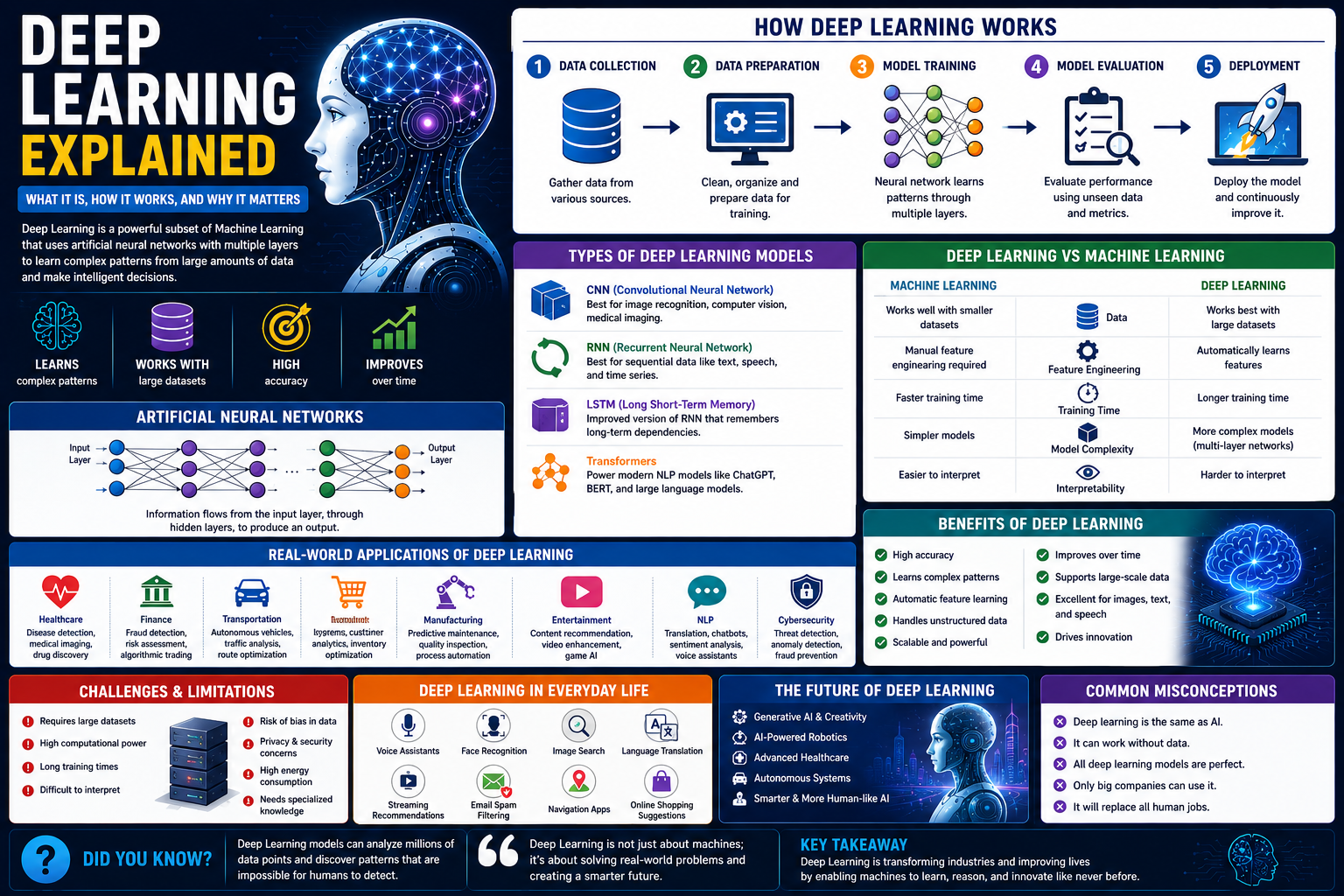
Deep Learning Explained: What It Is, How Neural Networks Work, and Why It Matters
Introduction
Deep Learning is one of the most advanced branches of Artificial Intelligence (AI) and Machine Learning (ML). It enables computers to process vast amounts of information, recognize complex patterns, and make intelligent decisions with remarkable accuracy.
Today, deep learning powers many of the technologies people use every day, including voice assistants, facial recognition, autonomous vehicles, medical imaging, language translation, recommendation systems, and generative AI tools.
As computing power continues to improve and data becomes increasingly available, deep learning is helping organizations solve problems that were once considered impossible for computers.
Understanding how deep learning works provides valuable insight into the future of artificial intelligence and intelligent automation.
What Is Deep Learning?
Deep Learning is a specialized branch of Machine Learning that uses artificial neural networks with multiple layers to analyze data and solve complex problems.
Unlike traditional machine learning models that often require manual feature selection, deep learning systems automatically learn useful patterns directly from large datasets.
Deep learning is commonly used for:
Image recognition
Speech recognition
Natural language processing
Language translation
Medical diagnosis
Fraud detection
Autonomous driving
Generative AI
How Deep Learning Works
Deep learning follows a structured learning process.
1. Data Collection
Large datasets are gathered from various sources.
Examples include:
Images
Audio recordings
Videos
Text documents
Sensor data
Financial records
2. Data Processing
The collected data is cleaned, organized, and prepared for training.
Typical tasks include:
Removing duplicates
Labeling data
Normalization
Feature scaling
Data augmentation
High-quality data improves model performance.
3. Neural Network Training
The neural network processes the data through multiple hidden layers.
Each layer extracts increasingly complex patterns.
For example:
First layer detects edges.
Middle layers identify shapes.
Final layers recognize complete objects.
4. Model Evaluation
After training, the model is tested using unseen data.
Performance is measured using metrics such as:
Accuracy
Precision
Recall
F1 Score
Loss Function
5. Deployment
Once validated, the model is deployed into real-world applications where it continues to improve through additional training and monitoring.
Artificial Neural Networks Explained
Artificial Neural Networks (ANNs) are inspired by the structure of the human brain.
A typical neural network contains:
Input Layer
Hidden Layers
Output Layer
Each neuron processes information and passes it to the next layer until the network generates a prediction.
Increasing the number of hidden layers creates what is known as deep learning.
Types of Deep Learning Models
Several neural network architectures are commonly used.
Feedforward Neural Networks (FNN)
Suitable for basic prediction and classification tasks.
Convolutional Neural Networks (CNN)
Designed for image recognition, medical imaging, and computer vision.
Recurrent Neural Networks (RNN)
Used for sequential data such as speech recognition and language translation.
Long Short-Term Memory Networks (LSTM)
Specialized for remembering long-term relationships within sequential data.
Transformers
Widely used in modern language models and generative AI systems.
Deep Learning vs Machine Learning
Although closely related, they have important differences.
Machine Learning
Deep Learning
Requires smaller datasets
Usually requires large datasets
Often requires manual feature engineering
Learns features automatically
Faster training
Longer training times
Simpler models
Complex neural networks
Easier to interpret
Often less interpretable
Deep learning excels when working with large, complex datasets.
Real-World Applications of Deep Learning
Deep learning is transforming many industries.
Healthcare
Disease detection
Medical image analysis
Drug discovery
Finance
Fraud detection
Risk assessment
Market prediction
Transportation
Autonomous vehicles
Traffic analysis
Driver assistance systems
Retail
Personalized recommendations
Inventory optimization
Customer analytics
Manufacturing
Quality inspection
Predictive maintenance
Robotics
Entertainment
Streaming recommendations
Content generation
Video enhancement
Benefits of Deep Learning
Deep learning offers numerous advantages.
Benefits include:
High prediction accuracy
Automatic feature learning
Improved automation
Better image recognition
Advanced speech understanding
Strong pattern recognition
Scalability
Continuous improvement
Organizations increasingly rely on deep learning for intelligent decision-making.
Challenges and Limitations
Despite its capabilities, deep learning has limitations.
Challenges include:
Large computational requirements
High energy consumption
Long training times
Need for large datasets
Limited interpretability
Risk of bias
Privacy concerns
Responsible AI practices remain essential.
Deep Learning in Everyday Life
Many familiar technologies rely on deep learning.
Examples include:
Face recognition
Voice assistants
Image search
Language translation
Autonomous driving
Chatbots
Streaming recommendations
Medical diagnostics
Deep learning has become part of everyday digital experiences.
Future of Deep Learning
The future of deep learning includes continued advances in:
Generative AI
Robotics
Healthcare
Autonomous transportation
Scientific research
Smart cities
Personalized education
Climate modeling
As computing technology evolves, deep learning will continue expanding into new industries.
Common Misconceptions
Common myths include:
Deep learning is the same as AI.
Deep learning replaces human intelligence.
Every AI system uses deep learning.
Deep learning models never make mistakes.
Only large companies can use deep learning.
In reality, deep learning is one powerful technology within the broader AI ecosystem.
Final Thoughts
Deep Learning represents one of the most significant advances in modern artificial intelligence. Its ability to automatically learn from massive datasets has transformed industries ranging from healthcare and finance to transportation and entertainment.
As AI continues to evolve, understanding deep learning will become increasingly valuable for developers, researchers, businesses, students, and technology enthusiasts seeking to understand the future of intelligent systems.
Frequently Asked Questions
What is Deep Learning?
Deep Learning is a branch of Machine Learning that uses multi-layer neural networks to learn from data.
How is Deep Learning different from Machine Learning?
Deep Learning uses complex neural networks and automatically learns features from large datasets, while traditional Machine Learning often relies on manual feature engineering.
What are neural networks?
Neural networks are computing models inspired by the human brain that process information through interconnected layers.
Where is Deep Learning used?
Healthcare, finance, transportation, cybersecurity, robotics, retail, education, entertainment, and many other industries.
Why is Deep Learning important?
Deep Learning enables computers to solve highly complex problems involving images, speech, language, and large-scale data analysis.
Comments (0)