
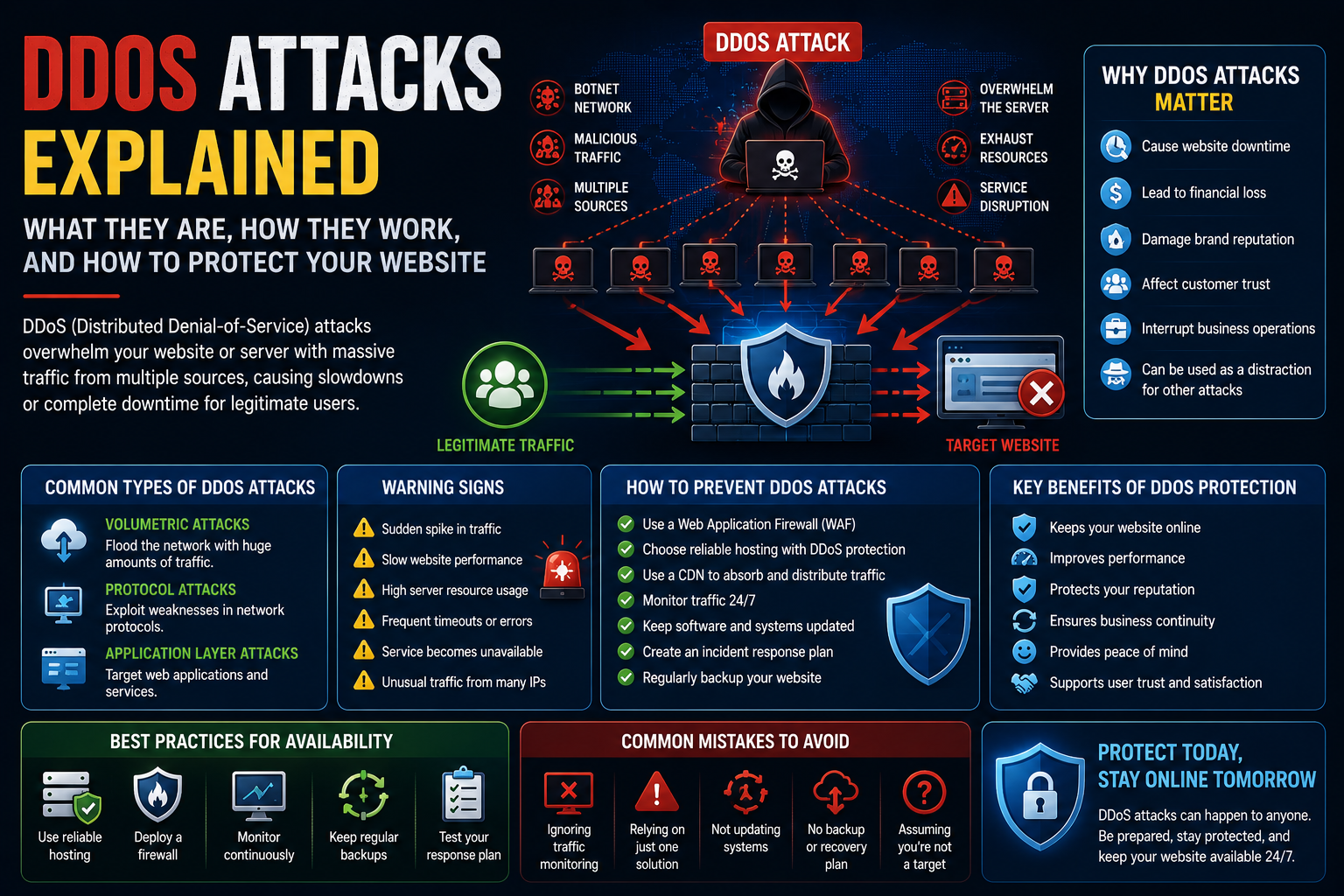
DDoS Attacks Explained: What They Are, How They Work, and How to Protect Your Website
Introduction
Website availability is essential for businesses, online stores, educational platforms, government portals, SaaS applications, and personal websites. Visitors expect websites to load quickly and remain accessible at all times. However, one of the most disruptive cyber threats that can interrupt this availability is a Distributed Denial-of-Service (DDoS) attack.
Unlike attacks that focus on stealing information, DDoS attacks attempt to overwhelm a website or online service with enormous amounts of traffic. The goal is to exhaust server resources, making the website slow, unstable, or completely unavailable to legitimate users.
Understanding how DDoS attacks work is an important step toward building a more resilient website.
What Is a DDoS Attack?
A Distributed Denial-of-Service (DDoS) attack is a cyberattack in which multiple compromised devices send large volumes of traffic to a website, server, or application simultaneously.
The objective is to overwhelm available resources until legitimate visitors can no longer access the service.
Unlike a simple denial-of-service attack that originates from a single source, a DDoS attack uses many devices, making it more difficult to block.
Why DDoS Attacks Matter
Website downtime can have serious consequences.
Potential impacts include:
Lost revenue
Interrupted business operations
Poor customer experience
Damage to brand reputation
Reduced customer trust
Increased operational costs
Missed business opportunities
Maintaining website availability is critical for organizations of all sizes.
How DDoS Attacks Work
A typical DDoS attack follows several stages:
Attackers compromise multiple internet-connected devices.
These devices become part of a botnet.
The botnet sends massive amounts of traffic toward the target website.
Server resources become overwhelmed.
Legitimate visitors experience slow performance or complete service outages.
The attack continues until the traffic subsides or effective mitigation measures are applied.
Common Types of DDoS Attacks
DDoS attacks take many forms.
Common categories include:
Volumetric attacks
Protocol attacks
Application-layer attacks
HTTP flood attacks
SYN flood attacks
UDP flood attacks
DNS amplification attacks
Each attack targets different parts of the networking stack.
Warning Signs of a DDoS Attack
Early detection can reduce downtime.
Common warning signs include:
Sudden spikes in traffic
Slow website loading
Frequent server timeouts
Unusual bandwidth consumption
Service interruptions
Increased server resource usage
Monitoring website performance helps identify unusual behavior quickly.
Business Impact of DDoS Attacks
Even short disruptions can affect business operations.
Possible consequences include:
Lost online sales
Reduced customer confidence
Interrupted communications
Poor search engine user experience
Increased infrastructure costs
Operational delays
Planning for availability is an important aspect of cybersecurity.
How to Prevent DDoS Attacks
Although complete prevention is difficult, several practices reduce risk.
Recommended measures include:
Use a Web Application Firewall (WAF).
Choose reliable hosting.
Use content delivery networks (CDNs).
Monitor traffic continuously.
Maintain software updates.
Prepare an incident response plan.
Perform regular backups.
Layered protection improves resilience.
Website Monitoring and Detection
Continuous monitoring helps identify abnormal traffic patterns.
Monitor:
Bandwidth usage
Server response times
Traffic sources
Request frequency
Error rates
Security alerts
Early detection supports faster response.
Website Firewalls and DDoS Protection
Modern Web Application Firewalls often provide DDoS mitigation capabilities.
Benefits include:
Traffic filtering
Rate limiting
Bot detection
Suspicious request blocking
Geographic filtering
Real-time threat monitoring
Firewalls are an important component of DDoS defense.
Best Practices for Website Availability
Maintain availability by:
Using reliable hosting.
Deploying a firewall.
Monitoring website health.
Maintaining backups.
Updating software regularly.
Preparing recovery procedures.
Testing incident response plans.
Availability planning should be part of routine website management.
Common DDoS Protection Mistakes
Avoid:
Assuming small websites are not targets
Ignoring traffic monitoring
Delaying software updates
Relying on a single security solution
Failing to prepare recovery plans
Neglecting website backups
Preparedness reduces recovery time.
Final Thoughts
DDoS attacks remain one of the most disruptive cyber threats affecting modern websites. While no organization can eliminate all risk, understanding how these attacks work and implementing layered protection significantly improves resilience.
Combining firewalls, traffic monitoring, reliable hosting, regular updates, and incident response planning helps maintain website availability and protects visitors from unnecessary disruptions.
Frequently Asked Questions
What is a DDoS attack?
A DDoS attack overwhelms a website or online service with traffic from many devices to make it unavailable.
Can small websites experience DDoS attacks?
Yes. Websites of all sizes may become targets.
Does a firewall stop DDoS attacks?
A Web Application Firewall can help mitigate many types of DDoS attacks, especially when combined with additional protection.
Why are DDoS attacks difficult to stop?
Because attack traffic often comes from many distributed devices rather than a single source.
How can businesses prepare?
Businesses should monitor traffic, maintain backups, use reliable hosting, deploy firewalls, and establish incident response procedures.
Comments (0)