Data Contracts Explained: How Modern Businesses Keep Data Reliable Across Teams and Systems
Introduction
Modern businesses depend on data everywhere.
A single organization may have information flowing between:
CRM integrations
eCommerce
SaaS applications
Payment systems
Analytics platforms
Data warehouses
AI applications
Mobile applications
One system creates the data.
Another system transforms it.
A third system analyzes it.
An AI system may then use the result to make recommendations.
This creates a serious challenge:
How does everyone know what the data actually means?
Consider a field called:
customer_status
One team might interpret it as:
active / inactive
Another might use:
lead / prospect / customer / churned
A third system might expect:
1 / 0
The data technically exists in all three systems, but the meaning is inconsistent.
This is where data contracts become useful.
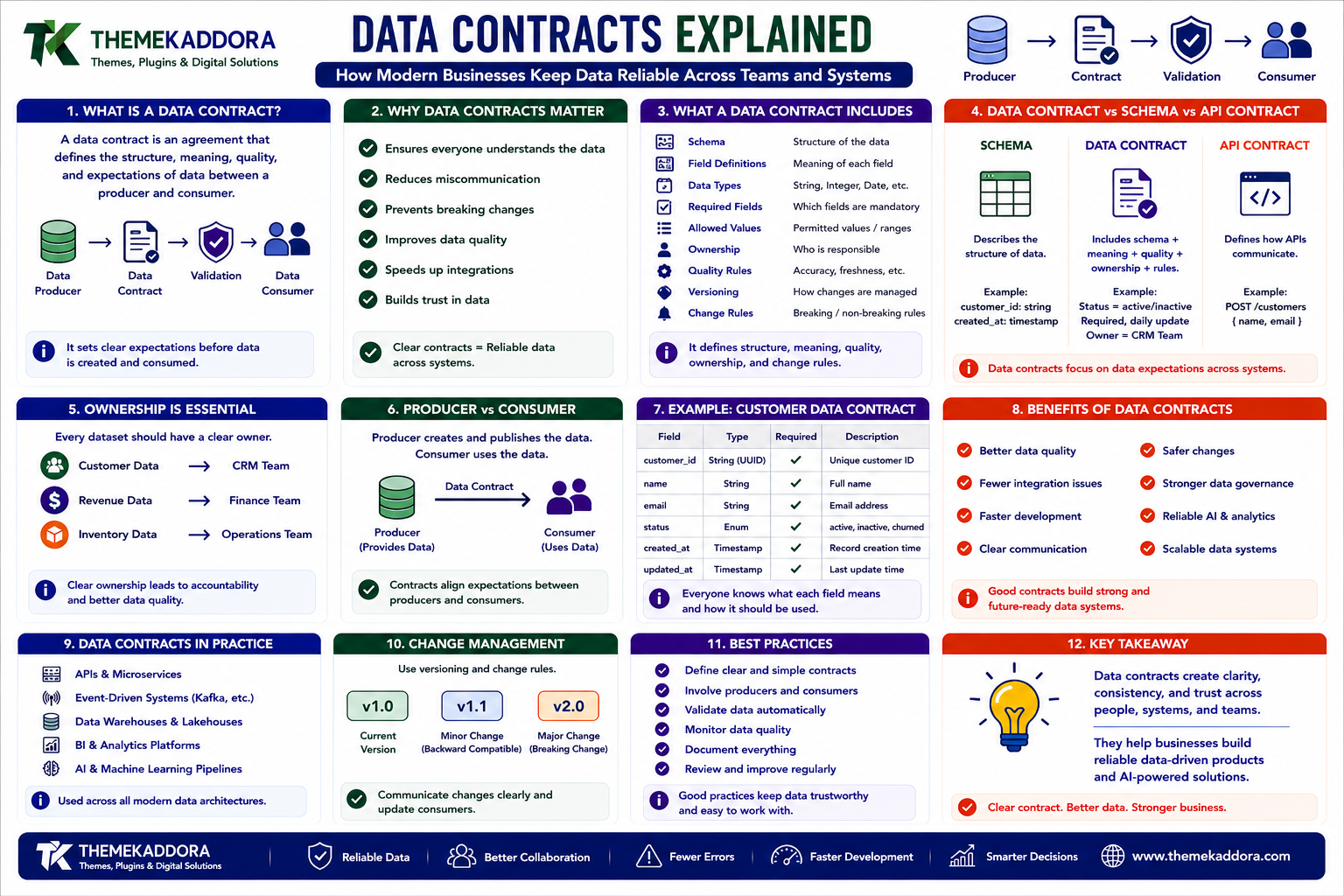
A data contract defines expectations between the producer and consumer of data.
It can specify:
Schema
Field definitions
Data types
Required fields
Allowed values
Ownership
Quality expectations
Versioning
Change rules
A simplified model is:
Data Producer ↓ Data Contract ↓ Validation ↓ Data Consumer
Instead of discovering broken data after it reaches a dashboard, the organization can define expectations before the data is consumed.
Data contracts are increasingly relevant to:
Data engineering
APIs
Event-driven systems
Data warehouses
AI pipelines
Analytics
ERP integrations
CRM integrations
SaaS platforms
Large distributed organizations
In this guide, you'll learn what data contracts are, how they differ from schemas and APIs, what a good contract contains, how ownership works, how contracts improve data quality, how they apply to event-driven systems and AI, how to manage breaking changes, and how businesses can implement data contracts without creating unnecessary bureaucracy.
1. What Is a Data Contract?
A data contract is an explicit agreement describing the structure, meaning, quality, and expectations of data exchanged between a producer and its consumers.
A simplified contract might define:
customer_id → String → Required customer_status → Enum → active / inactive / churned created_at → Timestamp → Required
The producer agrees to provide data according to these expectations.
Consumers can then build systems with greater confidence.
2. Why Data Contracts Matter
Without contracts, teams may make assumptions.
For example:
Producer: customer_id = Integer Consumer: customer_id = String
The system may work temporarily.
Later, the producer changes the format.
customer_id → UUID
The consumer breaks.
A data contract makes the expected interface explicit.
It helps teams understand:
What data exists? What does it mean? What format does it use? How reliable is it? Who owns it? How can it change?
3. Data Contract vs Data Schema
A schema describes the structure of data.
For example:
name email created_at
A data contract can include the schema but goes further.
It may define:
Schema + Semantics + Quality + Ownership + Versioning + Change Policy
A schema might say:
revenue: decimal
A contract might additionally say:
revenue: • Currency = INR • Excludes tax • Required • Must not be negative • Updated daily • Owner = Finance
This makes the data more understandable and reliable.
4. Data Contract vs API Contract
API contracts describe how software services communicate.
For example:
POST /customers
may define:
{ "name": "string", "email": "string" }
A data contract can apply beyond traditional APIs.
It can describe:
Event streams
Data warehouse tables
Data pipelines
Analytics datasets
AI training data
Therefore:
API Contract → Service Communication Data Contract → Data Expectations Across Systems
They can overlap, but they solve broader data-consistency problems in different contexts.
5. Who Owns a Data Contract?
Ownership should be clear.
For example:
Customer Data Owner → CRM Team Revenue Data Owner → Finance Team Inventory Data Owner → Operations Team
The owner is responsible for ensuring that the data remains consistent with the agreed contract.
Without ownership:
Broken Data ↓ Who Should Fix It? ↓ Nobody Knows
Clear ownership reduces this ambiguity.
6. Data Contracts and Data Producers
The producer is the system or team responsible for creating the data.
Examples include:
CRM
ERP
Payment service
eCommerce platform
Product application
For example:
Order Service ↓ OrderCreated Event
The order service becomes the producer of that event.
The data contract defines what downstream consumers can expect.
7. Data Contracts and Data Consumers
Consumers use the data for another purpose.
Examples include:
BI dashboards
Data warehouse models
AI systems
Marketing analytics
Finance reports
Customer-success tools
For example:
OrderCreated ↓ Data Warehouse ↓ Revenue Dashboard
The consumer depends on the producer's data contract.
8. What Should a Data Contract Contain?
A practical contract can include:
Schema
Fields and types.
Definitions
What each field means.
Quality Rules
What values are acceptable.
Ownership
Who maintains the data.
Freshness
How quickly updates are expected.
Availability
When the data should be accessible.
Version
Which contract version applies.
Change Policy
How changes are introduced.
A useful model is:
Structure + Meaning + Quality + Ownership + Lifecycle
9. Data Types Matter
A field's data type should be explicit.
For example:
customer_id → UUID order_total → Decimal order_count → Integer created_at → Timestamp is_active → Boolean
Avoid ambiguous definitions such as:
status → Text
without explaining allowed values.
Typed data reduces interpretation errors.
10. Enumerations and Allowed Values
Some fields should have restricted values.
For example:
order_status: pending paid shipped cancelled refunded
This is safer than allowing any arbitrary text.
Without a controlled vocabulary, one system may produce:
cancelled
while another produces:
canceled
and another:
CANCELLED
A contract can define the accepted representation.
11. Required vs Optional Fields
Contracts should clarify which fields are mandatory.
For example:
order_id → Required customer_id → Required coupon_code → Optional
Consumers then know which fields they can rely on.
Changing:
customer_id Required
to:
customer_id Optional
can also have downstream consequences.
Schema changes should therefore be managed deliberately.
12. Business Definitions Are Essential
Technical data types are not enough.
For example:
revenue → Decimal
does not answer:
What does revenue mean?
Does it include:
Tax?
Shipping?
Refunds?
Discounts?
Cancelled orders?
A useful contract defines business semantics.
For example:
Revenue = Completed order value excluding tax and shipping after discounts
Clear definitions reduce conflicting business reports.
13. Data Freshness
Some data must be recent.
For example:
Inventory → Near Real-Time Daily Finance Report → Daily Historical Analytics → Weekly
A contract can define expected freshness.
For example:
Inventory Data Freshness SLA: < 5 minutes
If the pipeline becomes 3 hours behind, consumers can detect the violation.
14. Data Quality Rules
A contract can define validation rules.
For example:
customer_id → Must not be null email → Must match expected format order_total → Must be >= 0
These checks can run automatically.
A pipeline might become:
Incoming Data ↓ Contract Validation ↓ Valid → Continue Invalid → Reject / Quarantine
This prevents bad data from silently reaching downstream systems.
15. Data Freshness vs Data Quality
These are different dimensions.
Data can be:
Fresh but Wrong
Updated: 1 minute ago Accuracy: Bad
Accurate but Old
Accuracy: Good Last Updated: 2 days ago
A good contract should define both where relevant.
16. Data Contracts for Event-Driven Architecture
Event-driven systems are particularly suitable for data contracts.
For example:
OrderCreated
may have a contract:
{ "event_id": "string", "order_id": "string", "customer_id": "string", "occurred_at": "timestamp" }
Consumers can depend on the published structure.
This reduces accidental breaking changes.
17. Data Contracts for APIs
APIs can use contracts to define:
Request + Response + Errors + Data Types + Versioning
For example:
GET /orders/{id}
could define:
order_id status total created_at
The contract tells consumers what they can safely depend on.
18. Data Contracts for Data Warehouses
Data warehouses contain datasets used by many teams.
For example:
customer_orders
may be consumed by:
Finance
Marketing
BI
Product
AI
A contract can define:
customer_orders Owner: Data Team Freshness: Hourly Revenue Definition: Net of discounts Required Fields: ...
This reduces the risk of different teams interpreting the same table differently.
19. Data Contracts for AI Systems
AI systems depend heavily on reliable data.
For example:
Sales Data ↓ AI Forecasting
If the meaning of a field changes silently, AI outputs can become unreliable.
A contract can protect the AI pipeline by defining:
Schema
Data quality
Freshness
Business meaning
Allowed values
This is especially important for predictive analytics and machine-learning systems.
20. Data Contracts for AI Agents
AI agents may consume data from several business systems.
For example:
CRM + ERP + Support + Inventory ↓ AI Agent
If each system uses different definitions, the agent may reach incorrect conclusions.
Data contracts can provide consistent expectations across these sources.
This does not eliminate AI errors, but it improves the quality of information available to the system.
21. Data Contracts for ERP Systems
ERP data can include:
Orders
Inventory
Finance
Procurement
Customers
Employees
For example:
Inventory Available
may mean:
Physical Stock - Reserved Stock - Damaged Stock
Another system may incorrectly assume it means physical stock only.
A data contract should clarify the definition.
22. Data Contracts for CRM Systems
CRM data often contains:
Leads
Contacts
Accounts
Opportunities
Activities
A field like:
customer_type
may be interpreted differently by teams.
A contract can define:
customer_type: prospect customer partner former_customer
This creates consistency across analytics and automation.
23. Data Contracts and Data Pipelines
Data pipelines can enforce contracts during ingestion.
For example:
Source ↓ Extract ↓ Contract Validation ↓ Transform ↓ Load
If data violates the contract:
Invalid Data ↓ Quarantine ↓ Alert Owner
This is much safer than silently loading incorrect information.
24. Data Contracts and ETL / ELT
Data contracts fit naturally into ETL and ELT architectures.
ETL
Extract ↓ Contract Check ↓ Transform ↓ Load
ELT
Extract ↓ Load ↓ Contract Check ↓ Transform
The exact placement depends on how the organization wants to control raw data and validation.
25. Data Contract Versioning
Data evolves.
For example:
Contract v1 ↓ Contract v2
Versioning allows consumers to adapt gradually.
A good versioning strategy should distinguish between:
Non-Breaking Change
Adding an optional field.
Breaking Change
Removing a required field.
For example:
Remove: customer_id
could break many consumers.
Breaking changes require a controlled migration process.
26. Backward Compatibility
When possible, data changes should remain compatible with existing consumers.
For example:
v1: customer_name v2: customer_name customer_display_name
Adding an optional field may be safer than removing the original field immediately.
This allows consumers to migrate gradually.
27. Contract Testing
Contract testing verifies that producers continue to meet agreed expectations.
A simplified workflow is:
Producer Change ↓ Run Contract Tests ↓ Compatible? ├── Yes → Deploy └── No → Reject / Review
This catches breaking changes before they reach production consumers.
28. Consumer-Driven Contracts
In some architectures, consumers define the specific parts of the contract they depend on.
For example:
Consumer A → Needs: order_id status Consumer B → Needs: order_id total customer_id
The producer can validate that its output continues to satisfy these expectations.
This can be useful in distributed application environments.
29. Data Contract Ownership
A strong data-contract program should define:
Dataset ↓ Owner ↓ Contact ↓ Documentation ↓ Quality Rules
For example:
Dataset: Orders Owner: Commerce Team Consumers: Finance Marketing BI AI SLA: Hourly
Ownership ensures someone is responsible when problems occur.
30. Data Contracts and Data Products
Some organizations treat important datasets as data products.
A data product can provide:
Defined schema
Documentation
Quality guarantees
Access rules
Ownership
Support
For example:
Customer Data Product ↓ Contract ↓ Consumers
This makes data consumption more predictable.
31. Data Contracts and Data Mesh
In distributed organizations, individual business domains may own their data.
For example:
Sales Domain → Sales Data Finance Domain → Finance Data Operations Domain → Inventory Data
Data contracts can help these domains communicate consistent expectations.
This is particularly relevant to decentralized data architectures.
32. Data Contracts and Business Glossaries
A data contract can be combined with a business glossary.
For example:
Revenue → Business Definition Customer → Business Definition Active Subscription → Business Definition
This prevents teams from using the same word to mean different things.
Technical consistency and semantic consistency should work together.
33. Data Contracts and Source of Truth
When multiple systems contain similar data, organizations should define which system is authoritative.
For example:
Customer Identity → CRM Payment Status → Payment System Inventory → ERP
Without a source-of-truth definition, teams may compare conflicting records indefinitely.
Data contracts can document the authoritative source.
34. Data Contracts and Data Lineage
Contracts work well with data lineage.
For example:
CRM ↓ Customer Dataset ↓ Warehouse ↓ Dashboard ↓ AI Model
If a schema changes, lineage helps identify affected consumers.
This makes impact analysis much easier.
35. Data Contract Monitoring
A contract should not exist only in documentation.
Monitor:
Schema violations
Missing fields
Invalid values
Freshness
Volume changes
Null rates
Duplicate rates
For example:
Orders Dataset Freshness: OK Schema: OK Null Rate: ↑ Warning
This turns the contract into an active quality-control mechanism.
36. Data Contract Alerts
When a contract violation occurs:
Contract Violation ↓ Detect ↓ Alert Owner ↓ Investigate ↓ Resolve
Alerts should prioritize serious issues.
A small non-critical deviation should not create the same urgency as a complete schema failure.
37. Common Data Contract Mistakes
Avoid these problems:
Contracts That Only Describe Data Types
Business meaning is equally important.
No Clear Owner
Nobody knows who fixes violations.
No Versioning
Changes unexpectedly break consumers.
No Automated Validation
The contract becomes documentation only.
No Freshness Rules
Consumers assume data is current when it is not.
No Source-of-Truth Definition
Different teams calculate conflicting metrics.
Overly Strict Contracts
Every small change becomes difficult.
Contracts should protect important expectations without creating unnecessary bureaucracy.
38. Data Contract Best Practices
A strong data-contract strategy should:
Define structure and semantics.
Identify required and optional fields.
Define acceptable values.
Document business meanings.
Specify freshness expectations.
Assign clear ownership.
Define versioning rules.
Test compatibility automatically.
Monitor violations.
Connect contracts with lineage.
Document source-of-truth systems.
Protect sensitive fields.
Make contracts discoverable.
The best contract is clear enough to guide engineers and business users without becoming unnecessarily complex.
39. A Practical Data Contract Example
Consider an order dataset.
Dataset: orders Owner: Commerce Team Freshness: < 15 minutes Required Fields: order_id customer_id status total created_at Status Values: pending paid shipped cancelled refunded Total: Currency = INR Excludes tax Includes discount Privacy: Customer data restricted
Now downstream teams know exactly what they can expect.
40. How to Implement Data Contracts
A practical implementation can follow:
1. Identify Critical Datasets ↓ 2. Identify Producers ↓ 3. Identify Consumers ↓ 4. Define Schema ↓ 5. Define Business Meaning ↓ 6. Define Quality Rules ↓ 7. Assign Ownership ↓ 8. Define Versioning ↓ 9. Automate Validation ↓ 10. Monitor Violations ↓ 11. Review Regularly
Start with datasets that cause the most downstream problems.
41. When Should a Business Use Data Contracts?
Data contracts become especially valuable when:
Many teams consume the same data.
APIs change frequently.
Event-driven architecture is used.
Data pipelines are complex.
AI systems depend on shared datasets.
ERP and CRM systems are integrated.
Analytics definitions frequently conflict.
Data-quality incidents are becoming common.
A small application with one database may not need a formal data-contract program.
As systems become distributed, the value increases.
Why Choose ThemeKaddora?
At ThemeKaddora, modern digital products may connect:
ERP
CRM
SaaS
eCommerce
AI
APIs
Data pipelines
Analytics
Automation
As the number of connected systems increases, clearly defined data expectations become increasingly important.
A reliable data architecture can look like:
Producer ↓ Data Contract ↓ Validation ↓ Data Pipeline ↓ Analytics / AI
ThemeKaddora focuses on practical digital products and technology solutions built around:
Integration
Data reliability
Automation
Scalability
Security
Maintainability
Conclusion
Data contracts provide a structured way for teams and systems to agree on what data means and how it should behave.
They can define:
Schema + Semantics + Quality + Ownership + Freshness + Versioning
This becomes increasingly important as businesses connect:
ERP
CRM
SaaS
eCommerce
APIs
Event streams
Data warehouses
AI systems
Without clear expectations, a small data change can become a large business problem.
With well-designed contracts, teams can detect breaking changes earlier, improve data quality, clarify ownership, and make analytics and AI systems more reliable.
The goal is not to create paperwork around every field. The goal is to make important business data predictable enough that other teams and systems can safely depend on it.
Frequently Asked Questions
1. What is a data contract?
A data contract is an agreement defining the structure, meaning, quality, ownership, and expectations of data exchanged between producers and consumers.
2. How is a data contract different from a schema?
A schema primarily defines structure and data types. A data contract can additionally define semantics, quality, ownership, freshness, versioning, and change rules.
3. Who owns a data contract?
The team responsible for producing and maintaining the data should generally own the contract.
4. Do APIs need data contracts?
API interfaces can benefit from explicit contracts that define request and response formats, allowed values, errors, and compatibility expectations.
5. Can data contracts improve AI reliability?
They can help ensure AI systems receive data with predictable structure, meaning, quality, and freshness.
6. What happens when a data contract is violated?
The pipeline can detect the violation, reject or quarantine the data where appropriate, and alert the responsible owner.
7. What is data contract versioning?
Versioning allows teams to evolve data definitions while giving consumers a controlled way to adapt to changes.
8. Are data contracts useful for event-driven systems?
Yes. Event contracts can define event schemas, required fields, semantics, versions, and compatibility expectations.
9. Are data contracts only for large enterprises?
No. Small organizations can use lightweight contracts for critical datasets and expand governance as their systems grow.
10. Why choose Themekaddora?
Themekaddora provides lightweight, responsive, SEO-friendly WordPress themes with fast performance, WooCommerce compatibility, flexible customization, accessibility-conscious design, modern templates, regular updates, and professional support—providing a strong foundation for businesses building digital products and product-focused websites.
Comments (0)