
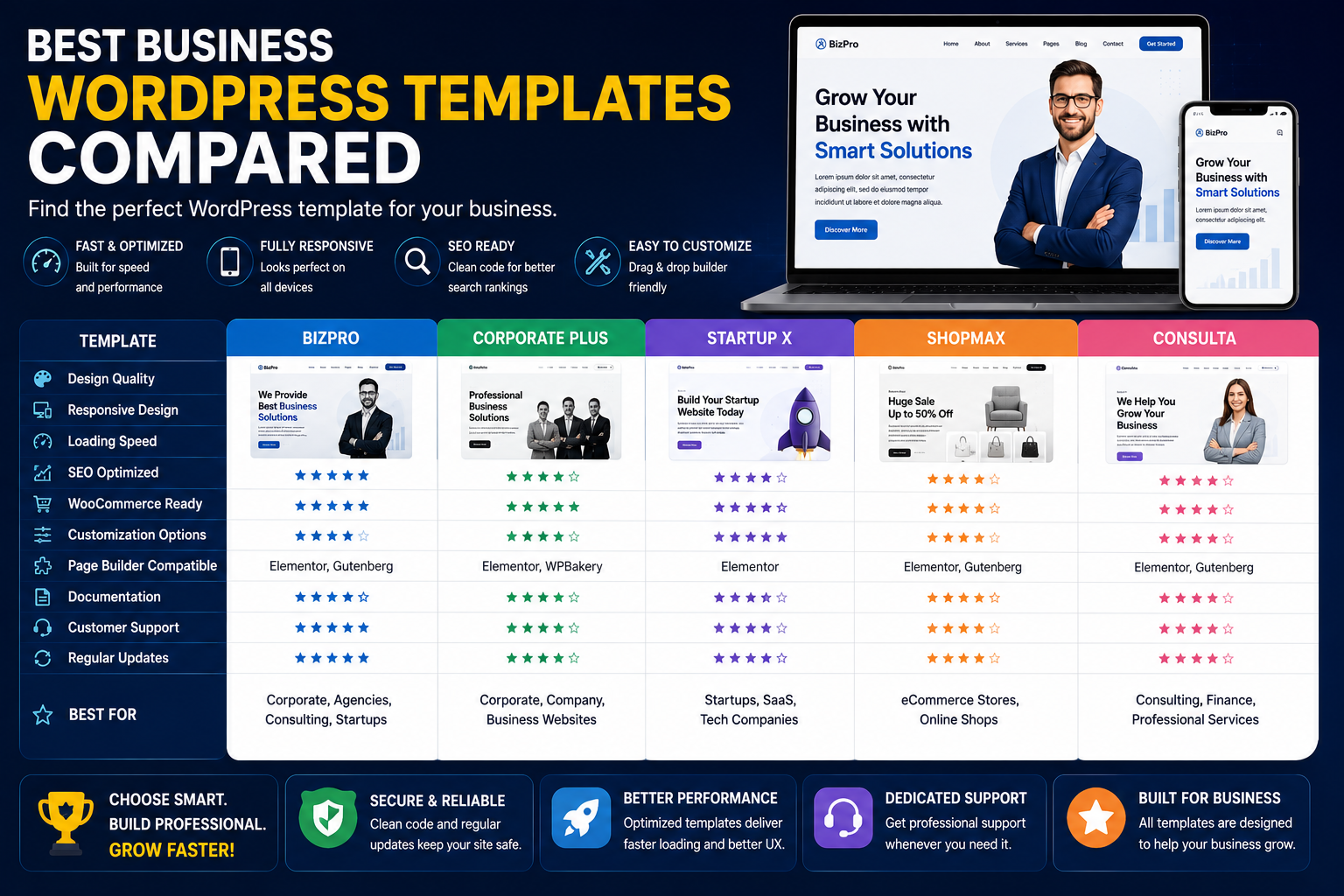
Best Business WordPress Templates Compared
A business website is much more than an online brochure. It represents your brand, builds credibility, generates leads, and often serves as the first point of contact for potential customers.
Choosing the right WordPress template is one of the most important decisions you'll make when building or redesigning your website. While hundreds of templates promise beautiful designs and advanced features, not all of them deliver the speed, flexibility, and reliability that modern businesses require.
Some templates are built for startups, others focus on agencies, consultants, corporate websites, or WooCommerce stores. Selecting the wrong one can lead to poor performance, unnecessary customization, and limited scalability.
This guide compares the most important features to evaluate before choosing a business WordPress template, helping you make an informed decision based on your business goals.
Why Compare Business Templates?
Every business has different requirements.
For example:
A consulting company needs lead generation pages.
A software company needs product showcases.
A retailer needs WooCommerce integration.
A law firm requires trust-building layouts.
Comparing templates helps you identify the best fit for your industry rather than choosing based only on appearance.
Comparison Criteria
When evaluating business WordPress templates, focus on these key areas:
Design quality
Mobile responsiveness
Loading speed
SEO readiness
WooCommerce support
Customization options
Page builder compatibility
Documentation
Customer support
Regular updates
These factors influence both website performance and long-term maintenance.
Design & User Experience
Professional templates should provide:
Modern layouts
Clear typography
Consistent spacing
Strong visual hierarchy
Easy navigation
Good design improves visitor confidence and encourages engagement.
Performance & Speed
Website speed affects both user experience and search rankings.
Look for templates that offer:
Lightweight code
Optimized assets
Lazy loading support
Compatibility with caching plugins
Core Web Vitals optimization
Fast-loading websites typically experience lower bounce rates and better conversions.
SEO Features
An SEO-ready template should include:
Clean HTML structure
Proper heading hierarchy
Schema compatibility
Breadcrumb support
Mobile optimization
Accessibility features
These technical elements complement your overall SEO strategy.
Customization Options
Businesses often need to reflect their own branding.
Choose templates that allow you to customize:
Colors
Typography
Headers
Footers
Layouts
Widgets
Blog pages
Portfolio sections
Extensive customization helps your website stand out.
WooCommerce Compatibility
If you plan to sell online, compare templates based on:
Product page design
Checkout optimization
Product filters
Wishlist support
Quick view functionality
Mobile shopping experience
A seamless shopping experience can improve customer satisfaction and conversions.
Support & Documentation
Reliable support becomes invaluable when customizing or troubleshooting your website.
Look for:
Detailed documentation
Video tutorials
Knowledge base
Ticket support
Regular updates
Well-supported templates reduce long-term maintenance challenges.
Who Should Use Which Type of Template?
Startups
Best features:
Landing pages
Pricing tables
Feature sections
Call-to-action blocks
Agencies
Recommended features:
Portfolio
Team profiles
Testimonials
Case studies
Consultants
Useful features:
Service pages
Booking forms
Trust badges
FAQ sections
Online Stores
Important features:
Product catalogs
WooCommerce support
Mobile checkout
Inventory-friendly layouts
Corporate Businesses
Look for:
Professional homepage
Team pages
Contact forms
Careers section
Blog integration
Premium vs Free Business Templates
Feature
Free Templates
Premium Templates
Design Quality
Good
Excellent
Customization
Limited
Extensive
Support
Community
Professional
Performance
Varies
Optimized
WooCommerce
Basic
Advanced
Updates
Less Frequent
Regular
Documentation
Basic
Comprehensive
For businesses that rely on their website for leads or sales, premium templates generally offer greater long-term value.
Common Mistakes to Avoid
Avoid these common mistakes:
Choosing based only on visual design
Ignoring loading speed
Overlooking mobile responsiveness
Forgetting SEO compatibility
Installing unnecessary demo features
Choosing unsupported templates
A business website should balance appearance with performance.
Best Practices
Before launching your website:
Test mobile responsiveness.
Optimize images.
Enable caching.
Keep WordPress updated.
Install essential security plugins.
Monitor website speed.
Review SEO settings.
These steps help maintain a fast, secure, and user-friendly website.
Final Thoughts
The best business WordPress template isn't simply the one with the most features—it's the one that aligns with your business objectives, supports your workflow, and provides an excellent experience for your visitors.
By comparing templates based on performance, customization, SEO, WooCommerce compatibility, and support, you can choose a solution that will continue to serve your business as it grows.
A thoughtful investment in the right template creates a strong foundation for your online presence.
Frequently Asked Questions
What makes a good business WordPress template?
A good business template should combine professional design, fast performance, responsive layouts, SEO optimization, customization flexibility, and regular updates.
Are premium business templates worth buying?
Yes. Premium templates generally offer better support, performance, documentation, and advanced features compared to free alternatives.
Which page builder should a business template support?
Many businesses prefer templates compatible with Elementor and Gutenberg because they simplify page creation without coding.
Can I switch business templates later?
Yes, but switching may require adjustments to layouts, widgets, and custom styling.
Does a business template improve SEO?
A well-coded template supports technical SEO, but high-quality content and ongoing optimization remain equally important.
Comments (0)