
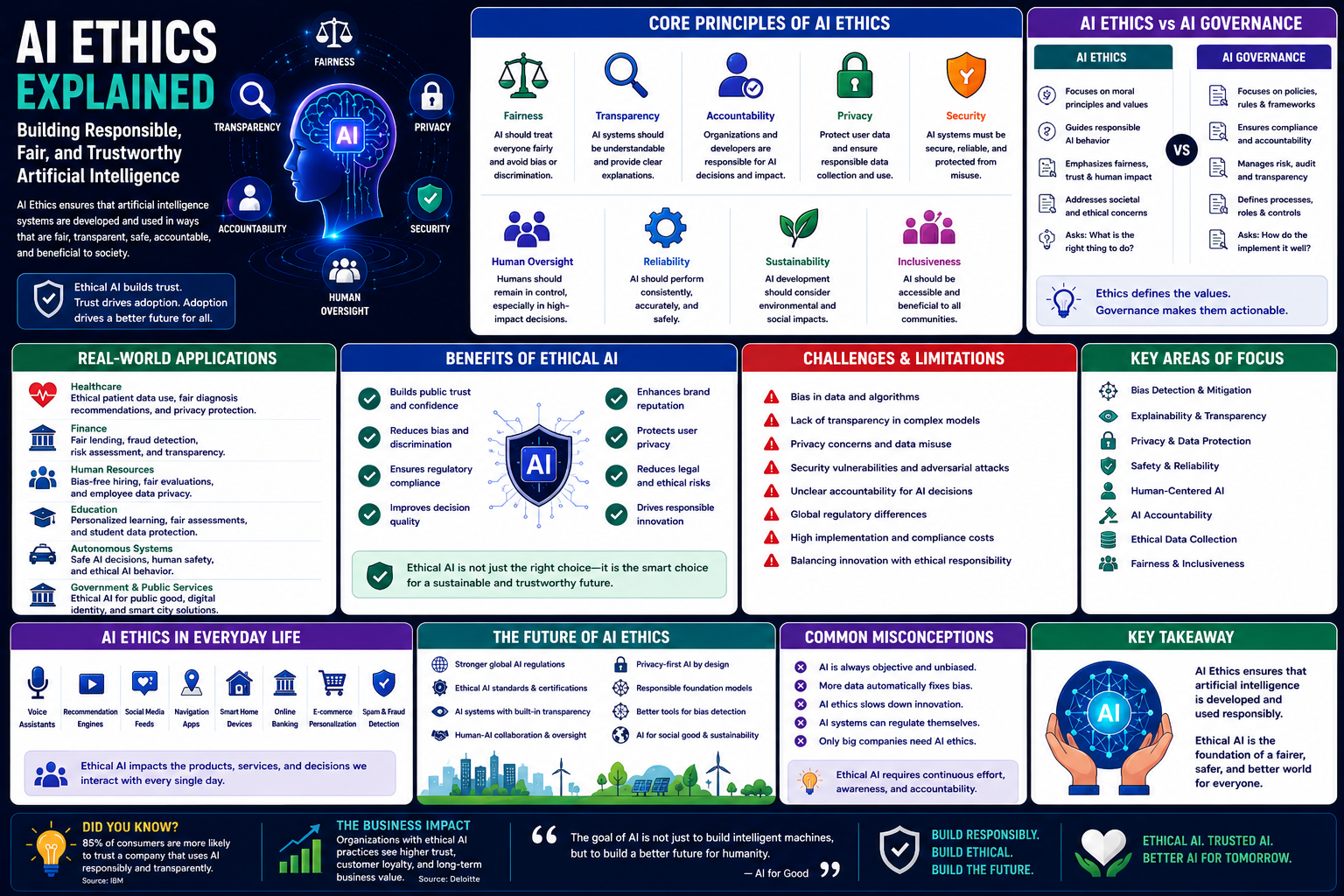
AI Ethics Explained: Building Responsible, Fair, and Trustworthy Artificial Intelligence
Introduction
Artificial Intelligence is transforming nearly every industry, from healthcare and education to finance, manufacturing, transportation, entertainment, and government. AI systems now assist with medical diagnoses, financial decisions, hiring processes, autonomous vehicles, customer service, and countless other tasks.
While these technologies offer tremendous opportunities, they also raise important ethical questions.
Can AI make fair decisions? How should personal data be protected? Who is responsible when AI makes mistakes? How can organizations reduce bias and ensure transparency?
These questions form the foundation of AI Ethics.
AI Ethics focuses on designing, developing, and using Artificial Intelligence responsibly. It encourages organizations to create systems that are fair, transparent, accountable, secure, and aligned with human values.
As AI becomes increasingly integrated into society, ethical AI practices are becoming essential for building trust and ensuring technology benefits everyone.
What Is AI Ethics?
AI Ethics is the field that studies the moral principles, values, and guidelines governing the design, deployment, and use of Artificial Intelligence.
Its goal is to ensure AI systems:
Treat people fairly
Respect privacy
Minimize bias
Remain transparent
Protect user data
Support accountability
Improve safety
Benefit society
AI Ethics combines technology, law, philosophy, public policy, and human rights to guide responsible AI development.
Why AI Ethics Matters
Ethical AI is important because AI decisions increasingly affect people's lives.
Examples include:
Loan approvals
Medical treatment recommendations
Hiring decisions
Insurance claims
Criminal justice systems
School admissions
Personalized advertising
Autonomous driving
Without ethical safeguards, AI systems may unintentionally reinforce discrimination, invade privacy, or make harmful decisions.
Responsible AI helps organizations reduce these risks while increasing public trust.
Core Principles of AI Ethics
Most ethical AI frameworks are built around several common principles.
Fairness
AI should avoid discrimination and provide equitable outcomes.
Transparency
Users should understand how AI systems make decisions.
Accountability
Organizations should remain responsible for AI outcomes.
Privacy
Personal data should be collected, stored, and processed responsibly.
Security
AI systems must protect data and resist malicious attacks.
Human Oversight
Humans should remain involved in important decisions, especially in high-risk scenarios.
Reliability
AI should perform consistently, accurately, and safely.
Sustainability
AI systems should consider environmental and social impacts.
AI Ethics vs AI Governance
AI Ethics
AI Governance
Focuses on moral principles
Focuses on organizational policies
Guides responsible AI behavior
Ensures compliance and oversight
Emphasizes fairness and trust
Defines processes and controls
Addresses societal impact
Manages operational risk
Applies broad ethical values
Implements practical governance frameworks
Organizations often combine both to build trustworthy AI.
Real-World Applications
AI Ethics influences many industries.
Healthcare
Fair diagnostic systems
Patient privacy
Clinical accountability
Finance
Bias-free credit scoring
Transparent lending decisions
Fraud prevention
Human Resources
Fair hiring systems
Inclusive recruitment
Employee privacy
Government
Public sector AI
Digital identity
Smart city governance
Education
Personalized learning
Student data protection
Fair assessments
Autonomous Vehicles
Safe decision-making
Risk management
Human safety
Benefits of Ethical AI
Ethical AI provides significant advantages.
Benefits include:
Greater public trust
Better regulatory compliance
Reduced legal risks
Fairer AI decisions
Stronger privacy protection
Increased transparency
Better user experiences
Responsible innovation
Organizations increasingly recognize ethical AI as a competitive advantage.
Challenges and Limitations
Despite its importance, AI Ethics presents challenges.
These include:
Hidden algorithmic bias
Conflicting ethical priorities
Global regulatory differences
Data privacy concerns
Rapid technological change
Difficult accountability questions
Limited explainability
Balancing innovation with regulation
Continuous monitoring and governance are essential.
AI Ethics in Everyday Life
AI Ethics affects many technologies people use daily.
Examples include:
Voice assistants
Recommendation systems
Facial recognition
Online banking
Healthcare applications
Navigation apps
Social media feeds
AI chatbots
Responsible AI improves safety, fairness, and user confidence.
Future of AI Ethics
Future developments include:
Global AI regulations
Responsible foundation models
AI auditing standards
Ethical AI certification
Improved transparency tools
Human-centered AI design
Stronger privacy protections
International AI governance
AI Ethics will become a central requirement for future AI innovation.
Common Misconceptions
Several myths surround AI Ethics.
Common misconceptions include:
AI Ethics prevents innovation.
Ethical AI eliminates all bias.
AI Ethics only matters for large companies.
AI systems can regulate themselves.
Ethics is only a legal issue.
In reality, AI Ethics supports innovation by helping organizations build trustworthy and sustainable AI systems.
Final Thoughts
AI Ethics is becoming one of the most important foundations of modern Artificial Intelligence. As AI systems take on greater responsibilities in business, healthcare, finance, education, and government, ensuring fairness, transparency, accountability, and privacy is essential.
Organizations that embrace ethical AI principles will be better positioned to build trustworthy technologies, comply with evolving regulations, and earn long-term user confidence. Responsible AI is not only about preventing harm—it is about creating intelligent systems that serve people, respect their rights, and contribute positively to society.
Frequently Asked Questions
What is AI Ethics?
AI Ethics is the study and application of moral principles that guide the responsible design and use of Artificial Intelligence.
Why is AI Ethics important?
It helps ensure AI systems are fair, transparent, accountable, secure, and beneficial to society.
What are the main principles of AI Ethics?
Fairness, transparency, accountability, privacy, security, human oversight, reliability, and sustainability.
Which industries need AI Ethics?
Healthcare, finance, education, government, manufacturing, retail, transportation, legal services, and nearly every sector using AI.
Does AI Ethics stop innovation?
No. Ethical AI promotes responsible innovation by reducing risks and increasing public trust.
Comments (0)